

Swimwear przy basenie
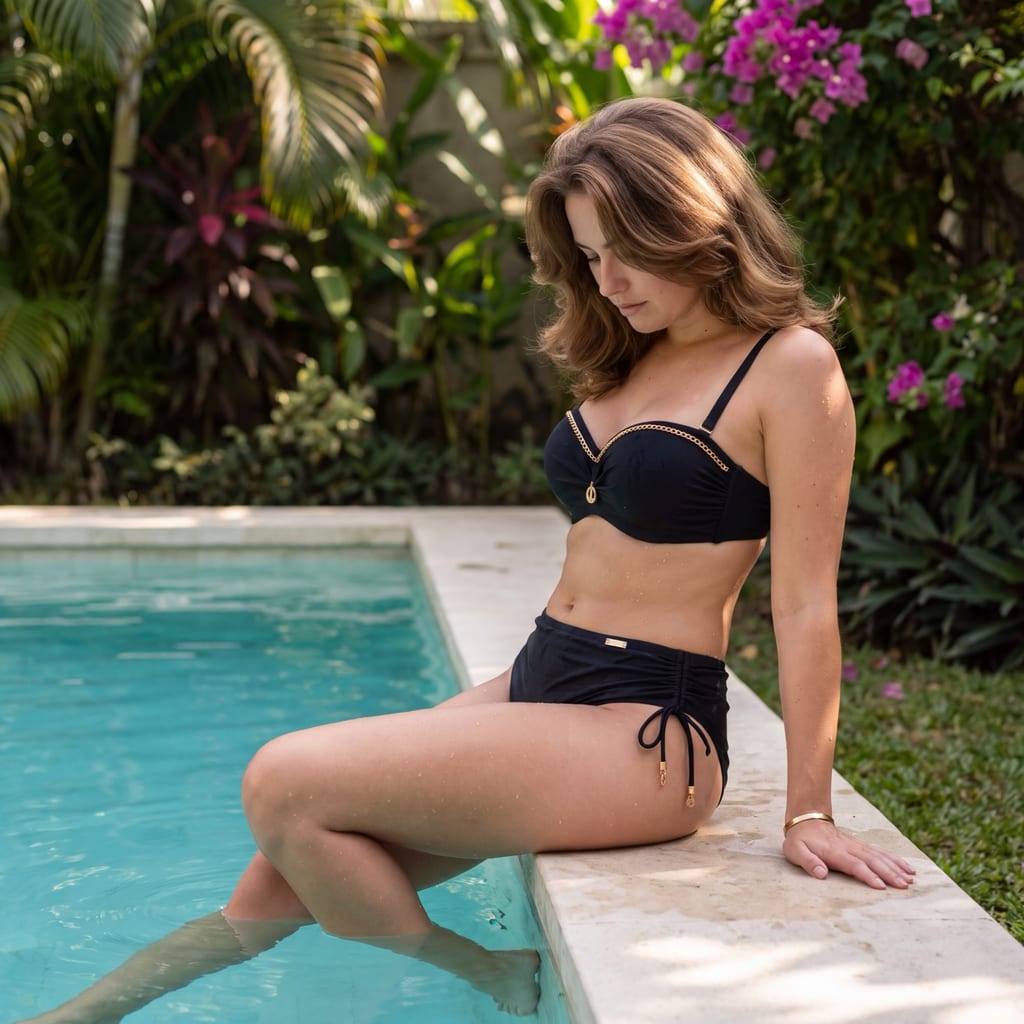
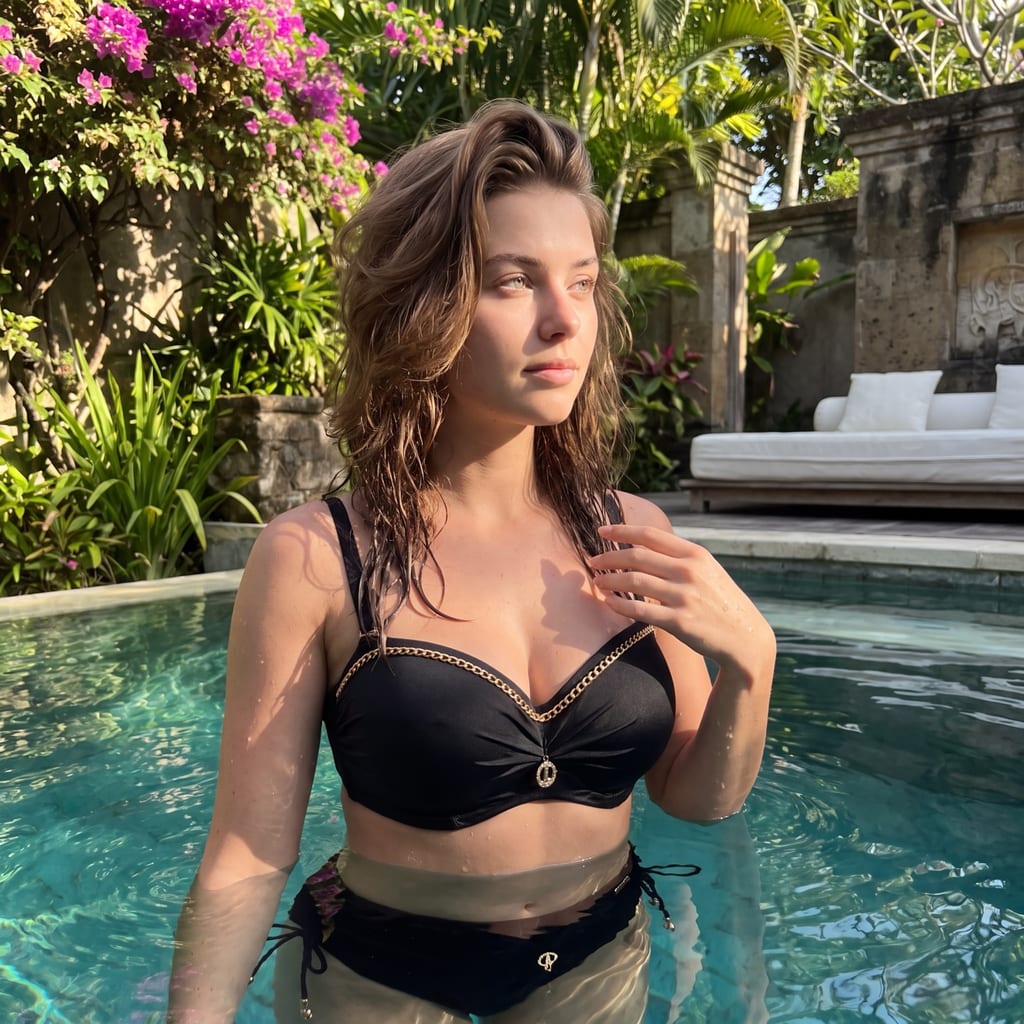
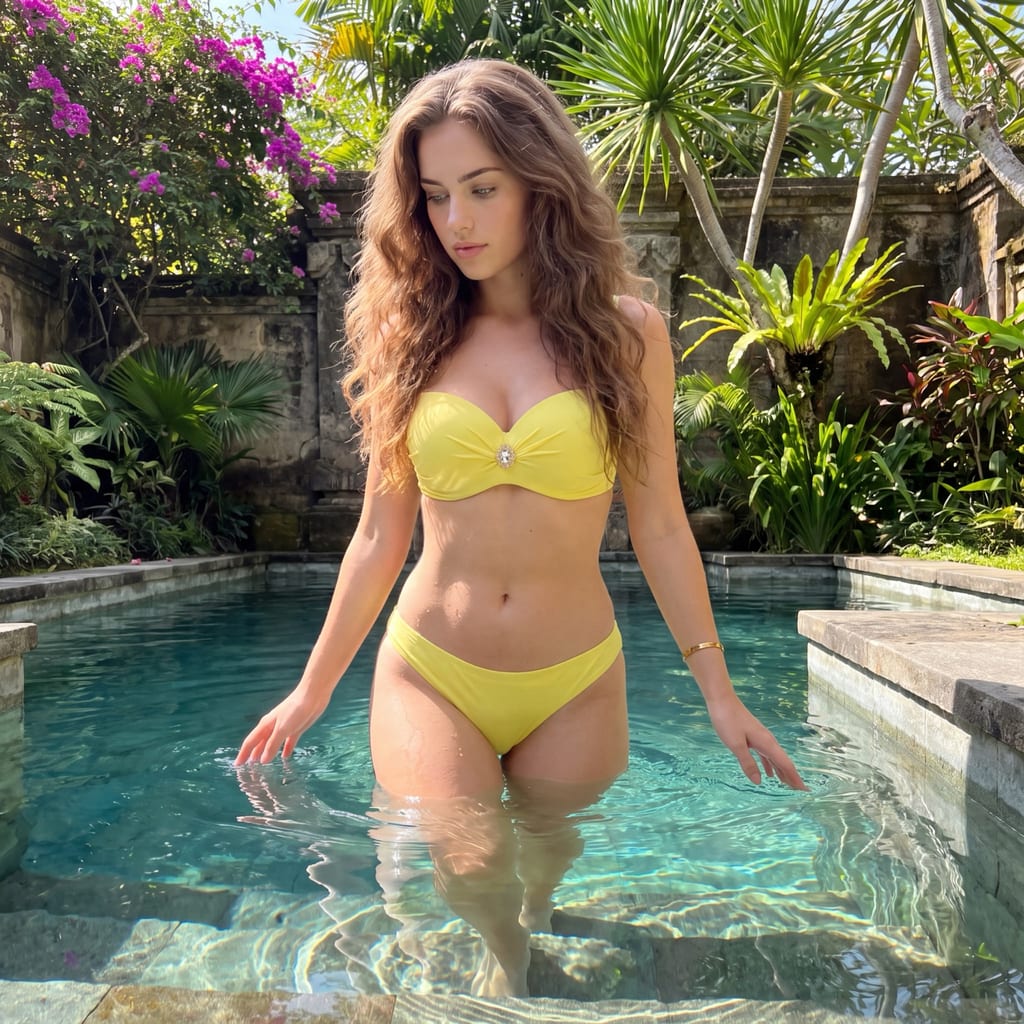
Spokojny, premium rejestr basenowy dla swimwear: woda jest tematem zdjęcia, nie tłem. Modelka jest w fizycznym kontakcie z wodą — mokra, ciemniejsza tkanina, linia wody na ciele, refleksy i kaustyka — a strój zostaje czytelny w każdym kadrze.
Pokaż kostium w jego żywiole. Modelka siada na kamiennej krawędzi z nogami w wodzie, stoi zanurzona, wychodzi po zanurzonych stopniach z tkaniną mokrą i przylegającą. Słońce zza pleców rysuje jasną krawędź na mokrych ramionach, a tafla oddaje światło z powrotem na przód kostiumu. Spokojnie, premium, bez pluskania — dziesięć zdjęć z jednego poranka przy jednym basenie.
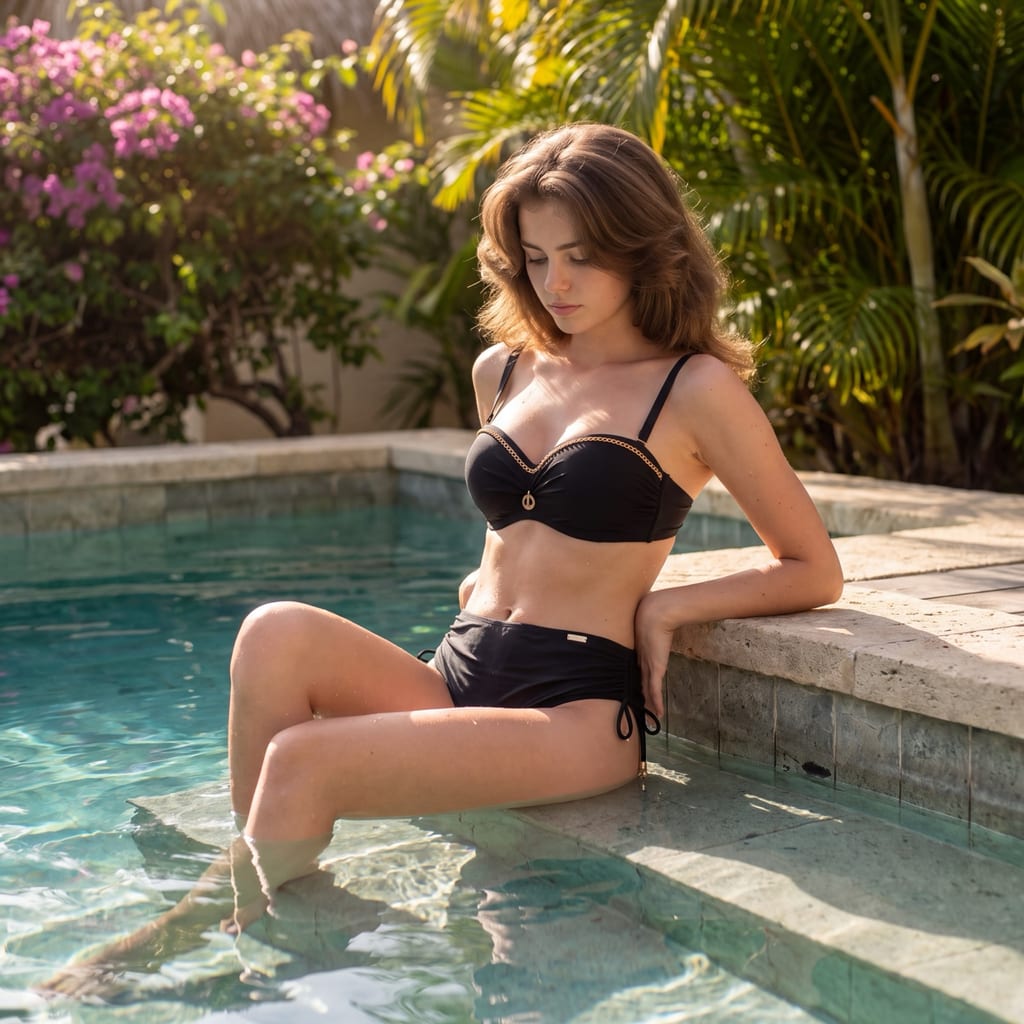
Galeria
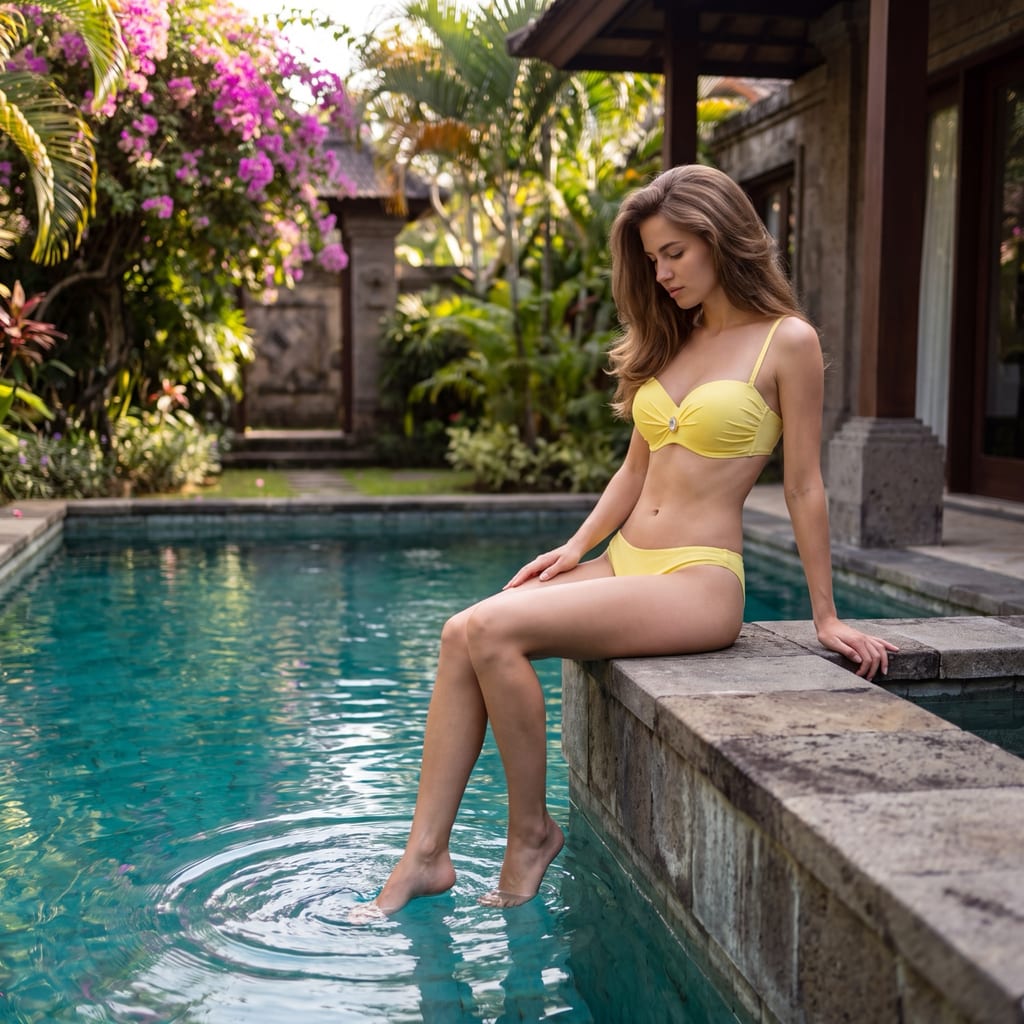
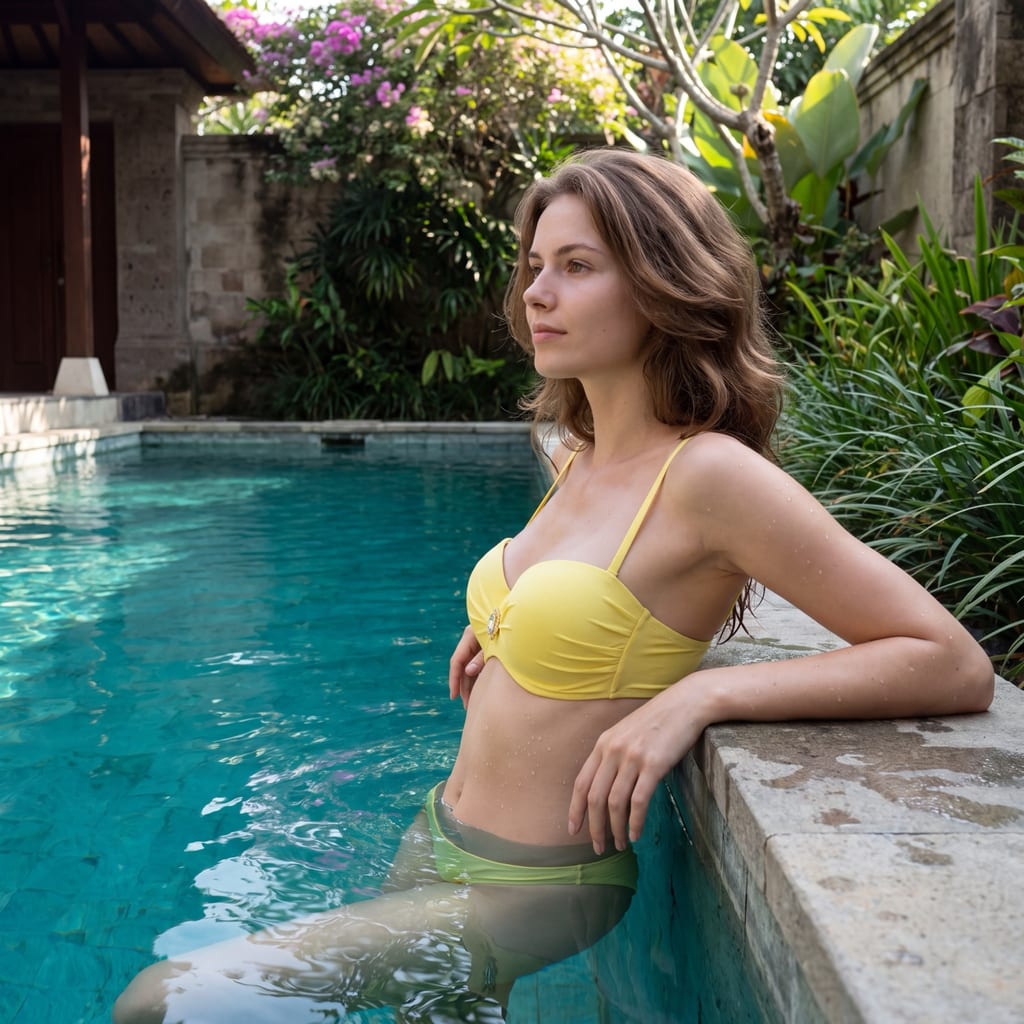
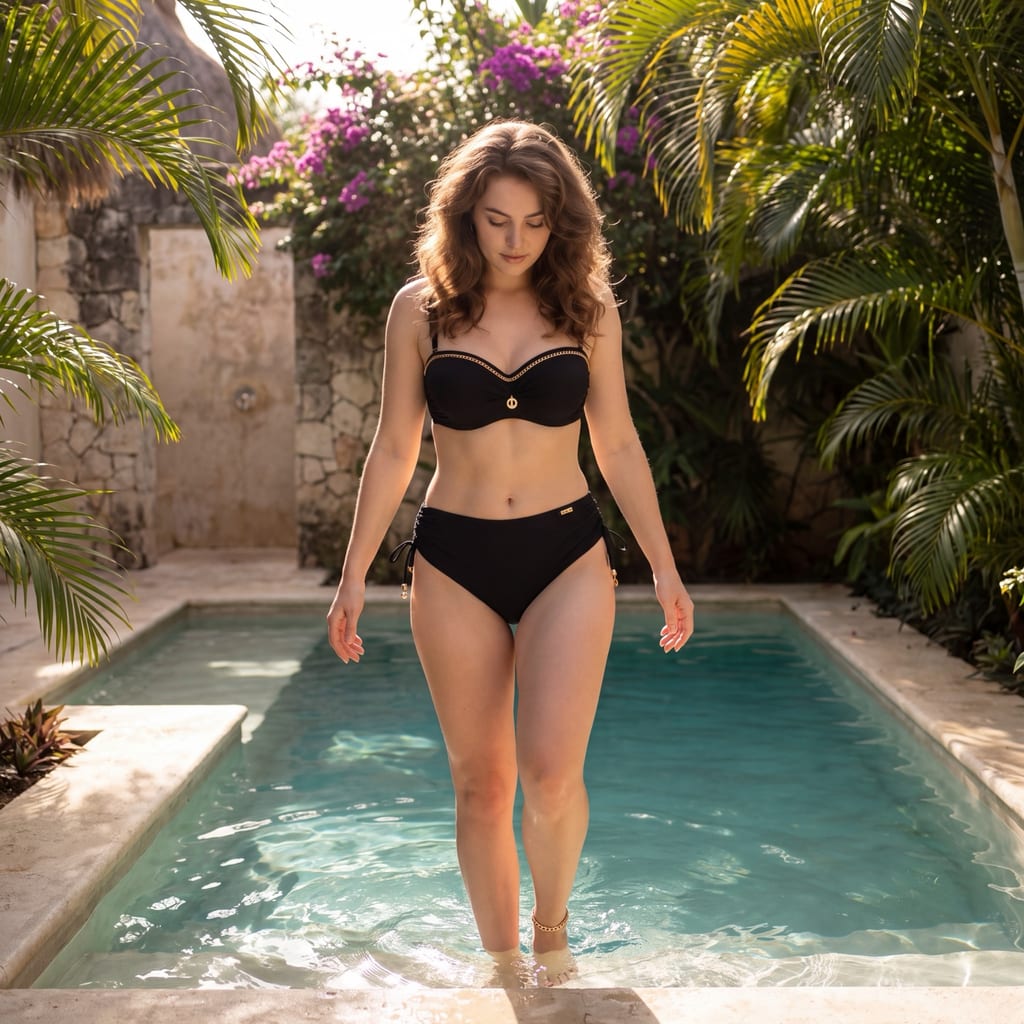
Najlepsze do
Najlepszy dla swimwear i beachwear, gdy chcesz pokazać kostium w realnym użyciu, a nie tylko na wieszaku i na modelce w studiu: kampania sezonowa, lifestyle'owa warstwa karty produktu, social i strona marki. Szczególnie dobrze wypada przy tkaninach, które mokre wyglądają lepiej — gładkich, gęstych, z wyraźnym wykończeniem krawędzi — i przy fasonach, w których sprzedaje się linia na ciele. Świetnie komponuje się jako druga sesja obok czystej siatki PDP: tam suchy fason w równym świetle, tu ten sam kostium w wodzie.
Wymagania wejściowe
Wgraj packshot tej strony produktu, którą chcesz pokazać — sesja fotografuje jedną stronę (przód ALBO tył). Komplet przód + tył to dwa wsady, po jednej sesji na stronę. Modelka jest wymagana; karnację, budowę i charakter skóry ustawiasz w modelce — styl jej nie nadpisuje. Sceneria nie jest potrzebna: styl ma własny basen (spokojna prywatna niecka, jasny kamień, czysta woda, jedno słońce). Jeśli podpinasz scenerię, wybierz taką, w której **jest woda** — basen, krawędź niecki, taras z basenem. Sceneria bez wody odbiera temat: zostanie spokojny plener, ale zniknie to, po co ten styl istnieje.
Wytyczne jakościowe
## Quality guidelines ### Style core A calm, premium resort swimwear style built on the one thing a swim frame can do that no studio can: physical contact with water. The images read like one quiet private resort pool photographed late in the morning — a composed woman sitting on the stone coping with her legs in the water, standing submerged to the waist in a still surface, or coming up the submerged steps with the fabric water-darkened and drawn close to the body. Water is the leading element of every frame: the plane of the surface, the level line of the coping, the waterline crossing the body, the specular path of sun across the ripples and the caustic net running over everything the water touches. The register is quiet and grown-up: stillness instead of play, one calm sun instead of drama, and the elemental relationship between a body, a swimsuit and water instead of personality or fashion sculpture. The garment stays the readable subject throughout — a swimsuit that has just been in the water is exactly how the customer will wear it, and that honesty is what this style sells. - Commerciality level: mix of `swim e-commerce lifestyle` and `seasonal campaign` — clearly sellable, calm and grown-up; not a plain catalog stand, not a fashion editorial, not a holiday snapshot - Dominant character: calm, still, premium, resort, elemental, water-led, sunlit with a neutral daylight balance - Image priority: the product and the water in balance — the swimsuit stays the readable subject in the clear majority of frames, while the physical relationship with the water is what makes the frame belong to this style - Directional references: quiet private-villa and resort pool photography; premium swim campaigns carried by water rather than by personality; still-water portraiture made at the waterline; contemporary resort imagery with restrained colour and one calm sun - Style-anchoring words: still water as the subject, physical contact with the water, the waterline across the body, sun from behind and water as the fill, calm resort stillness ### Product role in frame The product (swimwear / beachwear) is the readable subject on the body in the clear majority of frames — cut, coverage, strap and band placement, fabric tension and construction edges must read, because this style still sells the garment. What is particular here is that it sells the garment in its true working state: wet. Wet fabric reads water-darkened, heavier and drawn close to the body, with its weave, seams, bindings and edges more sharply defined and its drape pulled by real weight — and it stays fully opaque and true to its own colour, which is exactly how good swim fabric behaves. When the waterline crosses the garment, both parts stay readable: the part above the surface as itself, the part below tinted and optically displaced by the water body yet still recognizable in cut, construction and colour. When the garment's own hue sits close to the model's skin tone (nude, sand, ivory, tan) or close to the water's tone (aqua, teal, pale blue), the light and the grade keep every edge of the garment readable — against the body and against the surface alike; the garment never dissolves into the skin and never dissolves into the water. The session photographs the one side of the product supplied in the input: when the input shows the back of the garment, the back becomes the readable subject of the whole pack and the model is posed from behind. - Product role: hero on the body — the garment leads as the readable subject; the water, the light and the pose amplify it, never bury it - Visibility level: fully readable in the core of the pack, with a share of frames where the waterline crosses the garment (both parts still readable), a small share of natural partial obscuring, and a material / construction detail layer - What the style exposes: cut and coverage on the body, strap and band placement, the behaviour of wet fabric (weight, cling, drape, defined edges), construction detail (seams, bindings, cups, ties, closures), and how the garment sits when it comes out of the water - Wet-state fidelity: wet fabric is water-darkened, heavier and closer to the body while staying fully opaque and true to its own colour; its pattern or print stays legible wet - Waterline readability: where the surface crosses the garment, the transition is a clean, level, readable line; the submerged part keeps its identity through the water - Skin-to-garment and water-to-garment separation: every edge of the garment holds against close-toned skin and against the water's own tone - Acceptable obscuring: minor and natural — a wet strand of hair at a strap, a hand, the movement of the surface — only where cut and fit still read; never unreadable in the core of the pack - Product presentation character: premium, calm, honest — the garment shown in use, not staged as glamour and not sterilised into a catalog stand ### Light Default light — applied when no scenery is linked, or when the linked scenery does not name a directional light, a time of day or weather: ONE bright resort sun at ~120° azimuth off the camera–model axis — three-quarter behind the model, to one side — sitting ~50° above the horizon (the ~120° is azimuth, measured in the horizontal plane from the camera–subject axis, not from the pool's walls; the ~50° is the sun's own elevation above the horizon, high enough to drive light down into the water and never overhead), together with ONE broad, physically real fill: the light the water surface and the pale stone deck throw back up into the frame. The sun draws a bright, defined edge along wet shoulders, wet hair and the top edges of the garment; the water opens the front of the body so the swimsuit stays exposed and readable. The sun keeps this same relationship to the camera–model axis in every frame of the pack, and it stands off the camera axis — this style is lit against the light, not silhouetted by it. Discipline — always, whatever the light source: one dominant directional sun that draws a real edge on wet skin and wet fabric, with the water's own bounce as the fill that keeps the front of the garment open; medium contrast; highlights held, so the sparkle on the ripples stays a set of separate specular points with the water's own colour still around them; exactly one white balance per frame, following the resolved light source (the preset's neutral daylight value applies only when the preset's default light is the source). The water's bounce arrives from below the eye line and stays a fill: the modeling of the face and the body always comes from the sun above, and the surface never becomes the key. This discipline applies on top of whichever source is resolved. The water's optical signature belongs to the light, not to post-production: a specular sparkle path running across the ripples toward the camera, and a caustic net of light on the basin, on the submerged part of the body and on the wet coping. Both are controlled and physical — they read on the water and on wet surfaces, and the caustic pattern stays off the face. - Source type: natural sun by default, with the pool's water surface and the pale stone deck as a broad, physically real bounce; no strobe, no artificial fill panel - Default source direction: sun at ~120° azimuth off the camera–model axis (three-quarter behind the model, to one side) at ~50° elevation above the horizon — applied when no scenery is linked, or when the linked scenery does not name a directional light, a time of day or weather - Hardness: medium — the sun's edge is drawn and readable on wet surfaces; the front of the body is softened by the water's broad bounce - Light-to-shadow contrast: medium (discipline) — the shaded front of the body stays open and readable because the water fills it - Role of fill: the water surface and the pale stone deck only — a broad bounce from below the eye line that keeps the garment out of shadow, and that stays a fill - Shadow quality: short and soft-edged on the stone, calm rather than graphic; the model's own shadow may read on the wet coping or dissolve into the water - Water's optical signature: a specular sparkle path across the ripples toward the camera, and a caustic net on the basin, on the submerged body and on the wet coping — controlled, physical, and kept off the face - Color temperature: neutral daylight; the preset's neutral value applies only when the preset's default light is the source; the sun's own warmth reads in the light itself and the grade adds none - White balance count: exactly one per frame - What the light should model: first the relief of the waterline and of the wet fabric on the body, then the volume of the body and the cut of the garment, then the surface of the water and the grain of the stone - Light discipline (always, whatever the source): one dominant directional sun, the water's bounce as the only fill, medium contrast, held sparkle highlights, one white balance ### Color and tonality Calm, clear, natural tonality with accurate skin tones and — above all — an exact garment colour, wet or dry. Two tones are pinned as closed axes, because they are the two surfaces present in almost every frame and each drifts on its own when left to a word. The water's settled body tone is sRGB #4E9AA6 ≈ CIELAB L* 59 / a* -20 / b* -14 — a clear, calm aqua with green in it, mid-deep and restrained, the colour of clean water over a pale stone basin. The coping and the deck are one honed pale limestone, sRGB #DCD8CF ≈ CIELAB L* 86 / a* 0 / b* +5 — pale and warm-neutral, never white, never terracotta, never grey slate. Both are the preset's DEFAULT world values, used only when no scenery is linked; when a scenery is linked it owns the place and its own colours, and the grade never recolours it. Both are settled tones, not flat fills: the sunlit sparkle runs brighter, the deep end of the pool runs darker, wet stone runs a step darker than dry stone — what is held identical across the pack is the colour identity, not a painted value. Saturation is natural and restrained — the colour of real water under a real sun, held away from poster turquoise on one side and from a faded pastel on the other. Contrast medium. Exposure precise: the garment correctly exposed even when it sits on the shaded side of the body, sparkle held, the submerged part of the frame still carrying its colour. Whites clean and daylight-neutral, so a white or ivory swimsuit separates from the pale stone through the contact of light and shadow and from the water through tone. Blacks deep but open, so a black swimsuit keeps its internal detail wet as well as dry. Faithfulness of the product's own hue takes precedence over everything else in this section. - Palette: restrained and elemental — real skin + true product colour + two pinned world tones (the water and the pale stone); the product is the strongest hue in the frame - Water tone (default, closed axis): sRGB #4E9AA6 ≈ CIELAB L* 59 / a* -20 / b* -14 — one single value, held identically across the pack; used only when no scenery is linked - Stone tone (default, closed axis): sRGB #DCD8CF ≈ CIELAB L* 86 / a* 0 / b* +5 for the coping and deck — one single value, held identically across the pack; used only when no scenery is linked - Sky: not a pinned tone — when it enters the frame it reads as one clear daylight sky consistent with the single sun, and it is never a background plane the product reads against - White balance: neutral daylight, one per frame, following the resolved light source; the preset's neutral value applies only when the preset's default light is the source; the grade never recolours a linked scenery - Saturation: natural and restrained — a real pool under a real sun - Contrast: medium (discipline — supports the directional sun while the water keeps the front of the body open) - Exposure: precise; the garment correctly exposed on the shaded side of the body, sparkle held, the submerged zone still carrying colour and detail - Highlights character: held and specular on the ripples — separate points of light with the water's colour still around them - Shadows character: open, neutral, carrying the surface of stone and water - Blacks: deep yet open — a dark swimsuit keeps its internal detail when wet - Whites: clean and daylight-neutral - Overall tonal character: clear, calm, contemporary resort — restrained rather than vivid, and clean rather than faded - Faithfulness of the product's own hue takes precedence over the grade, and the wet state never shifts the garment's colour identity ### Lens and perspective feel One pinned focal length in the short-portrait range, held for the whole session, because this style has a specific optical hazard: water already refracts and displaces every submerged limb, and adding a wide framing on top of that gives a doubled distortion and proportions the customer cannot trust. A short-portrait length keeps body and facial geometry constant across a stateless pack and compresses the water surface into one calm, quiet plane behind the figure — which is also the register. Distance for full-length frames comes from the pool itself: the camera works along the long axis of the basin or from the opposite coping, so the pin never forces a cramped frame. Aperture / depth of field is a closed axis resolved once for the whole session and set moderately closed, because the structure of the water surface, the caustic net and the weave of wet fabric are load-bearing for this style and melting them into bokeh throws away its subject. Camera height is an expressive axis of its own here: from eye level down to just above the water surface, the lens kept level rather than tilted up — a low camera at the waterline is this style's device, and a dramatic upward fashion angle is not. - Focal length: PIN ~85mm in feel — one single value for the entire session, no ranges (never write "50–85mm in feel"); never taken from the scenery - Focal exception: a wider length (down to ~50mm in feel) is allowed ONLY when the idea explicitly calls for a wide establishing hero showing the whole pool — never as a per-frame default, and always resolved to ONE concrete value on that frame - Aperture / depth of field: ONE moderately closed value (~f/5.6 in feel) resolved for the whole session and held identical on every frame — the figure separates while the water surface, the caustic net and the wet fabric stay legible; never sourced from the scenery - Camera distance: medium to medium-far along the pool's long axis or from the opposite coping for full-length frames; close at the waterline for portrait and detail — all at the same pinned length - Camera height: eye level as the base; lowered to just above the water surface as the style's own device (the lens stays level, the surface runs across the base of the frame); a gentle high angle from the deck as an accent - Perspective: level and honest — the elongating low-angle fashion device belongs to other registers; here the drama is the water, not the lens - Sharpness character: as a real lens renders it in bright daylight — precise on the garment and the waterline, organic rather than synthetic - Gear character: a full-frame camera with a short-portrait prime, bright natural sunlight, a low-ISO daylight capture - Aspect ratio: no rigid requirement; the prompter picks (e-commerce usually 2:3 / 4:5, social 4:5 / 9:16); the format should hold both the body and a readable band of water ### Composition language Composition is deliberate, calm and water-led: the surface, the coping and the waterline are the structural lines of the frame, and the figure is placed in relation to them. Placement is centered or deliberately offset with clear geometric intent; the plane of the water gives large, quiet, genuinely usable negative space, and the pool's own geometry gives the straight lines. Those lines stay geometrically true: the coping reads level, the far edge reads level, the water surface reads level, and none of them cuts the body at a joint or crosses behind the head as an interrupting line. The waterline on the body is composed, not accidental — it crosses at a chosen height (across the thighs, the waist, the ribs or the shoulders) and reads as one unbroken, level transition. Two planes as the base — the figure and the calm water plane behind — with a third when the near coping, the deck or one quiet element of the space enters. Separation from the background is tonal (skin and garment against the water's mid-deep tone) plus the sun's bright edge on wet contours. - Frame type: leads with 3/4-length and portrait / bust made at the waterline; full silhouette a strong supporting share taken along the pool; a material / construction detail layer for wet fabric, straps, seams and edges - Object placement: centered or deliberately offset, always with clear geometric intent (rule of thirds / golden ratio), read against the horizontal of the water - Structural lines: the coping, the far edge and the water surface stay level and geometrically true; they never cut the body at a joint - Waterline as composition: the surface crosses the body at a chosen, composed height and reads as one unbroken, level line - Negative space: medium to large — the calm water plane is real, usable air, and a share of frames reserves it for a headline or logo - Background hygiene: the area behind the head and shoulders stays clear of intersecting lines and objects; a ladder rail, a coping corner or a planting never grows out of the head - Symmetry: controlled — the pool's own geometry may carry a symmetric frame; otherwise calm asymmetry - Open / closed composition: mixed, with a real share of open, breathing frames carried by the water plane - Number of planes: two as the base (figure + water), three where the near coping, the deck or one quiet element of the space enters - Separation from background: tonal contrast against the water plus the sun's bright edge on wet contours - Room for copy: yes, in a minority of frames — the still surface is unusually good copy space - Overall composition character: calm, deliberate, water-led, premium resort ### Pose language Posing is composed, semi-static and anchored in real contact with the water. The body is settled and at ease: sitting on the stone coping with the legs in the water, standing submerged with the surface at the thighs, waist or ribs, wading a slow step along the shallow shelf, drawing a hand through the surface, leaning back against the coping from inside the water, resting on the submerged steps, or coming up out of the water with the fabric drawn close. The contact is structural and physical: the water holds part of the body's weight, the stone takes the rest, and both read as real support rather than decoration. Expression is calm, composed and quietly warm — self-possessed, at ease, present; a soft closed-mouth smile is welcome, and the register is stillness and presence rather than performance to the camera. Line tension is low to medium and honest: an elongated, held sculptural shape belongs to the fashion registers, and a big playful gesture belongs to the sunny terrace register; here the interest comes from the meeting of body, fabric and water. When the input shows the back of the garment, the same composed, water-anchored stance reads from behind. - Expression: calm, composed, quietly warm and self-possessed; a soft closed-mouth smile welcome; reads whenever the face is visible - Pose dynamics: semi-static — settled positions with small natural adjustments, plus slow real movements (a wading step, a hand drawn through the surface, rising from the water) - Body openness: open and honest, angled so the loaded side of the garment reads - Line tension: low to medium — a natural, settled line rather than a held sculptural one - Posing character: composed resort — camera-aware but unperformed - Contact with the water: structural and physical — the water takes real weight, the stone takes the rest; the contact is the subject of the pose, not an accessory to it - Eye contact: mixed — a calm direct look, or a natural gaze across the water; both quiet - Spontaneity level: directed with a natural finish — placed on purpose, held without stiffness - Body-to-product relationship: the body presents the garment while the water gives the frame its reason; the product stays readable in the core of the pack ### Movement and physics The style is still, and its physics are the physics of calm water. The frame is frozen and sharp; movement, where it exists, is the slow kind: a ring of ripples spreading from where the body meets the surface, a small wake following a wading step, water sheeting off a forearm or a hip as it rises, droplets running down fabric and skin under real gravity, the surface settling back to stillness. All of it stays believable and physically consistent — one person in one body of water, with the ripples originating where the contact actually is. Refraction is honest: a submerged limb is displaced and softened by the water and carries the water's tint and the caustic net across it, reading as genuinely underwater rather than as a body placed behind a coloured pane. Wet fabric behaves as wet fabric: heavier, drawn close, slower to move, darker in tone, its edges and weave more defined, its drape pulled by the weight of the water it holds — and fully opaque throughout. Wet hair is a state the water produced, heavier and gathered into defined strands; it is a state of the scene, exactly as a caught mid-flip is a state of motion. Droplets on skin and on fabric are likewise the state of a scene the model has just been in. - Static vs movement: still and settled, with slow real water movement where the body meets the surface - Frozen vs blur: fully frozen and sharp — the ripple, the sheeting water and the droplets read as caught, never as motion blur, and never blurred on the product - Water behaviour: calm ripples spreading from the real point of contact, a small wake from a slow step, water sheeting off the body, the surface returning to stillness - Refraction: honest and physical — the submerged part of the body and of the garment is displaced, softened, tinted by the water and crossed by the caustic net - Wet fabric: heavier, drawn close to the body, darker in tone, edges and weave more defined, fully opaque, its drape pulled by real weight - Wet hair and droplets: a state of the scene produced by the water (heavier hair in defined strands, droplets running under gravity), not a styling or finish specification - Elements: water only, and calm — the air is still or barely moving ### Relation to scenery The style's world is ONE quiet private resort pool, locked as a single concrete set rather than a family of locations, and it is the preset's own default — used only when no scenery is linked. That set is: a long rectilinear pool held by a honed pale limestone coping (sRGB #DCD8CF ≈ CIELAB L* 86 / a* 0 / b* +5) running level with a wide deck of the same stone; still water with the settled body tone sRGB #4E9AA6 ≈ CIELAB L* 59 / a* -20 / b* -14; a submerged shelf and a run of broad steps at one end, shallow enough to sit in; a low stone wall closing one side; and a small number of quiet resort elements — a length of hanging linen at the far edge, one clipped planting in a stone trough, a folded linen towel left on the coping. Nothing else: no bar, no rows of loungers, no floats, no signage, no crowd. WHICH of those elements enter a given frame is an open axis and moves with the crop; the type of place, the water, the stone, the time of day and the character of the light do not. A linked scenery owns the location and the backdrop when the user supplies one, and the preset's discipline — the light character, the camera, the grade and the water-contact register — then applies on top. One fence belongs to the preset itself and is stated as a property of this style, not as a rule about layers: this style's subject is physical contact with water, so it is paired with a scenery that contains water (a pool, a pool terrace, a bathing edge) or with no scenery at all. Paired with a dry interior or a dry street, the style keeps its light and its camera but loses its subject — that is a mistake to fix at the input, and never a reason to invent a pool into somebody else's scenery. - Relationship to space: one quiet, private, premium pool by default; a linked scenery leads the location when supplied - Scene depth: shallow to medium — two to three planes (figure, water plane, near coping / deck / one quiet element) - Background activity: supporting and non-narrative — the water and the stone carry the frame; the few resort elements stay passive - Space scale: intimate to human — a private pool, never a hotel complex or a public bathing hall - Water tone (default world, closed axis): sRGB #4E9AA6 ≈ CIELAB L* 59 / a* -20 / b* -14, one value held across the pack; used only when no scenery is linked - Stone tone (default world, closed axis): sRGB #DCD8CF ≈ CIELAB L* 86 / a* 0 / b* +5, one value held across the pack; used only when no scenery is linked - Open axis: which elements of the locked world enter a given frame (coping, steps, low wall, hanging linen, planting, towel), and how much water fills the frame - Pairing fence (a property of this style): pair with a scenery that contains water, or with no scenery; the preset never invents water into a scenery that has none - What the scenery brings: the place, the backdrop, its surfaces, and — when it names a directional light, a time of day or weather — the light source. What it never brings: focal length, aperture / DoF, render character or grade; those stay preset-owned, and the preset's light discipline always applies on top of whichever source is resolved ### Props and styling behavior The style adds almost nothing, because the water is the subject and anything floating in the frame competes with it. The quiet resort elements of the locked world (hanging linen, a clipped planting, a folded linen towel on the coping) are passive scene elements, not objects the model uses. Accessories on the model are a session styling layer in a minority of frames and stay water-native: delicate gold jewellery that survives a swim, or a linen robe or towel picked up in a frame taken out of the water. Eyewear is not part of this style's language — the sunny styled terrace register owns that signature, and here the eyes and the calm expression stay visible. Footwear: bare feet throughout, which is what a pool asks for. The preset does not set the model's hair styling, make-up or skin finish — these come from the casting card (Mannequin input) and the preset must not override them; the water may leave the hair wet, and that is a state of the scene rather than a hairstyle specification. - Accessories: minimal and water-native — delicate gold jewellery in a minority of frames; a linen robe or towel only in a frame taken out of the water - Accessories = session styling layer, not the model's identity — the model is a separate, clean input (frequency is set in Quantity) - Eyewear: not part of this style's language; the eyes and the calm expression stay visible - Footwear: bare feet throughout - Scene elements: the locked world's quiet elements stay passive — present as surface and architecture, never handled as narrative props - Hair, make-up and skin come from the card; the preset only asserts non-override (it does not restyle or beautify them). Water-wet hair is a state of the scene, not a hairstyle - Avoid (Prompter instruction — formulate final values positively): pool inflatables, floats, rings and toys; cocktails, glassware and food; rows of loungers, parasol bars and hotel signage; a splash, a jump, a dive or a water fight; eyewear as a recurring signature — anything that turns a still pool into a party scene or adds a second subject ### Post-production and finish Finish clean, bright and natural — the image should read as a well-exposed daylight photograph taken at a pool, not as a graded creative asset. No grain: this style takes the digital branch of photographic character deliberately — a low-ISO daylight capture rather than a film stock — because its own carriers of realness are the water surface, the caustic net and wet fabric, not emulsion. Clarity medium — enough for the weave of wet fabric, the seams, the bindings and the structure of the water surface to read, without HDR, without sharpened advertising micro-contrast and without any resolution tokens. No vignette. Retouch minimal: natural texture and features preserved. Colour exact: the garment's hue true wet and dry, the water's own colour true, and no tint laid over the scene. Water on the body — droplets, sheeting water, the wet contour after rising from the surface — is the state of the scene the model has just been in, produced by the water itself; the preset never specifies the character of the skin. - Grain: none — a low-ISO daylight capture, digital rather than film-stock character - Texture: as recorded — the weave of wet fabric, the grain of honed stone and the structure of the water surface stay visible - Clarity: medium, without HDR and without sharpened advertising micro-contrast - Vignette: none - Retouch: minimal — natural texture and features preserved - Water on the body: droplets and sheeting water are the state of the scene (the water put them there), never a specification of the skin - Skin: the preset does not specify the model's skin, make-up or hair; it only requires that the render not smooth away or override the skin realism and identity supplied by the Mannequin input - Overall finish: clean, bright, natural, resort-ready — exact rather than styled ### Style render properties - Render character: true-to-life photographic rendering. The frame must read as a real photograph taken with a real camera at a real pool — a full-frame camera, a short-portrait prime, bright natural sunlight, a low-ISO daylight capture. Carry this into `Rendering_Style` as its own value — `True-to-life photographic rendering.` — and resolve it identically on every frame of the session. The style's register (calm resort swim) belongs in `Session_Concept` and `Output_Goal`; `Rendering_Style` carries ONLY the photographic character, never a genre label, never a quality or fidelity adjective. - Water is present and leading in EVERY frame — the surface, the coping line, the waterline on the body, or all three — and in the clear majority of frames the body and/or the garment is in physical contact with it: submerged, sitting on the coping with the legs in the water, wading, rising from the steps, or standing wet at the edge with the water in frame. A frame that loses the water is recomposed; the water is the subject, not a backdrop. - The default world (used only when no scenery is linked) is ONE quiet private resort pool: still water with the settled body tone sRGB #4E9AA6 ≈ CIELAB L* 59 / a* -20 / b* -14, and a honed pale limestone coping and deck at sRGB #DCD8CF ≈ CIELAB L* 86 / a* 0 / b* +5 — one value each, held identically across the pack, never drifting toward poster turquoise, navy, green, white concrete, terracotta or grey slate between frames. When a scenery is linked, the scenery owns the place and its own colours, and the grade never recolours it. - Light must read as ONE dominant directional sun with the water as its fill — by default the sun at ~120° azimuth off the camera–model axis (three-quarter behind the model, to one side) at ~50° elevation, drawing a bright edge on wet shoulders, wet hair and the top edges of the garment, while the water surface and the pale stone deck bounce a broad fill up into the front of the body. Medium contrast; highlights held; exactly one white balance per frame. The bounce from the surface stays a fill and never becomes the key — the modeling of the face always comes from the sun above. This discipline applies on top of whichever light source is resolved, and the sun keeps the same relationship to the camera–model axis in every frame. - The water's optical signature is part of the light: a specular sparkle path across the ripples toward the camera, and a caustic net on the basin, on the submerged body and on the wet coping. Both stay controlled and physical, the sparkle stays held as separate specular points, and the caustic pattern stays off the face. - Focal length is PINNED at ~85mm in feel and aperture at ~f/5.6 in feel for the whole session — one value each, never a range, never taken from the scenery — so body and facial geometry stay constant while the water surface, the caustic net and the weave of wet fabric stay legible. Water already refracts every submerged limb; the pinned short-portrait length is what keeps proportions trustworthy on top of that. - The product (swimwear / beachwear on the body) stays the readable subject in the majority of frames, wet as well as dry: wet fabric reads water-darkened, heavier and drawn close to the body, with weave, seams, bindings and edges more defined, staying fully opaque and true to its own colour. Where the waterline crosses the garment, both parts stay readable — the submerged part tinted and displaced by the water yet still recognizable in cut and colour. Every edge of the garment holds against close-toned skin and against the water's own tone. - Water physics are real: ripples spread from the actual point of contact, water sheets off the body under gravity, droplets run down fabric and skin, a submerged limb is displaced and softened by the water, and the surface settles back to stillness. The pack is calm water, held frozen and sharp. - The preset does not specify the model's skin, make-up or hair; it only requires that the render not smooth away or override the skin realism and identity supplied by the Mannequin input. Wet hair and droplets are a state of the scene the water produced. - Posing reads as composed, semi-static and anchored in real contact with the water — the water takes real weight, the stone takes the rest. Expression stays calm, composed and quietly warm, a soft closed-mouth smile welcome, with a calm direct look or a natural gaze across the water. The register is stillness and presence rather than performance. - The pool's geometry stays believable: the coping, the far edge and the water surface read level, the structural lines never cut the body at a joint, and the area behind the head and shoulders stays clear. Body proportions stay believable; the camera works from eye level down to just above the water surface with the lens level. - Overall the image must feel like one calm morning at one private resort pool — a real body in real water, premium and quiet — not a party frame, not a styled sunny terrace, not a dry studio stand, and not a holiday snapshot. ### Allowed variability Variability applies only to the open axes. What stays disciplined across frames is the preset's own DNA: the locked pool world with its two pinned tones, the light anchor and its discipline (one directional sun, the water as fill, medium contrast, one white balance), the pinned ~85mm focal length and ~f/5.6 aperture, the neutral daylight grade, the calm composed register and the water-contact floor. Everything below is open. - The exact pose, the settled position, the arrangement of the limbs and the small natural adjustments may vary, as long as they keep the calm composed register and the contact with the water. - WHICH part of the body is in the water, and at what height the waterline crosses it (thighs, waist, ribs, shoulders), may vary between frames. - Camera position around the pool and camera height may move: eye level as the base, down to just above the surface with the lens level, and a gentle high angle from the deck as an accent — all at the pinned focal length. - Frame / crop (full silhouette along the pool ↔ 3/4-length ↔ portrait at the waterline ↔ material detail) and micro-composition may change. - Gaze may alternate between a calm direct look, a natural gaze across the water and a downward look along the body line. - WHICH quiet element of the locked world enters the frame (coping, steps, low wall, hanging linen, planting, folded towel), and how much water fills the frame, is open. - The exact ripple pattern, the shape of the sparkle path and the drawing of the caustic net may differ between frames, as long as they stay physical and calm. - The presence of a delicate accessory, or of a linen robe or towel in a frame taken out of the water, may appear and disappear (session layer, a minority of the pack). - What may NOT vary: the water tone, the stone tone, the type of place, the light character and its anchor, the focal length, the aperture, the white balance, the calm register, or the presence of water in the frame. ### Session-level consistency Across the whole pack these stay constant, because the Prompter is stateless: the same ONE private resort pool (or, when a scenery is linked, the same one linked scenery for the whole session), the same water tone #4E9AA6 (CIELAB L* 59 / a* -20 / b* -14) and the same stone tone #DCD8CF (CIELAB L* 86 / a* 0 / b* +5) whenever no scenery is linked, the same sun in the same relationship to the camera–model axis (~120° azimuth, ~50° elevation) with the water's bounce as its fill, one neutral daylight white balance per frame, the same pinned ~85mm focal length and ~f/5.6 aperture, the same natural daylight grade with no grain, the same calm composed pose and expression register, and the same wet, water-led state of the session. The pack must read as one late morning at one pool: ten frames of the same water at the same time of day, not ten separate attempts. It must not mix a wet water-led frame with a dry styled-terrace frame, drift the water toward another colour, swing the light to another hour, or let a playful register enter a quiet one. ### Conflict resolution Default hierarchy, with one value declared as non-negotiable across all four levels: the water. This is a swim-selling preset, so product readability keeps the top, but a frame that loses the water is not a variant of this style — it is recomposed, not approved. 1. Product readability and fidelity: the garment readable and its hue exact, wet as well as dry; wet fabric opaque and true to colour; the waterline readable; every edge holding against close-toned skin and against the water's tone. 2. Realism and render believability: true-to-life photographic rendering, honest water physics (real refraction, real droplets, ripples originating at the contact), real skin from the card (non-override), true proportions at the pinned focal length. 3. Consistency of the pool world across the pack: one place, one water tone, one stone tone, one sun anchor and discipline, one white balance, one camera. 4. The calm resort register and its compositional accents: the waterline as a line, the sparkle path, the caustic net, the copy-ready water plane. The water is not traded at any of these levels. If an idea would move the frame away from the water, the frame is recomposed so the water returns — the surface, the coping line or the waterline on the body. If the submerged part of the garment reads unclear, the frame raises the waterline or moves the body up the steps rather than draining the colour out of the water or lifting the exposure past its highlights. When the linked scenery's own space conflicts with the preset's default pool, the scenery wins the location (below product readability, render realism and model identity, which stay higher) — the scenery is the sole owner of the place. The preset's default light applies for sessions without a scenery, or when the linked scenery does not name a directional light, a time of day or weather; a qualifying scenery's light leads, and the preset's light discipline always applies on top. The focal and aperture pins are never moved by the scenery — only an explicit per-batch Idea or suggestion may move them, and then to one concrete value. If a pose the idea asks for needs water the linked scenery does not contain, the pose gives way — the preset never invents a pool, a shelf or a step into somebody else's scenery.
Wytyczne ilościowe
## Quantity guidelines ### Session goal By default 10 images in the pack. Main use: swim e-commerce imagery in a lifestyle register that sits next to a brand's studio PDP, seasonal campaign assets, paid social and brand pages. The pack's goal is a series that reads as one late morning at one private resort pool — calm, premium, physically wet — while keeping the garment sellable throughout: cut, coverage, construction and true colour read in the core of the pack, wet as well as dry. The pack photographs the one product side supplied in the input; a complete front-plus-back card is two sessions, one per loaded side. ### Shot mix About 30% 3/4-length / American frame (the workhorse — the garment, the waterline and the water plane together), 30% portrait / bust made at the waterline (shoulders, wet hair, the surface running across the base of the frame — the intimate signature of the style), 25% full silhouette taken along the pool's long axis or from the opposite coping (the space and the body in the water read as one), 15% material or construction detail (wet fabric surface, a strap with water running off it, a seam or binding crossed by the waterline). When the input shows the product's back, the same shot mix reads from behind (rear bust at the waterline, 3/4-length from behind, full rear silhouette along the pool, back construction detail). Every frame at the pinned ~85mm. ### Perspective mix Product orientation = input, not preset. The input always shows one side of the product — the front or the back — and that loaded side dictates whether the model is posed facing the camera or with her back to it. The preset does NOT redistribute or assign this (no "X% front / Y% back"); it takes the orientation from the input and only varies the camera angle and height within it. The distribution concerns the camera setup with the loaded side kept to the lens: about 30% straight on (camera frontal to the loaded side — readable fit), 25% a slight 3/4 camera swing (the loaded side still readable), 15% closer to profile (as far as the loaded side stays visible — a natural setup when the body sits along the coping), 20% the camera lowered to just above the water surface with the lens kept level (the style's own device: the surface runs across the base of the frame and the sparkle path leads into it), 10% a gentle high angle from the deck looking down at the body in the water (the caustic net and the submerged silhouette read). Angles do not deform proportions, tilt the water surface off level, rotate the silhouette so the loaded product side disappears, or kill fit readability. The sun keeps the same relationship to the camera–model axis in every frame, so the light reads identically across the pack. ### Gaze distribution About 30% a calm direct look to camera (quiet presence, never worked), 50% a natural gaze off frame — across the water, along the coping, into the distance (the register's home), 20% downward along the body line or eyes closed with the face turned up into the sun (the calm resort signature). Every gaze stays quiet and composed. This applies to frames where the face is visible; in detail frames the face may fall outside the crop. ### Interaction distribution About 55% the body actually in the water (standing submerged to the thighs, waist or ribs, sitting on the submerged shelf or steps, leaning back against the coping from inside the water), 30% at the water's edge with part of the body still in contact with it (sitting on the stone coping with the legs in the water, a hand drawn through the surface, feet on the first submerged step), 15% just out of the water on the coping or deck, still wet, with the water in frame. Contact with the water is the strongest axis of this preset — it is what the style exists to photograph — and it stays physical support and real touch, never a splash, a jump or a played-up action. ### Product visibility distribution About 40% garment fully readable on the body above the water (the sales floor — the entire loaded side legible at a glance), 25% the waterline crossing the garment with both parts readable (the signature frame — part above the surface, part below, both recognizable in cut and colour), 10% garment on the body in a wider frame where the pool space carries the image, 10% natural partial obscuring (a wet strand of hair at a strap, a hand, the movement of the surface), 15% material or construction detail. Full readability holds as a hard floor across roughly 40% of frames, and neither the water nor the wet state ever pushes the garment below it. ### Composition openness distribution About 45% open, breathing compositions (the calm water plane as real air, a share of them holding copy room), 55% closed, body-led frames where the figure and the waterline fill the frame. The still surface makes the open share genuinely usable rather than merely empty. ### Safe vs expressive ratio About 45% safe (readable, sellable, product-first frames that a store can use directly), 40% expressive (the water-led signature frames — submersion, the waterline across the body, the caustic net, the sparkle path), 15% copy-ready (the calm water plane reserved for a headline or logo). Expression here works through the water and the light, never through losing the product-readability floor or the coherence of the pool world. ### Spatial and depth mix About 50% two planes (the figure against the calm water plane, separation by tone and by the sun's edge on wet contours), 30% embedded in the space with three planes (a near coping or deck edge, the figure, the far edge and one quiet element of the world behind), 20% a tighter frame at the waterline where the water falls soft behind. The space always supports the figure and the product; it never becomes a narrative subject of its own. ### Recurring motifs or accessories frequency The recurring motif is the water itself, and it is the reason this preset exists as a separate style: water present and leading in 10/10 frames. Physical contact between the body and/or the garment and the water in 8-9/10. The body partly submerged in 5-6/10. The waterline crossing the body or the garment in 6/10. Wet, water-darkened fabric in 9/10 — at most one frame shows the model before she has entered the water, and the water still leads that frame. Droplets or sheeting water on skin and fabric as the state of the scene in 8/10; water-wet hair in 6/10. The sun's sparkle path on the surface in 8/10; the caustic net on the basin, the submerged body or the wet coping in 7/10. The stone coping as a structural line of the composition in 7/10. One quiet element of the locked world (a folded linen towel, the low stone wall, the hanging linen, a clipped planting) in 3/10. Delicate gold jewellery in 2-3/10 (session styling layer, never baked into the model identity). Bare feet in 10/10. ### Energy mix About 55% calm (still water, settled body, quiet presence — the register's home), 25% sensual through warmth and body awareness (composed and self-possessed, the meeting of skin, wet fabric and water), 10% quietly active (a slow wading step, a hand drawn through the surface, rising from the steps), 10% stronger / campaign (one composed hero frame anchored on the water — the full silhouette along the pool, the sparkle path leading in). The pack's strength is stillness and the element; the playful, high-energy holiday register belongs to the sunny styled terrace, not here.
Wskazówki dla użytkownika
Wybierz modelkę i wgraj packshot jednej strony produktu. Nie podpinaj scenerii albo podepnij jedną z wodą. Generuj 8–10 zdjęć naraz, żeby dostać pełen zakres: od pełnej sylwetki wzdłuż niecki po kadry przy samej linii wody.
Rób
Uruchamiaj bez scenerii — prywatny basen jest częścią stylu i trzyma spójność całej paczki. Jeśli podpinasz scenerię, podepnij jedną, z wodą, na całą sesję, żeby dziesięć zdjęć czytało się jak jedna wizyta przy jednym basenie. Wybieraj kostiumy, które mokre trzymają kolor i kształt — to jest kadr, w którym klient je zobaczy w wakacje. Traktuj ten styl jako uzupełnienie karty produktu, nie jej zamiennik: siatkę fasonową zrób stylem katalogowym, a tę sesję dołóż jako warstwę żywiołu. Konkretną pozę albo kadr wpisz w sugestiach sesji; sugestie są nadrzędne nad stylem. Generuj 8–10 zdjęć naraz.
Nie rób
Nie oczekuj wakacyjnego rejestru ze śmiechem, pluskaniem i skokami do wody — to styl cichy; słoneczny playful świat prowadzi `Dolce Vita Swim Terrace`. Nie oczekuj suchej, studyjnej prezentacji fasonu — tu kostium jest mokry; czysty fit w równym świetle robi `Fit Clarity PDP Studio`. Nie podpinaj scenerii bez wody ani wnętrza — styl straci swój temat. Nie licz na rekwizyty basenowe (koła, materace, drinki, rzędy leżaków) — świat jest zredukowany do wody i kamienia. Nie oczekuj przodu i tyłu z jednej sesji: strona produktu idzie z wgranego packshotu. Nie generuj bez modelki.
Powiązane style
Twarde słońce na tynku
Letni styl kampanijny na twardym słońcu: modelka przy ciepłej, tynkowanej ścianie, ostry rzucony cień jako element kompozycji, wysoki kontrast i nasycony kolor. Jedno mocne, rozpoznawalne zdjęcie na sezon — nie kolejna miękka sesja na plaży.
Wyblakły brzeg
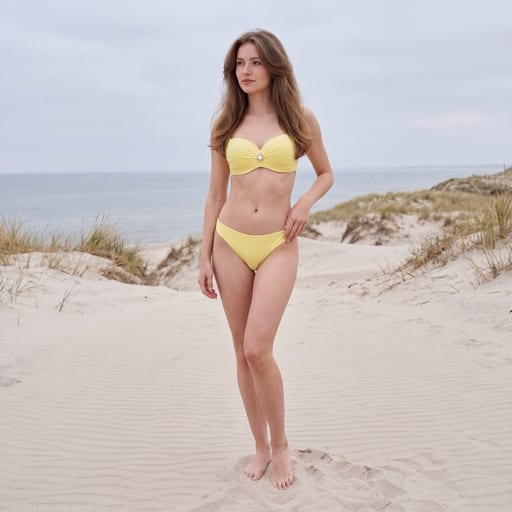
Wyblakły słońcem, spokojny brzeg morza jako jeden świat dla całego katalogu: ten sam piasek, to samo zawoalowane światło, ta sama ogniskowa, ta sama cisza. Produkty różnych marek zaczynają wyglądać jak jedna sesja — a kolor każdego produktu zostaje wierny.
Natywny social w lustrze
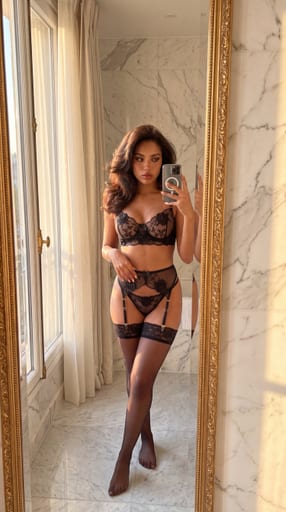
Natywne treści social: pionowy kadr 4:5, lustro, telefon w dłoni i światło zastane prywatnego wnętrza. Zdjęcia wyglądają jak zrobione przez samą modelkę — ale są ostre, prawidłowo naświetlone i pełnowymiarowe, bez fejkowych artefaktów telefonu.
Czysty fason PDP
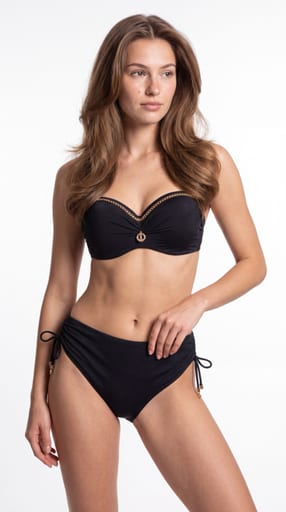
Czysty katalogowy styl PDP: modelka na jasnym neutralnym tle, kontrolowane światło, pół-statyczna poza. Fit, proporcje i konstrukcja produktu przed nastrojem — powtarzalna siatka zdjęć na kartę produktu.
Hero z miejscem na tekst
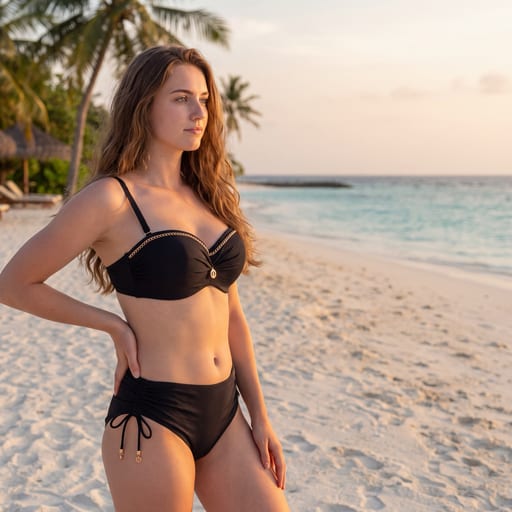
Kadr projektowany pod layout: sylwetka po jednej stronie klatki, druga strona zostaje cicha i pusta — realne miejsce na nagłówek, CTA albo logo. Jasne, ciepłe tło studyjne, kontrolowane światło i pełna czytelność produktu w części kadru przypadającej modelce.
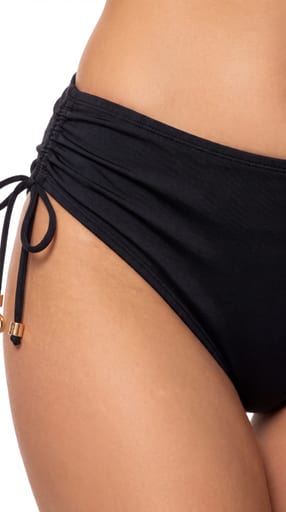
Makro detalu i konstrukcji
Studyjne makro jako dowód jakości: koronka, ścieg, fiszbina, splot, krawędź, okucie i napięcie tkaniny na ciele. Cała paczka jest warstwą detalu — 7–8 kadrów makro i półmakro plus kadry orientujące, w jednym grabiącym świetle i na jednym neutralnym tle.
Gotowy, aby rozbudować swoją bibliotekę kreacji?
Dodaj ten styl do swojego konta i zacznij tworzyć lepsze kampanie w kilka minut.