

Natywny social w lustrze
Natywne treści social: pionowy kadr 4:5, lustro, telefon w dłoni i światło zastane prywatnego wnętrza. Zdjęcia wyglądają jak zrobione przez samą modelkę — ale są ostre, prawidłowo naświetlone i pełnowymiarowe, bez fejkowych artefaktów telefonu.
Kupujący rozpoznaje treść natywną w ułamku sekundy — i tak samo szybko rozpoznaje reklamę przyciętą do pionu. Ten styl robi to pierwsze: dziesięć pionowych kadrów 4:5 z prywatnego pokoju, z lustrem, telefonem w dłoni i światłem zastanym z okna, które czytają się jako zrobione przez samą modelkę. Bez spadku klasy obrazu: ostro, prawidłowo naświetlone, bez interfejsu na ekranie, bez filtra i bez lo-fi.
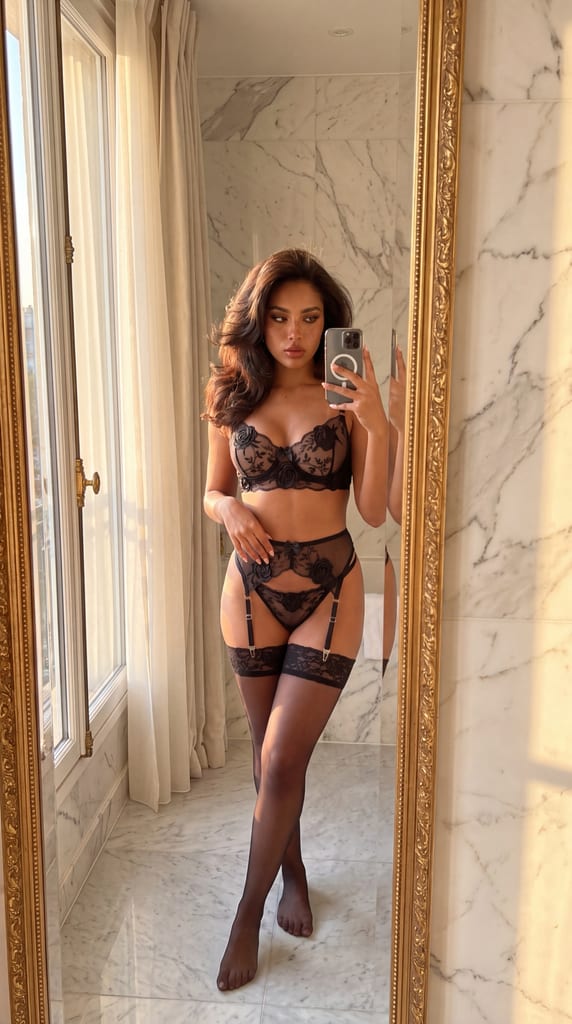
Galeria
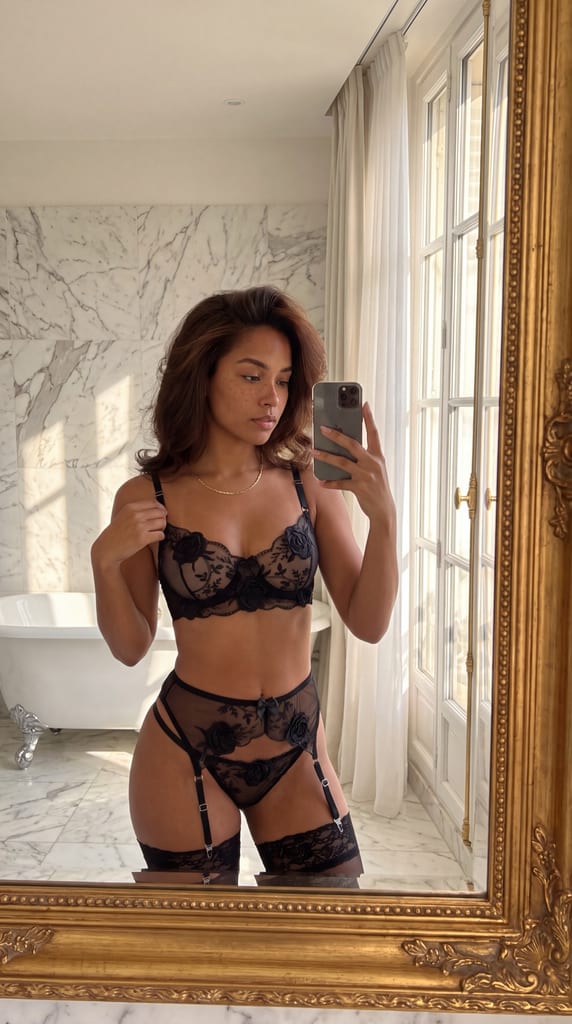
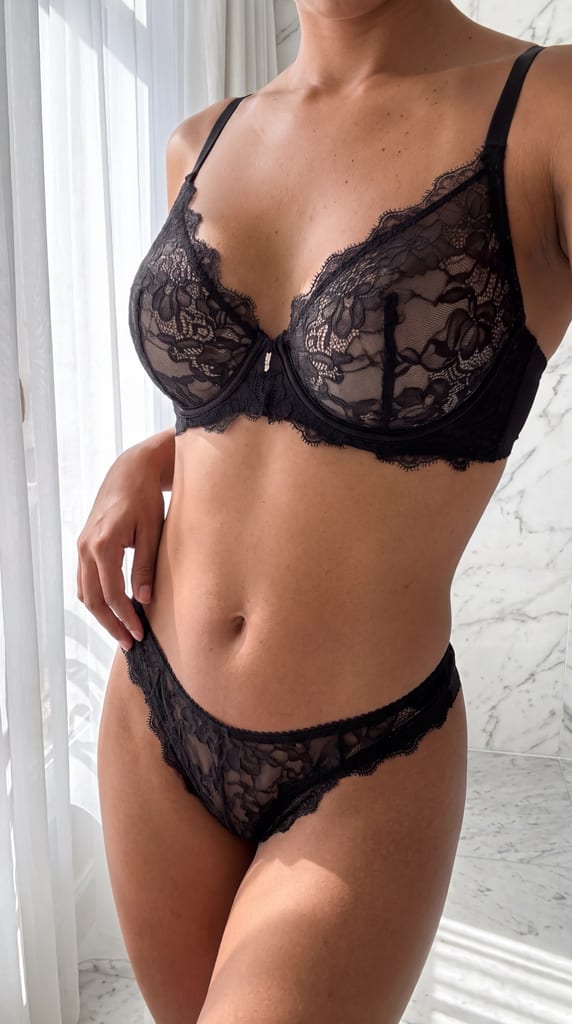
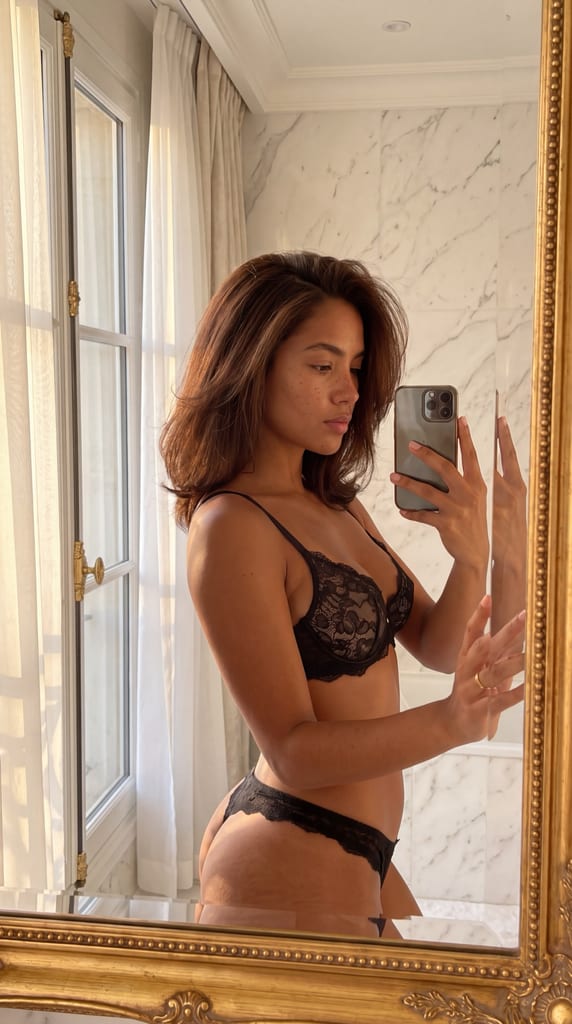
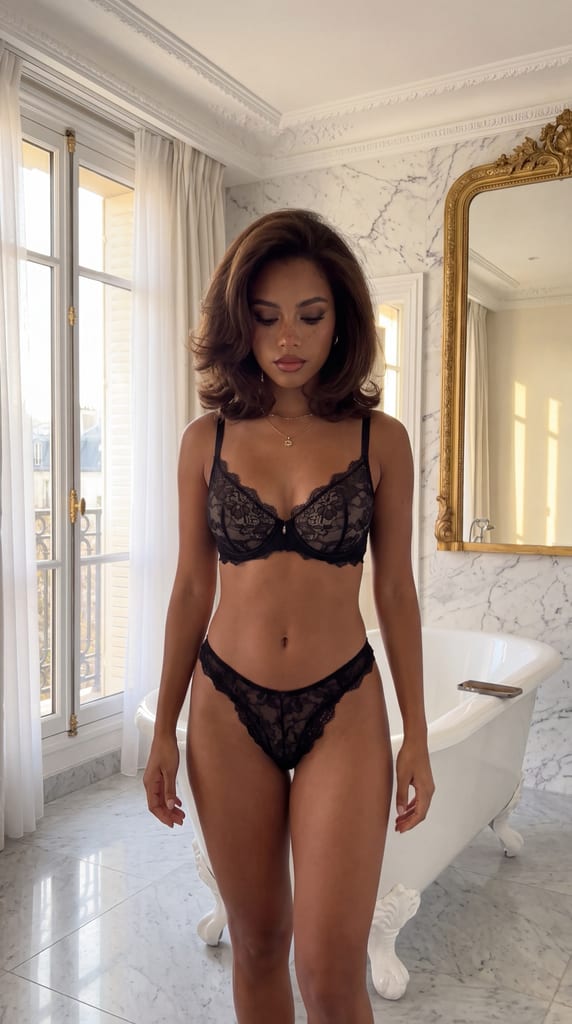
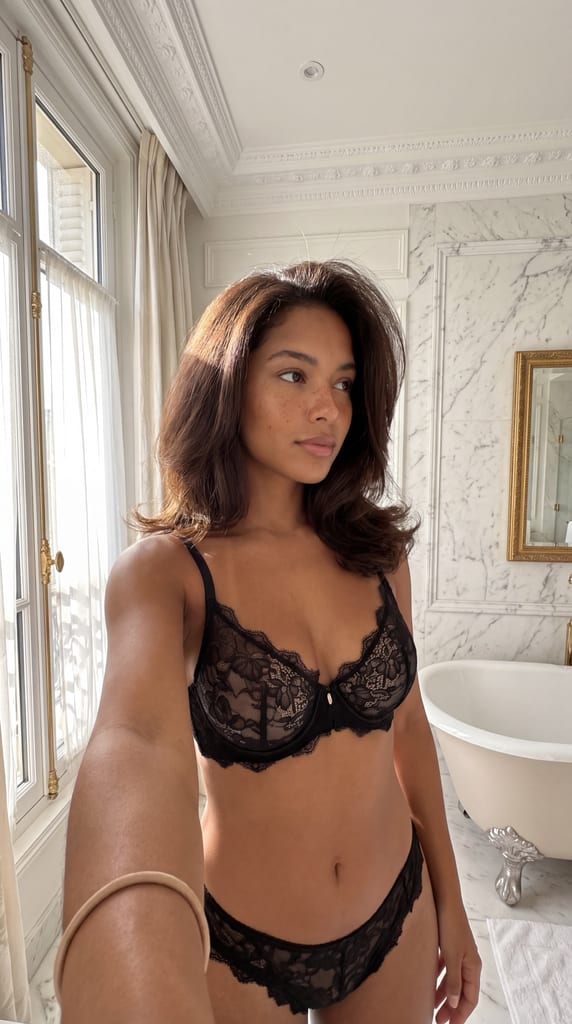
Najlepsze do
Najlepszy dla bielizny, swimwearu i lekkiej odzieży domowej na feed marki, paid social, retargeting i UGC-podobne kreacje — wszędzie tam, gdzie wiarygodność sprzedaje lepiej niż produkcja. Cała paczka jest pionowa 4:5, więc wchodzi na feed i w karuzelę bez przekadrowania, a część kadrów ma spokojne miejsce pod caption albo nagłówek. To kanał osobny od karty produktu — na PDP jest styl katalogowy, na kampanię hero są style kampanijne.
Wymagania wejściowe
Wgraj packshot tej strony produktu, którą chcesz pokazać — sesja fotografuje jedną stronę (przód ALBO tył); przy tyle modelka staje tyłem do lustra i czyta je przez ramię. Modelka jest wymagana; jej karnację, budowę i niedoskonałości skóry ustawiasz w modelce — styl ich nie wygładza. Sceneria nie jest potrzebna: styl ma własny prywatny pokój z lustrem całopostaciowym. Jeśli podpinasz scenerię, wybieraj wyłącznie prywatne wnętrza (sypialnia, garderoba, mieszkanie) — lustro styl wnosi sam do każdej przestrzeni. Format wychodzi pionowy 4:5; jeśli potrzebujesz assetu 9:16 pod Stories albo Reels, napisz to w sugestiach sesji.
Wytyczne jakościowe
## Quality guidelines ### Style core A self-captured social register for lingerie, swimwear and light homewear — images that read as if the person wearing the product made the photograph herself, in her own room, in front of her own mirror, on her phone. The world is one private interior with a full-length mirror and one window; the camera is hand-held and lives within her own reach; the frame is vertical. What separates this from a snapshot is the execution: the photograph is sharp, correctly exposed and fully resolved, and the phone in the frame is a physical object she is holding, never a source of image degradation. Camera awareness is total and it is the whole point — she is looking at herself, framing her own picture, and the picture says so. This is decidedly NOT a studio session, NOT a produced campaign and NOT a documentary photograph taken by a stranger; equally it is NOT a degraded, lo-fi or filtered image. The register's value is a believable native asset that a brand is not embarrassed to put its name on. - Commerciality level: `lifestyle` led, social-native, with catalog-grade product readability underneath — believable first, sellable throughout - Dominant character: self-captured, private, composed, contemporary, hand-held, quietly premium, un-produced in look and fully produced in execution - Image priority: the believability of the self-captured moment leads the feel; the product stays readable and worn-in-real-life in the clear majority of frames - Directional references: a brand's own best native social post; a considered mirror post from a private dressing corner in real daylight; contemporary phone-shot content that happens to be well lit, well framed and correctly exposed - Style-anchoring words: self-captured, mirror and phone in hand, one room's own daylight, vertical 4:5, sharp and correctly exposed, never staged-studio, never degraded ### Product role in frame The product (lingerie / swimwear / light homewear) is worn and stays readable in the majority of frames — fit, cut, fabric behaviour and construction must read, because a social asset still has to sell the garment. The self-captured register actually helps here: a person in front of a mirror is naturally checking how a garment sits, so the body's own behaviour is product-serving without being posed. Two operational rules carry the readability. First, the hand and the phone stay clear of the garment's construction: the phone is held at chest-to-face height, off to one side of the torso, so it never sits over a cup, a band, a waistband, a strap line or a closure in the core of the pack. Second, in a mirror frame the **mirror is the lens** — the loaded side of the product faces the mirror, not the physical camera, and the reflection is what the frame reads. When the garment's own hue sits close to the model's skin tone (nude, blush, ivory, tan), the light and the grade must preserve the edge between fabric and skin — the outline of every strap, cup, band and lace edge stays visible; the garment never dissolves into the body. The presentation character is honest, personal and current — never staged glamour, never clinical. - Product role: hero on the body, worn and self-checked — the garment leads as the readable subject; the mirror, the room and the register amplify, never bury it - Visibility level: mostly readable on the body (fit, cut, fabric read), with a minority of frames where the phone-holding arm or a natural gesture partially obscures it, plus a material / construction detail layer - What the style exposes: how the garment actually sits on a real body in a real room — fit and coverage, strap and band placement, cut and construction (cups, edges, ties, closures), fabric surface and behaviour - Hand and phone discipline: the phone-holding arm is placed so the garment's construction lines stay visible; nothing in the model's own hands crosses the product zone in the core of the pack - Loaded side in mirror frames: the mirror stands in for the lens — the loaded product side is turned toward the mirror, and the reflection carries the readable subject - Skin-to-garment separation: when the garment's hue is close to the skin tone, the window light and the neutral grade keep every edge of the garment readable against the body - Acceptable obscuring: moderate and only from the register's own mechanics (the phone-holding arm, a natural adjusting gesture, a crop) if cut and fit still read; never unreadable in the core of the pack - Product presentation character: honest, personal, current, clearly sellable ### Light Default light — applied when no scenery is linked, or when the linked scenery does not name a directional light, a time of day or weather: ONE window as the only key, off frame, to one side of the room. Daylight enters at roughly 30° azimuth off the camera–model axis, on the camera side, the window's centre level with the model's eye line (the ~30° is azimuth measured from the camera–subject axis, not from the walls; the source sits at eye height, never below as an uplight). The window is large and close, so the light is soft with a readable direction: there is a lit side and a shadow side, the shadow edge is wide and gentle, and the light falls away into the depth of the room. The only fill is the room's own bounce off its wall, floor and textiles — plus one fill that belongs to this style alone: the mirror itself returns a soft secondary bounce back into the space, a real and believable part of a room with a large mirror in it. Discipline — always, whatever the light source: one dominant ambient interior source with real direction, real falloff and real bounce; soft to medium-soft in hardness; medium contrast; the room's own surfaces as the only fill; one single white balance per frame, following the resolved light source (the preset's neutral daylight value applies only when the preset's default light is the source). This applies on top of whichever source is resolved — a qualifying scenery may set a different window, a different time of day or an interior lit by its own practicals, and the ambient, believable, single-source character stays. The light of this style is the light that is already in the room; it is what makes the frame read as captured rather than lit. - Source type: ambient daylight through one window by default, off frame; a qualifying scenery may resolve another interior source. Always one dominant source - Default source direction: one window at ~30° azimuth off the camera–model axis, on the camera side, its centre level with the model's eye line — applied when no scenery is linked, or when the linked scenery does not name a directional light, a time of day or weather - Hardness: soft to medium-soft — a large near source; the shadow edge is wide and gentle, and it is present - Light-to-shadow contrast: medium — a real room's contrast between the window side and the room side; readable, open shadows that still carry the wall's surface - Role of fill: the room's own bounce off wall, floor and textiles, plus the mirror's own soft return into the space; controlled enough that the garment never falls into shadow - Falloff: present and physical — the model stands in the window's light and the depth of the room sits materially darker. This gradient is what tells the viewer the light is real, and it stays in every frame - Shadow quality: soft, directional, believable — grounding and modelling, never graphic, never a studio cutout - Color temperature: the preset's neutral daylight white balance applies only when the preset's default light is the source; otherwise white balance follows the resolved light source - White balance count: exactly one per frame; a room's practical fixtures may be visible as part of the space and may add a small local accent, but the frame always resolves to one dominant source and one white balance - What the light should model: first the volume of the body and the way the garment sits on it, then the surfaces of the room, then the depth the falloff creates - Light discipline (always, whatever the source): one dominant ambient interior source, soft-to-medium-soft, real direction, real falloff, room bounce as the only fill, medium contrast, one white balance - Avoid (Prompter instruction — formulate final values positively): an on-camera flash, a phone torch, a second competing key, a flat sourceless ambient wash. The positive value is the one already written above: the frame is lit by the room's own daylight alone, and every reflective surface in it returns that same light ### Color and tonality Honest, contemporary interior tonality whose job is to look un-graded: the picture should read as the room's own colour recorded correctly, not as an asset that went through a grade. This matters more here than in any other register of the library, because a visible creative grade is the fastest tell that an image was produced rather than captured — a film character, a colour wash or a fashionable tint would undo the whole premise. The default background (used only when no scenery is linked) is the dominant wall of the preset's own room: ONE quiet, warm-neutral greige plaster tone — sRGB `#B7B0A6` ≈ CIELAB L* 72 / a* 1 / b* 6 — a mid-light, faintly warm surface with the window's own gradient falling across it, clearly NOT a bright near-white studio sweep, NOT a neutral mid-grey seamless, NOT a strong beige or sand, NOT a cool blue-grey. It is mid-light on purpose: bright enough that any garment hue separates against it, dark enough that the model reads as lit by a window rather than floating on a backdrop. Saturation natural and true; contrast medium; whites clean and neutral; blacks honest and open, still carrying the wall's surface. - Palette: natural and limited — real skin + true product colour + the room's own warm-neutral surfaces (the `#B7B0A6` wall only when no scenery is linked); the product is the strongest hue in the frame - Background tone (default, closed axis): sRGB `#B7B0A6` ≈ CIELAB L* 72 / a* 1 / b* 6, one single value with the window's own gradient across it — never a family, never a range, never drifting toward white, cool grey, sand or blue between frames; used only when no scenery is linked - White balance: one per frame, following the resolved light source; the preset's neutral daylight value applies only when the preset's default light is the source; the grade never recolours a linked scenery - Saturation: natural and true-to-life — no muting, no boosting, no fashionable desaturation - Contrast: medium — the honest contrast of one window in one room - Exposure: correct and a touch bright, the way a phone meters a daylit room; the window wall's highlights held, the shadow side open and readable - Highlights character: neutral and controlled, including the window itself and the mirror's own bright return when they enter the frame - Shadows character: soft, open, neutral; the unlit part of the room keeps its surface - Blacks: honest and open — real interior blacks, not a studio cutout, not lifted in post - Whites: clean and neutral — a white garment separates from the `#B7B0A6` wall through the soft contact of light and shadow, never by recolouring the background - Overall tonal character: contemporary, honest, interior, deliberately un-graded — no film character, no colour wash, no tint - Faithfulness of the product's own hue takes precedence over everything else in this section; the grade never recolours a linked scenery ### Lens and perspective feel One pinned focal length: **~35mm in feel, for the whole session** — a single value, never a range. This is the library's only deliberately wide anchor and it sits at the wide edge of the sanctioned spectrum, chosen for the register's physics rather than for style: a mirror frame is made from 1.5–2.5 m to the glass, so the optical path is 3–5 m and a short-portrait length simply cannot hold a full figure together with the mirror's frame inside a room. The wide pin also carries the phone-native character — a moderately wide field with the room legible around the figure — and it keeps the wall, the mirror and a piece of the space in the frame, which is what makes the image believable. There is NO second focal value in this preset: a closer read comes from moving the camera closer at the same ~35mm, exactly as a phone behaves in a real hand, and the length never widens further into caricature. Aperture / depth of field is a closed axis resolved once for the whole session: one moderately deep value (~f/8 in feel), so the room reads legibly behind and around the figure the way a phone's small sensor renders it. Deep rendering is load-bearing twice over here: it keeps the room as visible proof that the picture was taken in a real place, and it holds a mirror frame together optically — the reflection sits at twice the mirror's distance, so both the mirror's frame and the reflected figure have to be sharp in the same image. A shallow, synthetic subject separation is off-register: it is the look of a portrait-mode effect, and it reads produced. Camera height and distance belong to a hand, not to a stand. The camera lives within the model's own reach — from about hip height to just above her eye line — because she is holding it, and in the frames where the phone rests on a surface of the room with a self-timer running, the height is that surface's height. Distance is close and personal: the mirror distance for mirror frames, arm's length for direct frames, and closer still for the material detail layer — all at the same ~35mm. - Focal length: **PIN ~35mm in feel — one single value for the entire session, no ranges** (never write "35–50mm in feel"); never taken from the scenery. No second focal value exists in this preset: a tighter read comes from moving the camera closer at the same ~35mm, and the length never goes wider - Aperture / depth of field: ONE moderately deep value (~f/8 in feel) resolved for the whole session and held identical across every frame; the room stays legible, the mirror frame and the reflection are both sharp. Never sourced from the scenery - Camera distance: close and personal — mirror distance for mirror frames, arm's length for direct frames, closer for the construction detail layer; all at the same focal length - Camera height: within the model's own reach — from about hip height to just above her eye line, because a hand is holding it; in propped frames, the height of the surface the phone rests on - Perspective: the hand-held heights above as the register; the camera is level with the room, so the mirror's frame and the room's verticals stay true - Sharpness character: as a modern phone's main camera renders a daylit room — fully sharp across the frame, real photographic detail - Gear character: a modern phone's main camera, hand-held, moderately wide, deep rendering, available window light - Aspect ratio: **PIN 4:5 vertical — one single value for the entire session**, because the vertical native format is part of what this style delivers. A taller 9:16 vertical is used ONLY when the idea explicitly calls for a Stories/Reels asset, never as a per-frame default; when it is used, that frame resolves to that one concrete value ### Composition language Hand-held composition, honest and slightly imperfect — the frame reads as one a person actually made, not as one an art director planned. The vertical 4:5 shape drives the layout: a vertical frame wants a vertical body, so the figure runs along the frame's long axis with the room's own lines around it. Placement is central or gently offset, and the imperfection is real but small — a horizon of the floor line that is honest, a margin that is not measured — never a tilted or careless frame, because carelessness reads as a fault, not as a register. Two to three optical planes in a mirror frame, and they are specific to this style: the mirror's own surface and frame, the reflected figure, and the part of the room that appears behind the camera in the reflection. The mirror's plane stays flat and its frame stays straight — a mirror is a geometric object and a bent one destroys the whole image. Negative space is modest, with a minority of frames leaving a calm zone (the wall plane above the head or beside the figure) usable for a caption or a headline overlay. Separation from the background is the window's light plus the tonal difference between skin, garment and the `#B7B0A6` wall. One rule pays the price of the wide focal pin: the figure sits inside the central area of the vertical frame, away from the frame's edges, so body proportions stay true and limbs are never stretched at the border. The room's verticals stay vertical and its perspective stays physically believable. - Frame type: leads with mirror frames from 3/4-length to full figure (the register's core) and closer mirror frames from the waist up; an arm's-length direct frame share; a propped full-figure share; a material / construction detail layer - Object placement: central or gently offset, inside the central area of the vertical frame; hand-held honesty in the margins, never a careless or tilted frame - Wide-lens discipline: the body stays away from the frame's edges so proportions stay true; the room's vertical lines stay vertical - Mirror geometry: the mirror's plane is flat and its frame is straight; the reflected perspective agrees with the real room - Background hygiene: the area behind the head and shoulders stays clear of intersecting objects and lines, in the reflection as well as in the real plane; the room's horizontal lines do not cut the body at a joint - Negative space: modest in body-led frames; a calm wall zone in the minority of frames reserved for a caption or headline overlay - Symmetry: incidental, not sought — a person squared to her own mirror is naturally near-symmetrical, and that is where the symmetry comes from - Open / closed composition: mixed — closed frames where the figure is composed fully inside the vertical frame, open frames where the hand-held crop naturally cuts the figure at the thigh or the waist - Number of planes: two to three — the mirror's surface and frame, the reflected figure, the room appearing behind the camera in the reflection; direct frames run one to two - Separation from background: the window's light plus tonal contrast with the wall; never a rim-light effect, never a synthetic shallow separation - Room for copy: yes, in a minority of frames — a calm wall zone in the vertical frame, which is what the paid-social use case buys - Overall composition character: hand-held, vertical, honest, native — composed by the person in the picture ### Pose language Posing is what a person actually does in front of a mirror, raised half a step in control — not a fashion vocabulary and not an absence of one. The repertoire is real and specific: squared to the mirror with the weight settled on one hip; a slight turn to read the side line of the garment; a look over the shoulder to check the back; a hand at a strap or a waistband, adjusting; a hand in the hair; a small lean toward the glass; a seat on the edge of the bed or bench facing the mirror. Amplitude is contained to natural — the body is aware and composed, but it is never worked into sculptural fashion shapes, because a worked shape is the moment the image stops reading as self-captured. Expression is composed, self-possessed and private: she is looking at herself, not performing for an audience — calm, at ease, quietly confident. Camera awareness is total and it is the register; in a mirror frame she meets her own eyes in the glass, which reads to the viewer as a direct look into the lens. When the input shows the back of the garment, the canonical shape of this register applies: she stands with her back to the mirror and reads it over her shoulder. - Expression: composed, self-possessed, private, quietly confident; reads whenever the face is visible — never a worked fashion attitude, never a performed glamour look, never a blank one - Pose dynamics: semi-static with real micro-movement — set stances plus the natural adjustments a person makes at a mirror (a turn, a weight shift, a hand rising) - Body openness: open and honest — the body squared or gently angled to the mirror so the loaded side of the garment reads - Line tension: low to medium and natural — settled posture, a hip taking the weight; no elongation overload, no held editorial tension - Posing character: `lifestyle` / `natural` with full camera awareness — the specific language of a person reading her own reflection - Contact with the room: casual and real — a hand on the mirror's frame or the wall, a lean against a doorframe, a seat on the edge of the bed; it supports the stance, it is never a domestic action and never a narrative device - Eye contact: mixed and register-specific — her own eyes met in the mirror (which reads as direct to camera), a glance down at the phone as she frames the shot, a look off into the room, or down along the body line at the garment - Spontaneity level: composed — every stance is one she chose, with small natural adjustments keeping it from reading set - Body-to-product relationship: the body presents the garment the way a person checks a fit, so the pose is product-serving by its own nature; the product never drops below the sales floor ### Movement and physics The style is essentially still and fully sharp. Movement is the small, real kind that happens at a mirror — a turn to check a side, a weight shift, a hand rising to a strap, hair settling after a turn — and it is always frozen: a phone in daylight records sharply, so blur here would read as a fault rather than as a device, and it would break the image-class floor the whole preset is built on. Indoors there is no wind; fabric behaves under real gravity and the garment sits as it truly sits. Two physical requirements are load-bearing in this register. The phone has real weight and a real grip: it reads as a solid object held in a hand, with the hand's fingers wrapped around it. And the mirror obeys optics: it shows exactly one reflection, laterally reversed, at the correct reflected distance, with the reflected room agreeing with the real room and the reflected figure agreeing with the real figure. - Static vs movement: essentially still — set stances with real micro-adjustments; no motion devices - Frozen vs blur: fully frozen and sharp; no motion blur anywhere, least of all on the product - Hair/body: natural and settled, or caught just after a small turn; kept clear of the garment's readable zones - Contact physics: real and load-bearing — a hand on the mirror's frame or the wall takes weight; the phone has weight and a real grip in the hand - Mirror optics: exactly one reflection, laterally reversed, at the correct reflected distance; the reflected room and the reflected figure agree with the real ones; the glass is a flat plane - Elements: none — no wind, no water, no environmental devices ### Relation to scenery The style's world is ONE believable private interior with a full-length mirror, and it is the preset's own default rather than a location statement. That default room is a single, specific space, not a family of rooms: a quiet bedroom-and-dressing corner with a warm-neutral greige plaster wall (sRGB `#B7B0A6` ≈ CIELAB L* 72 / a* 1 / b* 6) as its dominant plane, a full-length mirror in a slim, plain frame standing against that wall, one window to one side of the room, a pale wooden floor, the edge of a made bed or a low upholstered bench, the edge of an open wardrobe with a few garments on a rail, and soft everyday textiles. It reads lived-in and real — a room someone uses, not a decorated set, not a hotel suite, not a studio with a mirror propped in it. Which of those elements enter a given frame is an open axis and varies with the crop; the room itself, its wall tone, its window and its mirror stay locked across the whole pack. Scale is intimate — a room, never a hall. Depth is present in every frame because a window in a room makes it visible. The mirror is the one element that belongs to the preset rather than to the world. It is the instrument of the register, in the same way the phone is the camera — so when a linked scenery leads the place, the preset brings a full-length mirror into that space rather than waiting for the scenery to supply one. Everything else comes from the world: a linked interior scenery owns the location, its surfaces, its furnishings and its windows, and the preset's ambient light discipline, camera, grade discipline, composition and pose DNA apply on top. - Relationship to space: a private, lived-in interior — intimate, human-scaled, real; a linked interior scenery leads the location when supplied - Scene depth: layered and always present — the near plane of the mirror's frame, the reflected figure, the depth of the room falling away from the window - Background activity: supporting and non-narrative — the room's own surfaces are visible and welcome as proof of a real place; its furnishings stay passive - Space scale: intimate to human (a room), never monumental - Default background: the warm-neutral greige wall `#B7B0A6` (CIELAB L* 72 / a* 1 / b* 6) — one value, not a range, not a family; used only when no scenery is linked - Default world: one quiet bedroom-and-dressing corner (greige wall, full-length mirror in a slim frame, one window to one side, pale wooden floor, the edge of a bed or bench, the edge of an open wardrobe, soft textiles), the same room across the whole pack - The mirror belongs to the preset: whatever room is resolved, a full-length mirror stands in it — the register does not exist without one - What a linked scenery brings: the place, the backdrop, its surfaces and architecture, and — when it names a directional light, a time of day or weather — the light source. What it never brings: focal length, aperture / DoF, aspect ratio, render character or grade; those stay preset-owned, and the preset's light discipline always applies on top ### Props and styling behavior Two objects are present in this style and neither of them is a prop. The **mirror** is the instrument of the register, and the **phone** is the camera — they are the mechanism that makes the image what it is, not decoration. The phone is held in one hand at chest-to-face height, off to one side of the torso so it never crosses the garment; in mirror frames it reads back-toward-the-glass, as a rear camera physically requires, so the mirror shows its plain back rather than a screen. Everything else in the room comes from the world or from the linked scenery and stays passive — furniture, textiles and fixtures may enter the frame as surface and architecture, never as objects the model uses to tell a story. Accessories are minimal and ordinary: a fine chain, a small watch, a hair tie at the wrist — the pieces a person actually wears at home, added in a minority of frames as a session styling layer, NOT part of the base model identity (accessories baked into the model return in every frame and break the register). Bare feet are native to a private room and are the default. - The mirror: the preset's own instrument — one full-length mirror in a slim, plain frame, glass plain and its plane flat; present in the majority of frames - The phone: the camera, and the register's signature — a real object with weight, held in one hand at chest-to-face height, off to one side of the torso, back toward the glass in mirror frames - Objects in the room: supplied by the world or the linked scenery, passive, never used narratively by the model - Accessories: optional and ordinary — a fine chain, a small watch, a hair tie at the wrist, in a minority of frames - Accessories = session styling layer, not the model's identity — the model is a separate, clean input (frequency is set in Quantity) - Footwear: bare feet as the default, native to a private room - Hair, make-up and skin come from the card; the preset only asserts non-override (it does not smooth, restyle or beautify them) - Hair movement as a POSE cue stays available: hair may settle after a turn in a minority of frames (motion, not a hairstyle spec) - Avoid (Prompter instruction — formulate final values positively): styled set dressing, holiday clutter, held objects other than the phone, anything that turns a private room into a produced set. The positive value is the one above: the room carries its own ordinary contents and the model carries only the phone ### Post-production and finish Finish honest, correctly exposed and current — the image should read as a well-made photograph that happens to have been taken by its subject. No grain: a phone records a daylit room cleanly, and grain added here would read as an applied effect rather than as photographic character, which is precisely the tell this register cannot afford. Texture as recorded — the room's own surfaces and the garment's own weave stay legible. Clarity medium-high so fabric, lace, seams, edges and the mirror's own frame read fully, without HDR and without sharpened "advertising" micro-contrast. No vignette. Retouch minimal, with natural texture and features preserved. And one boundary specific to this style: the picture's surface stays a plain photograph — the image is not a screenshot of anything, carries no interface, no timestamp, no applied filter and no colour wash, and the phone in the frame is a physical object rather than a source of image degradation. - Grain: none — the frame reads as a phone records a daylit room, not as an applied texture - Texture: as recorded; the room's own surface texture and the garment's weave stay visible - Clarity: medium-high, without HDR or advertising micro-contrast - Vignette: none - Retouch: minimal — light cleanup only, never at the cost of fabric or surface texture - Skin: the preset does not specify the model's skin, make-up or hair; it only requires that the render not smooth away or override the skin realism and identity supplied by the Mannequin input - Image surface: a plain photograph — correctly exposed, fully sharp, un-filtered and un-graded; the phone is a physical object in the frame - Avoid (Prompter instruction — formulate final values positively): a screen interface, an app overlay, a timestamp, a filter or colour wash, compression artefacts, a flash blowout, a lo-fi or degraded look. The positive value is the one above: a clean, correctly exposed, fully sharp photograph - Overall finish: honest, current, correctly exposed — native in look, fully resolved in execution ### Style render properties - Render character: true-to-life photographic rendering. The frame must read as a real photograph taken with a real camera — a modern phone's main camera held in a hand, a moderately wide field, the room's own window light, correct exposure and full sharpness. Carry this into `Rendering_Style` as its own value — `True-to-life photographic rendering.` — and resolve it identically on every frame of the session. The style's register (social-native, self-captured) belongs in `Session_Concept` and `Output_Goal`; `Rendering_Style` carries ONLY the photographic character, never a genre label, never a quality or fidelity adjective. - The frame is VERTICAL 4:5 — one single aspect ratio for the whole session, written identically on every frame. A taller 9:16 vertical appears ONLY when the idea explicitly calls for a Stories/Reels asset, never as a per-frame default. - Focal length is PINNED at ~35mm in feel and aperture at ~f/8 in feel for the whole session — one value each, never a range, never taken from the scenery. The wide pin is deliberate: it is what lets a full figure and the mirror's frame coexist inside a room and what carries the hand-held, phone-native field. A closer read comes from moving the camera closer at the same ~35mm; the length never widens further. - At the wide pin, body proportions stay true: the figure sits inside the central area of the vertical frame, away from its edges, and the room's vertical lines stay vertical. The camera is level with the room; the mirror's frame stays straight. - The register is SELF-CAPTURED and the mechanism must be visible: a full-length mirror, the model's reflection as the subject of the frame, and the phone held in one hand at chest-to-face height, off to one side of the torso. In mirror frames the phone reads back-toward-the-glass, as a rear camera physically requires, so the mirror shows its plain back. Camera awareness is total — she is framing her own picture. - The mirror obeys optics: exactly one reflection, laterally reversed, at the correct reflected distance, with the reflected room and the reflected figure agreeing with the real ones, on a flat plane in a straight frame. - In a mirror frame the mirror stands in for the lens: the loaded side of the product is turned toward the mirror, and the reflection carries the readable subject. - Camera height stays within the model's own reach — from about hip height to just above her eye line — because a hand is holding it; in propped frames it is the height of the surface the phone rests on. - The world is ONE private, lived-in interior with a full-length mirror. The default background (used only when no scenery is linked) reads as ONE warm-neutral greige plaster wall — sRGB `#B7B0A6` ≈ CIELAB L* 72 / a* 1 / b* 6 — with the window's own gradient across it; never a bright studio sweep, never a neutral mid-grey seamless, never a strong beige or sand, never a cool blue-grey, and never a different value between frames. When a scenery is linked, the scenery owns the place and its surfaces — and the preset still brings the full-length mirror into it. - Light must read as ONE dominant ambient interior source with real falloff — by default one window off frame at ~30° azimuth off the camera–model axis, on the camera side, its centre level with the eye line, soft to medium-soft, with the room's own bounce and the mirror's own return as the only fill; medium contrast; the model in the window's light and the depth of the room materially darker. This discipline applies on top of whichever light source is resolved, and each frame resolves to exactly one white balance. - White balance follows the resolved light source; the preset's neutral daylight value applies only when the preset's default light is the source. Tonality stays honest and un-graded — natural saturation, medium contrast, blacks open, whites clean-neutral, no film character, no tint, no colour wash. The grade never recolours a linked scenery. - The product (lingerie / swimwear / homewear on the body) stays the readable subject in the majority of frames — fit, cut, fabric and construction must read, and every edge of the garment stays visible against the skin even when their tones are close. The phone-holding arm is placed so it never sits over a cup, band, waistband, strap line or closure in the core of the pack. - The preset does not specify the model's skin, make-up or hair; it only requires that the render not smooth away or override the skin realism and identity supplied by the Mannequin input. - Pose reads as a person reading her own reflection — composed, self-possessed and private, with the natural adjustments of someone checking how a garment sits. Expression is calm and quietly confident. No sculptural fashion shapes, no performed glamour, no motion devices. - The image's own surface stays a plain, correctly exposed, fully sharp photograph: the phone is a physical object in the frame and never a source of image degradation; the picture carries no interface, no overlay, no filter and no grain. - Overall the image must feel like a believable native social post that a brand would be glad to publish — captured, personal and current — not a studio frame, not a produced campaign, not a documentary photograph taken by a stranger, and not a degraded snapshot. ### Allowed variability Variability applies only to the open axes. What stays disciplined across frames is the preset's own DNA: the vertical 4:5 frame, the pinned ~35mm focal length and ~f/8 aperture, the hand-held camera heights, the ambient one-window light discipline, the honest un-graded tonality, the `#B7B0A6` wall default, the self-captured mechanism (mirror plus phone in hand) and the image-class floor. Everything below is open. - The exact stance, weight distribution, turn, adjusting gesture and micro-movement may vary — squared to the glass, a side turn, a look over the shoulder, a hand at a strap, a hand in the hair, a lean toward the mirror, a seat on the edge of the bed — as long as they keep the composed self-captured register and the product-readability floor. - Head and face angle may vary (frontal to the mirror, three-quarter, over the shoulder). Model identity is carried by the Mannequin input regardless of the face angle. - Frame / crop may move along the register's ladder (full figure in the mirror ↔ 3/4-length ↔ waist-up ↔ arm's-length close frame ↔ construction detail) — always at the pinned ~35mm and in the pinned vertical frame. - Camera height may move within the model's own reach (hip height to just above the eye line), and in propped frames to the height of the surface the phone rests on. - Gaze may change (her own eyes met in the glass, a glance down at the phone, off into the room, down along the body line), as long as it stays composed and private. - Which elements of the room enter the frame — the mirror's frame, the window, the wall, the floor, the bed or bench edge, the wardrobe edge — is open and varies with the crop; the room itself does not change. - Whether the mirror's own frame or edge is visible in a given shot is open, and so is which part of the room appears in the reflection behind the camera. - The presence of an ordinary everyday accessory may appear and disappear between frames (session layer, a minority of the pack). - The degree of partial product obscuring by the phone-holding arm or a natural gesture may vary within "still readable in the core of the pack". - What may NOT vary: the aspect ratio, the focal length, the aperture, the room and its wall value, the light character, the self-captured mechanism, the pose and expression register, or the image-class floor. ### Session-level consistency Across the whole pack these stay constant, because the Prompter is stateless: the same ONE private interior with the same full-length mirror, the same warm-neutral greige wall default (sRGB `#B7B0A6` ≈ CIELAB L* 72 / a* 1 / b* 6 — never a different value between frames) whenever no scenery is linked, the same one window at ~30° azimuth with its centre level with the eye line and the same falloff into the room, one white balance per frame, the same honest un-graded tonality, the same pinned ~35mm focal length and ~f/8 aperture on every frame, the same vertical 4:5 frame, the same hand-held camera heights, the same self-captured mechanism (the mirror and the phone in hand), the same composed and private pose and expression register, and the same fully sharp, un-filtered image surface. The pack must read as one afternoon in one room, photographed by one person of herself: ten frames that could be posted as a single set without one of them betraying a different room, a different light, a different camera or a different day. The pack must not mix self-captured frames with studio, campaign or third-person documentary frames, and it must never drop the image class in the name of looking native. ### Conflict resolution Declared hierarchy shift, with its business reason: this preset serves a channel bought separately from the product page, and on that channel the asset has exactly two ways to fail. If it stops reading as self-captured, it becomes an ordinary photograph that performs like an ad. If it drops image class — a fake interface, a degraded surface, a blown flash — it stops being something the brand can publish. So render believability here explicitly includes both the optical truth of the mirror and the image-class floor, and it is raised above product readability — but the product stays readable, because a social asset that does not sell the garment has no reason to exist. 1. Realism and render believability: a true-to-life photograph with an optically correct mirror, one believable ambient interior light with real falloff, believable interior geometry, true proportions at the wide pin, and the image-class floor (fully sharp, correctly exposed, un-filtered, no interface, no degradation); the product's own hue not twisted; model identity carried by the Mannequin input. 2. Product readability on the body: fit, cut, fabric and construction read in the majority of frames, garment edges hold against close-toned skin, and the phone-holding arm never covers a construction line in the core of the pack. 3. Consistency of the self-captured world: one room, one mirror, one light source and direction, one grade, one focal length, one aperture, one vertical frame across the pack — the series signature. 4. Any expressive accent — kept inside the register: expression here works through presence and self-possession, never through fashion posing or performed glamour. When a linked scenery's own space conflicts with the preset's default room, the scenery wins the location (below product readability, render realism and model identity, which stay higher) — and the preset still brings the full-length mirror into whatever space the scenery supplies, because without it the register does not exist. The preset's default light and background apply for sessions without a scenery, or when the linked scenery does not name a directional light, a time of day or weather; a qualifying scenery's light leads, and the preset's ambient single-source discipline applies on top. The camera pins are never moved by the scenery — the focal length, the aperture and the vertical 4:5 frame are preset-owned, and only a per-batch Idea or suggestion may move them (the 9:16 exception is exactly such an explicit Idea). If a pose or a camera position would improve the picture at the cost of the self-captured mechanism — a height no hand could hold, an angle no mirror could return, a light no room contains — the mechanism wins and the frame is recomposed within it. If full product readability would fight the register, a minority of frames may allow partial obscuring from the phone-holding arm or a natural gesture — but never below the threshold where the garment stops being a recognizable, sellable subject.
Wytyczne ilościowe
## Quantity guidelines ### Session goal By default 10 images in the pack. Main use: native social content for a brand's own feed, paid social, retargeting and a channel bought separately from the product page, for lingerie, swimwear and light homewear. The pack's goal is a vertical, believable, self-captured set: ten frames that look like one person photographed herself in one room over one afternoon, in one light, on one phone — while staying sellable (fit, cut and construction read) and staying publishable (fully sharp, correctly exposed, no degraded surface). The whole pack is 4:5 vertical, so it drops onto a feed or into a carousel without recropping. ### Shot mix About 40% mirror frames from 3/4-length to full figure (the core of the register — the reflection is the subject, the phone is in hand, the room reads around her), 20% closer mirror frames from the waist up (the garment's upper construction, the phone still in hand), 20% arm's-length direct frames without the mirror (close and personal — bust to waist-up, the camera held toward her at her own reach), 10% propped full figure (the phone resting on a surface of the room with a self-timer running, so the full figure reads without the mirror and without the phone in hand), 10% material or construction detail (the camera brought close to a strap, a lace edge, a band, a tie or the fabric's surface). The pack leads with mirror frames because they are what the register is; the propped share exists so a full figure is available in a frame that is not a reflection. When the input shows the product's back, the same shot mix reads from behind: she stands with her back to the mirror and reads it over her shoulder, and the detail layer works the back construction. Every frame at the pinned ~35mm, in the pinned vertical 4:5. ### Perspective mix Product orientation = input, not preset. The input always shows one side of the product — the front or the back — and that loaded side dictates whether the model stands facing the mirror or with her back to it, reading it over her shoulder. The preset does NOT redistribute or assign this (no "X% front / Y% back"); it takes the orientation from the input and only varies the camera angle and height within it. The distribution concerns the camera setup with the loaded side kept toward the lens — and in a mirror frame the mirror stands in for the lens, so the loaded side faces the glass: about 40% straight on (the model squared to the mirror, or the camera frontal to the loaded side in a direct frame — fully readable fit), 25% a slight 3/4 swing (the loaded side still readable), 15% the camera held a little above the eye line (the native hand-held high angle — a phone raised slightly), 10% the camera held at chest-to-hip height (the native hand-held low angle, and the height of a propped phone), 10% closer to profile (as far as the loaded side stays visible — how a person reads the side line of a garment). Every height stays within a hand's reach; no tripod-level fixed height, no floor-level or overhead angle. Angles never deform proportions at the wide pin, never bend the room's architecture, and never rotate the figure so the loaded product side leaves the mirror's view. The direction of the light stays constant regardless of the camera setup — the window does not move between frames. ### Gaze distribution About 35% her own eyes met in the mirror (which reads to the viewer as a direct look into the lens — the register's signature gaze), 30% down at the phone as she frames the shot (a real, honest beat of self-captured content, and the one that most clearly says who took the picture), 25% off into the room or past the mirror's edge (composed, unperformed), 10% down along the body line at the garment itself (how a person checks a fit). Every gaze stays composed and private — never a performed intensity, never a coy look. This applies to frames where the face is visible; in detail frames the face may fall outside the crop. ### Interaction distribution About 45% holding the phone toward the mirror with no other contact (the core mechanic — she is simply standing and photographing herself), 30% light contact with a real surface of the room (a hand on the mirror's frame or the wall, a lean against a doorframe, a seat on the edge of the bed or bench), 15% a natural self-adjusting gesture (a hand at a strap or waistband, a hand in the hair, a shoulder settling), 10% propped frames with the phone out of her hands and no contact (standing in the room). Contact is casual and real; it supports the stance and it is never a domestic action, a household narrative or an object used to tell a story. ### Product visibility distribution About 45% garment fully readable on the body (the sales floor — the whole loaded side legible at a glance), 25% garment readable with the register's own geometry leading (the mirror's frame, the room around her, the reflection's doubled plane), 15% partial obscuring from the phone-holding arm, an adjusting gesture or a crop — never over a construction line, 15% material or construction detail. Full readability stays a hard floor across roughly 45% of frames, and no amount of native character pushes the product below it. ### Composition openness distribution About 60% closed compositions (the figure composed fully inside the vertical frame — the mirror frames and the propped full figure), 40% open framing where the hand-held crop naturally cuts the figure at the thigh or the waist (the arm's-length and closer frames). Openness here is the honest consequence of a hand-held vertical crop, not a narrative device — and never a careless or tilted frame. ### Safe vs expressive ratio About 55% safe (fully readable, sellable, ready to run as a paid social asset as it is), 30% expressive (stronger self-captured character — the mirror's geometry leading, a livelier gesture, a more personal crop), 15% copy-ready (a calm wall zone in the vertical frame reserved for a caption card, a headline or a price overlay — this is what the paid-social use case buys, and it is a real share here rather than an incidental one). Expression works through presence and self-possession, never through fashion posing, performed glamour or a drop in image class. ### Spatial and depth mix About 50% the mirror's doubled plane (the mirror's surface and frame, the reflected figure, and the part of the room appearing behind the camera in the reflection — the depth structure unique to this style), 25% the figure against a simple plane of the room (the wall, minimal depth, separation by the window's light), 15% embedded in the room with layered depth (the propped full-figure frames, where the room's own depth carries the image), 10% a close frame where the room falls just soft behind. At the pinned ~f/8 in feel the room stays legible in every one of them — the visible room is what makes the picture believable, so it is never melted away. ### Recurring motifs or accessories frequency No props supplied by the preset beyond the two objects that are the register's mechanism. The recurring motif is the self-captured DNA itself: one private room with its greige wall and its window, one ambient light with visible falloff, the pinned ~35mm / ~f/8 hand-held camera, the vertical 4:5 frame and the fully sharp, un-filtered image surface — present in 10/10 frames. The full-length mirror reads in roughly 7/10 (the six mirror frames plus one frame where its edge enters the picture); the phone visible in her hand in 6/10 (every mirror frame — it is the signature, and it disappears only in the arm's-length frames, where it is the camera, and in the propped frames, where it is resting). Light contact with a real surface of the room in roughly 3/10. A calm wall zone usable for a caption in roughly 2/10. An ordinary everyday accessory (a fine chain, a small watch, a hair tie at the wrist) in at most 2/10, as a session styling layer never baked into the model identity. Bare feet in the frames where feet read. ### Energy mix About 40% calm (quiet, composed, settled — the register's home), 30% warm and self-assured (private body awareness and confidence, the natural register for a person reading her own reflection — composed, never performed), 20% lightly active (a turn to check a side, a step toward the mirror, a hand rising to a strap), 10% stronger presence (the most confident frame of the pack — squared to the glass, meeting her own eyes directly). Nothing in the pack rises to campaign energy or drops to a blank snapshot; the strength of this preset is a believable, self-possessed calm.
Wskazówki dla użytkownika
Wybierz modelkę i wgraj packshot jednej strony produktu. Nie podpinaj scenerii, jeśli chcesz domyślny prywatny pokój z lustrem. Podpinaj tylko wnętrza prywatne — plener i studio wyłączają ten rejestr. Generuj 8–10 zdjęć naraz.
Rób
Uruchamiaj bez scenerii — prywatny pokój z lustrem jest częścią stylu. Wybieraj fasony, które mają wyglądać wiarygodnie na prawdziwym ciele w prawdziwym pokoju. Pozwól, by lustro i telefon w kadrze były widoczne — to one niosą wiarygodność. Wykorzystaj kadry z zapasem ściany pod caption albo nagłówek w paid social. Konkretną pozę, kadr albo format 9:16 wpisz w sugestiach sesji — sugestie są nadrzędne. Generuj 8–10 zdjęć naraz.
Nie rób
Nie oczekuj kampanii ani rzeźbiarskich póz modowych — to rejestr self-captured: poza jest tym, co człowiek robi przed lustrem. Nie oczekuj gorszego obrazu w imię natywności — tu nie ma interfejsu na ekranie, filtra, ziarna ani rozmycia; „natywnie" nie znaczy „byle jak". Nie podpinaj scenerii plenerowej ani studyjnej — bez prywatnego wnętrza ten styl traci grunt. Nie oczekuj przodu i tyłu z jednej sesji — strona produktu idzie z wgranego packshotu. Nie generuj bez modelki.
Powiązane style
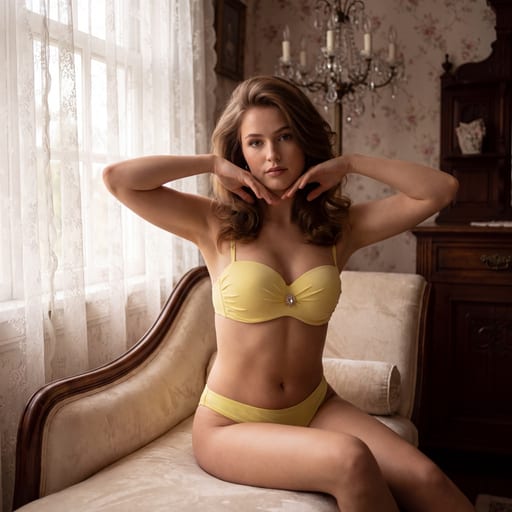
Buduar glamour
Zmysłowy glamour w klasycznym buduarze: ciepłe światło lamp, bogaty „glossy" grade obrazu i wysoka amplituda pozy budowana na relacji z meblem. Rejestr pewny siebie i zapraszający dla bielizny zmysłowej — z własnym, spójnym wnętrzem w komplecie.
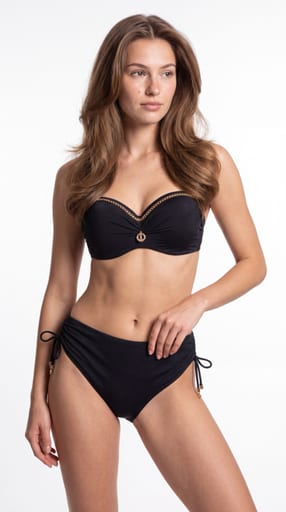
Czysty fason PDP
Czysty katalogowy styl PDP: modelka na jasnym neutralnym tle, kontrolowane światło, pół-statyczna poza. Fit, proporcje i konstrukcja produktu przed nastrojem — powtarzalna siatka zdjęć na kartę produktu.
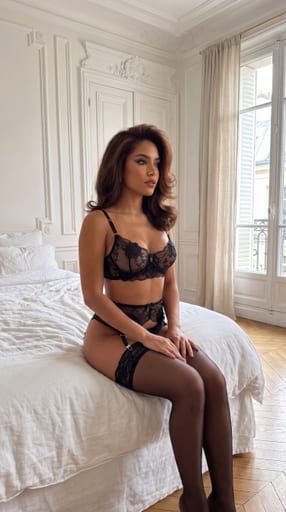
Bielizna w cichej sypialni
Spokojna, prywatna sypialnia w miękkim świetle jednego okna — rejestr quiet-luxury dla bielizny premium. Intymność bez glamouru: wyciszona poza, pozy leżące i naturalna relacja z meblem, len i blady tynk zamiast buduarowej scenografii.
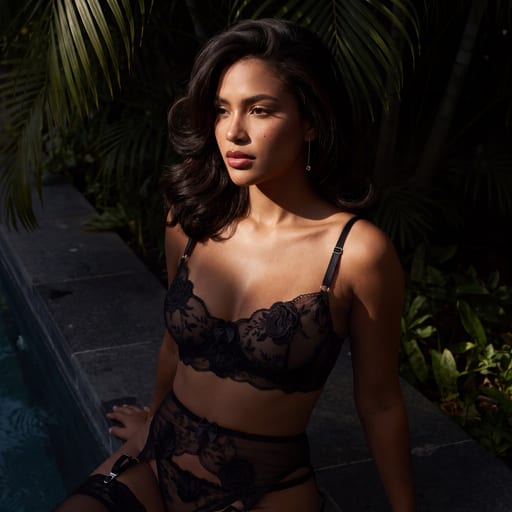
Chiaroscuro low-key
Rejestr low-key dla bielizny premium: jedno twarde kierunkowe światło, zero wypełnienia, większość kadru w głębokiej czerni. Światło wycina fragment sylwetki i wyciąga koronkę, taśmy i szwy w relief — produkt zawsze stoi w strefie światła.
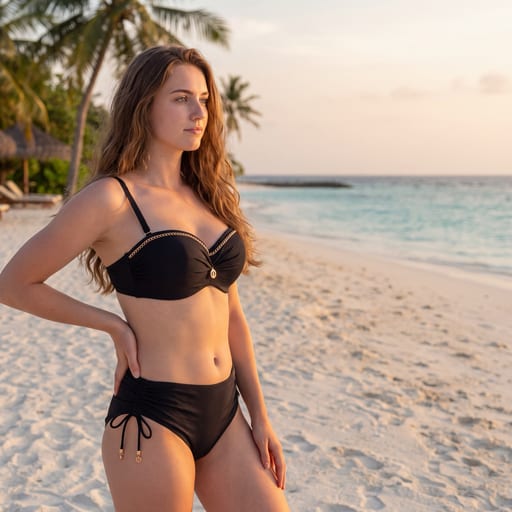
Hero z miejscem na tekst
Kadr projektowany pod layout: sylwetka po jednej stronie klatki, druga strona zostaje cicha i pusta — realne miejsce na nagłówek, CTA albo logo. Jasne, ciepłe tło studyjne, kontrolowane światło i pełna czytelność produktu w części kadru przypadającej modelce.
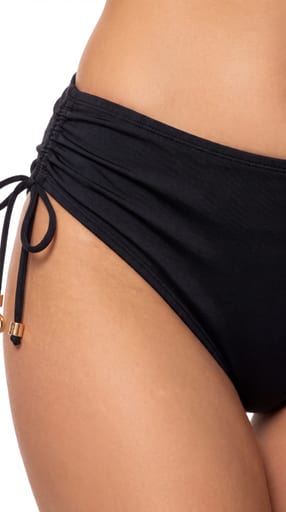
Makro detalu i konstrukcji
Studyjne makro jako dowód jakości: koronka, ścieg, fiszbina, splot, krawędź, okucie i napięcie tkaniny na ciele. Cała paczka jest warstwą detalu — 7–8 kadrów makro i półmakro plus kadry orientujące, w jednym grabiącym świetle i na jednym neutralnym tle.
Gotowy, aby rozbudować swoją bibliotekę kreacji?
Dodaj ten styl do swojego konta i zacznij tworzyć lepsze kampanie w kilka minut.