

Zdjęcia na białym tle
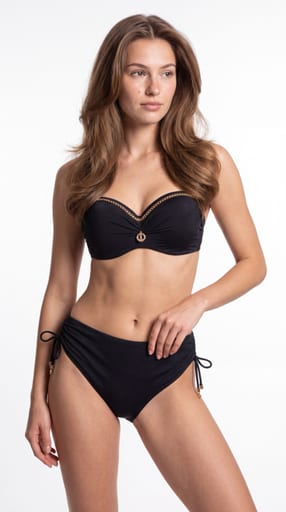
Czysty fason na białym tle: modelka na czystej bieli (#FFFFFF), płaskie, rozproszone światło bez cieni i spokojna katalogowa poza. Zdjęcie gotowe na marketplace bez poprawiania tła.
Najlepsze do
Zdjęcia produktu na modelce na białym tle: marketplace'y i karty produktu, które wymagają czystej bieli bez cieni. Bielizna i stroje kąpielowe.
Wymagania wejściowe
Wgraj packshot jednej strony produktu (przód albo tył) i wybierz modelkę. Scenerii nie wybieraj: białe studio jest częścią stylu, a wybrana sceneria przejmie tło.
Wytyczne jakościowe
## Quality guidelines ### Style core A clean, repeatable catalog register for swimwear and lingerie photographed on a model against a pure white (#FFFFFF) studio seamless — images that read like the product page of a well-run e-commerce store: the garment's fit, proportions and construction first, mood second. The world is a controlled studio: one pure white #FFFFFF seamless, one even shadowless high-key light, one pinned focal length, a composed semi-static model whose body serves the garment. This is decidedly NOT a campaign, NOT an editorial and NOT a lifestyle frame — no worked fashion drama, no narrative, no styled set. The register is quiet, orderly and product-true: a calm, confident person presenting a garment so a customer can judge cut, fit and fabric at a glance. Premium here comes from precision, consistency and true color — never from expression amplitude, props or grading. - Commerciality level: `catalog` — readable, safe, product-first, PDP-grade - Dominant character: controlled, orderly, neutral, bright, repeatable, product-true - Image priority: the product leads every frame; the body supports and presents it, the face stays calm and secondary - Directional references: marketplace on-model listings on a pure white background, top-tier e-commerce product pages (clean studio on-model catalog), modern lingerie/swim PDP photography with consistent framing across a whole category grid - Style-anchoring words: fit-first catalog, pure white #FFFFFF seamless, shadowless high-key light, controlled semi-static pose, true product color, repeatable across the grid ### Product role in frame The product (swimwear / lingerie) is the hero of every frame and the reason the frame exists. Fit is the subject: how the garment sits on a real body — cut, coverage, proportions, strap placement, fabric tension, edges, closures. The body is the mannequin that makes fit readable, never a competing subject. Hands, hair and pose stay clear of the garment: nothing covers a cup, a waistband, a strap line or a construction edge in the core of the pack. When the garment's own hue sits close to the model's skin tone (nude, blush, ivory, tan), the light and the grade must preserve the edge between fabric and skin — the outline of every strap, band, cup and hem stays visible; the garment never dissolves into the body. The session photographs the one side of the product supplied in the input: when the input shows the back of the garment, the model is posed from behind and the back becomes the readable subject of the whole pack. - Product role: hero — the garment is the subject; body, pose and expression exist to present it - Visibility level: fully readable in the clear majority of frames; a construction / material detail layer completes the pack; no frame drops below "instantly readable" - What the style exposes: cut and coverage on the body, true proportions, strap and band placement, fabric tension and surface, construction edges (seams, cups, closures, hems) - Skin-to-garment separation: when the garment's hue is close to the skin tone, the even light and the neutral grade keep every edge of the garment readable against the body - Acceptable obscuring: minimal — an incidental sliver of hair at a shoulder strap at most; never a hand, prop or pose over the garment in the core of the pack - Product presentation character: utilitarian-premium, precise, honest — never staged glamour, never editorial obscuring ### Light One fixed light for every frame — the marketplace white-background standard: high-key, fully diffused, shadowless studio light. Very large soft sources wrap the model evenly from the front: one large frontal source centred just above the lens axis and two equal large soft sources at the same power on both sides of the camera, plus separate backdrop lights that take the seamless to pure white. The light has no readable direction: both sides of the face and body receive the same light, neither side of the frame is brighter than the other, and nothing casts a shadow — not on the body, not on the backdrop, not on the floor. The body's volume reads only through the gentle, symmetrical tonal roll-off at its own contours. Highlights are soft and wide, with no specular hot spots or glare on skin or fabric. The light is flat by intent but never overexposes the subject: skin tones and the garment's color stay fully exposed, with texture and detail held. This is the preset's own light and applies to every session without a scenery — the intended use; a linked scenery that names a directional light, a time of day or weather leads with its light, and the even, shadow-free discipline applies on top. - Source type: studio strobes through very large diffusers — symmetrical frontal wraparound plus separate backdrop lights - Direction: none readable — frontal and symmetrical; never a side key, never light coming from the left or from the right - Hardness: maximally soft; no shadow edge anywhere in the frame - Light-to-shadow contrast: low — even illumination across the whole figure and garment - Role of fill: equal to the front light on both sides — nothing in the frame falls into shadow - Shadow quality: none cast — no shadow on the backdrop or the floor, no shadow at the side of the body beyond the natural contour roll-off - Highlights: soft and wide; no specular hot spots, shine or glare (a property of the light — the skin itself still comes from the card) - Color temperature: neutral daylight-balanced studio light; accurate skin tones and, above all, accurate garment color - What the light should model: the garment's surface, color and construction evenly; the body's volume only through the natural contour roll-off - Carry the light into `Lighting` as its own value, identical on every frame: "High-key, fully diffused, shadowless frontal studio light from very large soft sources placed symmetrically around the camera; both sides of the face and body equally lit; no directional key light, no side light; separate backdrop lights keep the background pure white." Carry into `Light_Description`, identical on every frame: "Even, soft, shadowless high-key light; soft wide highlights with no hot spots or glare; true garment color." ### Color and tonality Neutral, bright, marketplace-true tonality whose one job is color fidelity on a pure white ground: the garment's own hue is the most protected value in the frame. The background is ONE value — pure white, sRGB #FFFFFF (RGB 255/255/255) — evenly lit from edge to edge: no gradient, no falloff, no vignette, no grey or off-white areas, no visible floor line or horizon, no shadow. Whites clean and neutral; blacks deep but honest; saturation natural and true — nothing muted, nothing pushed; contrast low and clean. No tint, no creative grade, no film character: the tonality must be invisible so the product's color is exact. - Palette: real skin + true product color + the pure white #FFFFFF background; the product is the only strong hue in the frame - Background tone (closed axis): pure white #FFFFFF, one value from edge to edge in every frame — never light grey, never off-white, never cream, never cool-blue, never a gradient - White balance: neutral daylight; the white background renders neutral white, never warm-cream, never icy - Saturation: natural, true-to-product; no muting, no boosting - Contrast: low — even, clean, readable - Exposure: the backdrop is lit about one stop above the model so it renders pure white, while skin and garment stay correctly exposed with texture and detail held - Highlights character: soft, wide, controlled — nothing blown on skin or garment - Shadows character: none cast; only the soft natural roll-off at the body's contours - Blacks: honest and readable — dark garments keep their internal detail - Whites: clean and neutral — a white garment separates from the white background through its own edges, seams, texture and the soft contour roll-off, never by greying the background - Overall tonal character: bright, neutral, marketplace-clean; deliberately invisible - Faithfulness of the product's own hue takes precedence over everything else in this section; the grade never recolours a linked scenery - Carry the background into `Location` as its own value, identical on every frame: "Pure white seamless studio background (#FFFFFF), evenly lit from edge to edge; no gradient, no vignette, no floor line, no shadow." ### Lens and perspective feel One pinned focal length: ~85mm in feel, fixed for the whole session and written identically on EVERY frame, so facial geometry, body proportions and garment proportions stay constant across the pack — proportions are catalog data here, and a focal drift falsifies them. Aperture / depth of field is a closed axis resolved once for the whole session: one moderately deep value (~f/8 in feel), so the entire garment is tack-sharp from strap to hem in every frame; the seamless needs no melting, and fabric microtexture stays legible. Camera at eye level as the near-exclusive base — the catalog register reads straight and honest; no dramatic angles. Distance medium to medium-far so the framed portion of the body and garment reads completely, closer for the construction detail layer — all at the same 85mm. - Focal length: PIN ~85mm in feel — one single value for the entire session, no ranges (never write "50–85mm in feel"); never taken from the scenery - Aperture / depth of field: ONE moderately deep value (~f/8 in feel) for the whole session; the full garment sharp in every frame; never sourced from the scenery - Camera distance: medium to medium-far for fit frames; close for construction details — same focal length throughout - Perspective: eye level as the standing rule; at most a barely-perceptible high or low shift when a frame needs it technically (a waistband detail, a full-length in a tight crop) — never a fashion device - Sharpness character: precise and clean across the whole garment; real photographic sharpness, not synthetic over-crispness - Gear character: a full-frame camera with a short-portrait prime lens, controlled studio strobes — a working e-commerce studio, rendered true-to-life - Aspect ratio: no rigid requirement; the prompter picks (product pages usually 2:3 / 4:5); the format should frame the garment with modest, even margins ### Composition language Centered, orderly, repeatable composition — the grid logic of a product page. The figure sits centrally (or minimally offset for balance), upright, with even margins; the framing of comparable frames repeats across the pack so a category grid built from this session looks uniform. One plane: the figure against the pure white seamless; separation comes from the tonal difference between skin/garment and the #FFFFFF background, never from a shadow. Negative space modest and even — breathing room around the garment, not designed copy space. No layered depth, no foreground elements, no environmental framing. Symmetry welcome; asymmetry only as a small, controlled balance shift. - Frame type: leads with 3/4-length and full-silhouette frames (fit on the body is the subject), a bust/waist-up share where the product sits high on the body, plus a construction/material detail layer - Object placement: centered or minimally offset; upright; even margins; repeatable across the pack - Negative space: modest and even — clean margins, not a reserved layout zone - Symmetry: welcome; the register is orderly, not dynamic - Open / closed composition: closed as the rule — the figure composed fully inside the frame; open framing only where a crop naturally cuts the figure (waist-up frames) - Number of planes: one — figure on seamless; no foreground, no layered depth - Separation from background: tonal separation from the pure white seamless; never a cast shadow, never a rim-light effect, never background recoloring - Room for copy: not a goal of this style; margins stay modest and even - Overall composition character: catalog grid — centered, orderly, repeatable ### Pose language Posing is controlled, semi-static and product-serving — the model presents the garment the way a professional fit model does: upright, composed, weight settled, with small natural adjustments that keep the frame alive without ever costing readability. Arms and hands stay clear of the garment — resting at the sides, lightly touching the hip below the product zone, or softly bent — never crossing the torso, never covering a cup, strap, waistband or closure. Expression is calm, pleasant and neutral-confident: composed, at ease, believable — never a worked fashion attitude, never smized glamour, never sweetness played to the camera. The face supports trust in the product; it never competes with it. The body's line is natural and honest: no sculptural elongation, no exaggerated contrapposto, no editorial tension — a true-to-life stance from which fit can be judged. When the input shows the back of the garment, the same composed, product-serving stance reads from behind. - Expression: calm, composed, pleasantly neutral, confident; reads whenever the face is visible; never worked, never coy, never dramatic - Pose dynamics: semi-static — set stances with small natural adjustments (a settled weight shift, a relaxed hand); no motion devices - Body openness: open and honest — the body squared or gently angled to the camera so the loaded side of the garment reads fully - Line tension: low and natural — upright posture, relaxed shoulders; no elongation overload - Posing character: fit-model `catalog` — professional, composed, product-serving - Eye contact: mixed — a calm direct gaze or a soft off-camera glance; both quiet - Spontaneity level: controlled — every stance is set; small natural micro-adjustments keep it from reading stiff - Body-to-product relationship: the body serves the product in every frame — stance and hands are chosen so the garment reads first ### Movement and physics The style is static by design. No walking, no jumping, no hair flips, no flowing-fabric devices — movement adds nothing to fit readability and costs repeatability. At most a small, natural micro-adjustment between stances (a settled weight shift, a hand coming to rest). Everything is frozen and sharp; no motion blur anywhere, least of all on the product. Hair sits naturally and stays clear of the garment — over the shoulder away from straps when the product sits high on the body. Fabric behaves under real gravity: the garment sits as it truly sits, with no artificial wind, no tucked-and-clipped styling illusions and no invented tension. - Static vs movement: static — set stances, micro-adjustments only - Frozen vs blur: fully frozen and sharp; no motion blur - Hair/body: natural, settled, kept clear of the garment's readable zones - Elements: none — no wind, no water, no environmental devices ### Relation to scenery The style's world is a pure white studio — and that world is the preset's own default, built to be used WITHOUT a scenery. The default background is the ONE pure white seamless defined in `Color and tonality` (sRGB #FFFFFF), evenly lit from edge to edge — a clean, non-narrative plane on which the garment and the body read instantly, ready for a marketplace listing with no retouching of the background. A linked scenery owns the location and backdrop when the user supplies one; the even, shadow-free light discipline and the catalog discipline (product-first framing, composed pose) then apply on top. This style's business value is the uniform white-background product grid; a scenery works against it. - Relationship to space: a pure white studio plane by default; a linked scenery leads the location when supplied - Scene depth: flat — one plane, no falloff, no layered depth - Background activity: none — the seamless is a clean, silent, pure white plane - Space scale: intimate studio; the frame is about the garment, not a space - Default background: pure white #FFFFFF — one value, not a range, not a family; used whenever no scenery is linked - The attached scenery owns the location and backdrop when linked; the preset's even, shadow-free light discipline and catalog discipline still apply on top ### Props and styling behavior The style is strictly clean — no props, no set elements, no accessories by default. Anything extra in the frame competes with the product on a page whose only job is to sell the product. No jewelry, no sunglasses, no hats, no bags; no furniture, no fabric backdrops, no plants. Footwear only when the product itself requires it contextually (a swim frame reads fine barefoot — bare feet are the default). The preset does not set the model's hair styling, make-up or skin finish — these come from the casting card (Mannequin input) and the preset must not override them; the register simply asks that hair sits settled and clear of the garment. - Accessories: none — the frame carries the product and nothing else - Props: none — no environmental or styling objects - Footwear: bare feet as the default; footwear only when the product context requires it - Hair, make-up and skin come from the card; the preset only asserts non-override (it does not smooth, restyle or beautify them) - Avoid (Prompter instruction — formulate final values positively): jewelry, eyewear, headwear, held objects, set dressing — anything that adds a second subject to a PDP frame ### Post-production and finish Finish clean, bright, exact and invisible — the image should read as a precisely executed e-commerce photograph, not as a graded creative asset. No grain (clean digital target), clarity medium-high so fabric weave, seams and edges read fully — without HDR, without sharpened "advertising" micro-contrast and without any resolution/quality tokens. Retouch minimal: natural skin texture and features preserved; the preset never smooths, "flawless-es" or beauty-glows the skin — skin character, micro-texture and imperfections come from the Mannequin/card input (non-override). No vignette. Color exact: the garment's hue as true as the file allows. - Grain: none — clean digital - Texture: real fabric and skin texture preserved and legible - Clarity: medium-high, without HDR or advertising micro-contrast - Vignette: none - Retouch: minimal — light cleanup only, never at the cost of skin or fabric texture - Skin: the preset does not specify the model's skin, make-up or hair; it only requires that the render not smooth away or override the skin realism and identity supplied by the Mannequin input - Overall finish: exact, bright, catalog-clean, deliberately invisible ### Style render properties - Render character: true-to-life photographic rendering. The frame must read as a real photograph from a working e-commerce studio — a full-frame camera, a short-portrait prime, controlled studio strobes. Carry this into `Rendering_Style` as its own value — `True-to-life photographic rendering.` — and resolve it identically on every frame. The catalog register belongs in `Session_Concept` / `Output_Goal`; `Rendering_Style` carries ONLY the photographic character, never a genre label or a quality adjective. - The garment is the subject of every frame: fully readable, perfectly exposed, its own hue exact and never falsified by grade, light or background. Nothing — hand, hair, prop, crop or shadow — covers a cup, strap, waistband, closure or construction edge in the core of the pack. - The default background (used whenever no scenery is linked) reads as ONE pure white seamless — sRGB #FFFFFF — evenly lit from edge to edge: no gradient, no vignette, no grey or off-white areas, no floor line, no shadow, and never a different value between frames. When a scenery is linked, the scenery owns the background. - Light must read as high-key, fully diffused and shadowless: frontal and symmetrical, both sides of the face and body equally lit, no readable light direction, no cast shadow on the body, backdrop or floor, soft wide highlights with no hot spots or glare. Never a side key, never light from the left or the right, never a dramatic or graphic light. The flat light never flattens the render: the skin realism supplied by the card and the garment's texture stay fully legible. - Focal length is PINNED at ~85mm in feel and aperture at ~f/8 in feel for the whole session — one value each, never a range, never taken from the scenery — so face geometry, body proportions and garment proportions stay constant and the full garment is sharp in every frame. - When the garment's hue is close to the skin tone (nude, blush, ivory, tan), the even light and the neutral grade keep every edge of the garment readable against the body — the garment never dissolves into the skin. - Pose reads composed, semi-static and product-serving — a professional fit-model stance; hands and hair stay clear of the garment's readable zones. Expression stays calm, pleasant and neutral-confident. No worked fashion drama, no motion devices. - The preset does not specify the model's skin, make-up or hair; it only requires that the render not smooth away or override the skin realism and identity supplied by the Mannequin input. - Body proportions stay true — eye-level camera, no deforming angles; proportions are catalog data. - The session photographs the one side of the product supplied in the input; the whole pack keeps that side toward the lens. - Overall the image must feel like a precise, bright, uniform product-page photograph — exact, honest and repeatable — not a campaign, not an editorial, not a lifestyle frame. ### Allowed variability Variability applies only to the open axes. What stays disciplined across frames is the preset's own DNA: the pure white #FFFFFF seamless default, the even shadowless high-key light, the pinned ~85mm focal and ~f/8 aperture, the neutral invisible grade, the composed product-serving pose register and the full-readability floor. Everything below is open. - The exact stance, weight distribution, arm position (within "clear of the garment") and small natural micro-adjustments may vary between frames. - Frame / crop may move along the catalog ladder (full silhouette ↔ 3/4-length ↔ waist-up ↔ construction detail) — always at the pinned 85mm. - Gaze may alternate between a calm direct look and a soft off-camera glance. - Head angle may vary gently (frontal, slight three-quarter) while the body keeps the loaded product side square to the lens. - The construction-detail layer may choose different construction points (strap, cup edge, waistband, closure, hem) in different frames. - Micro-framing and margins may breathe slightly, within the repeatable grid logic. - What may NOT vary: the background value, the light character and its symmetry, the focal length, the aperture, the pose register, the expression register, or the readability floor. ### Session-level consistency Across the whole pack these stay constant, because the Prompter is stateless: the same ONE pure white seamless background (#FFFFFF — never a different value between frames, never a gradient) whenever no scenery is linked, the same high-key, fully diffused, shadowless frontal light with both sides of the model equally lit — written with the same `Location`, `Lighting` and `Light_Description` values on every frame — the same neutral invisible grade, the same pinned ~85mm focal length and ~f/8 aperture on every frame, the same composed semi-static pose register with the same calm expression register, the same minimal-retouch skin realism from the card, and the same full-readability floor for the garment. The pack must read as one uninterrupted studio session photographed for one product page: ten frames that could sit in one category grid without one of them betraying a different day, light, background or camera. The pack must not mix catalog frames with campaign, editorial or lifestyle frames. ### Conflict resolution Default hierarchy, unchanged — this is a catalog preset and the default hierarchy IS its identity: 1. Product readability and fidelity: the garment fully readable, its hue exact, fit and construction legible; nothing covers it; edges hold against close-toned skin. 2. Realism and render believability: true-to-life photographic rendering, real skin from the card (non-override), true proportions at the pinned focal, believable physics. 3. Consistency of the catalog world: one background value, one light, one camera, one pose register across the pack — the grid signature. 4. Any aesthetic accent — permitted only inside the margins left by 1–3, which in this register is deliberately little. When a linked scenery's own space conflicts with the preset's default studio, the scenery wins the location (below product readability, render realism and model identity, which stay higher). The preset's pure white background and shadowless high-key light apply to every session without a scenery — the intended use; a linked scenery that names a directional light, a time of day or weather leads with its light, and the preset's even, shadow-free light discipline applies on top. A white background requested in the Idea/suggestion is this preset's own #FFFFFF — never an off-white or grey seamless. The focal and aperture pins are never overridden by the scenery — only a per-batch Idea/suggestion may move them. If a pose, crop or gesture would improve liveliness at any cost to garment readability, readability wins — in this register there is no trade the product loses.
Wytyczne ilościowe
## Quantity guidelines ### Session goal By default 10 images in the pack. Main use: product page (PDP), category grid, product-focused retargeting and fit comparison for swimwear and lingerie. The pack's goal is a uniform, repeatable catalog set of ONE loaded product side: every frame PDP-usable, shot in one light, on one background, at one focal length, so the store can drop any subset onto a product page and the grid still looks like one session. A complete front-plus-back product card is TWO sessions — one per loaded packshot side; this pack maximizes the readability of the one side it was given. ### Shot mix About 30% full silhouette (whole-garment fit and proportions), 35% 3/4-length / American frame (the fit workhorse — garment zone large in frame, body context intact), 20% waist-up / bust frames (for products sitting high on the body: bras, bikini tops — the garment zone fills the frame), 15% construction / material detail (strap, cup edge, waistband, closure, hem, fabric weave). When the loaded side is the back, the same mix reads from behind. Every frame at the pinned 85mm. ### Perspective mix Product orientation = input, not preset. The input always shows one side of the product — front or back — and that loaded side dictates whether the model faces the camera or stands with her back to it. The preset does NOT redistribute or assign sides (no "X% front / Y% back"); it takes the orientation from the input and only varies the camera setup within it. The distribution concerns the camera setup with the loaded side kept square to the lens: about 60% straight on (camera frontal to the loaded side — the PDP standard), 30% a slight 3/4 camera swing (the loaded side still fully readable — adds depth to the grid), 10% closer to profile ONLY as far as the loaded side stays fully readable (a fit-profile accent, e.g. how a one-piece sits along the torso). All at eye level; no low or high fashion angles. ### Gaze distribution About 40% calm direct gaze to camera (trust and presence — the PDP standard), 45% soft off-camera glance (quiet, natural), 15% downward or along the body (fits detail and adjustment frames). Every gaze stays quiet and composed — no worked intensity. This applies to frames where the face is visible; in detail frames the face may fall outside the crop. ### Interaction distribution About 80% neutral product-serving stance (no environment to interact with on a seamless; hands at the sides, at the hip below the product zone, or softly bent — always clear of the garment), 20% small natural self-adjustment gestures that do not touch the garment's readable zones (a hand settling at the hip, a shoulder relaxing). No environmental interaction, no props to interact with. ### Product visibility distribution About 70% garment fully readable on the body (the sales floor of this preset — the entire loaded side legible at a glance), 15% garment on the body in a slightly livelier stance (still fully readable — the "alive" frames of the grid), 15% construction / material detail (a strap, cup edge, waistband, closure or weave filling the frame). There is NO partial-obscuring share in this preset: nothing covers the garment in any frame. ### Composition openness distribution About 80% closed compositions (the figure fully composed inside the frame — the grid standard), 20% naturally open framing where the catalog crop cuts the figure (waist-up and detail frames). Openness here is a crop consequence, never a narrative device. ### Safe vs expressive ratio About 85% safe (PDP-grade, instantly readable, grid-uniform), 10% lightly expressive (a touch more life in stance or gaze — still fully readable and grid-compatible), 5% copy-ready at most (an incidentally cleaner margin a store may use for a badge — never a designed layout zone). Expression in this preset means "slightly more alive", never "editorial". ### Spatial and depth mix 100% figure (or garment detail) against the pure white #FFFFFF seamless — one plane, no falloff, no layered depth, no environmental frames. Separation comes from tonal contrast against the white, identical across the pack; no frame carries a cast shadow. When a scenery is linked, the spatial mix follows that scenery for the whole pack; the catalog discipline stays. ### Recurring motifs or accessories frequency No props and no accessories — 0/10 by design. The recurring motif is the catalog discipline itself: the pure white #FFFFFF seamless, the even shadowless high-key light, the pinned 85mm / f/8 camera, the composed product-serving stance and the fully readable garment — present in 10/10 frames. The uniformity IS the motif: this pack should be recognizable as this preset by its consistency, not by any added element. ### Energy mix About 65% calm (composed, settled, quiet — the register's home), 20% softly warm (a relaxed, pleasant presence — never played up), 10% lightly active (small natural adjustments between set stances), 5% stronger presence (a confident straight-on stance that anchors the grid). Nothing in the pack rises to campaign energy; the strength of this preset is its evenness.
Rób
Uruchamiaj bez scenerii. W sugestii opisz kadr i pozę (np. „przodem, kadr od kolan w górę”), a styl zadba o światło i tło. Zlecaj kilka zdjęć naraz i wybierz najlepsze.
Powiązane style
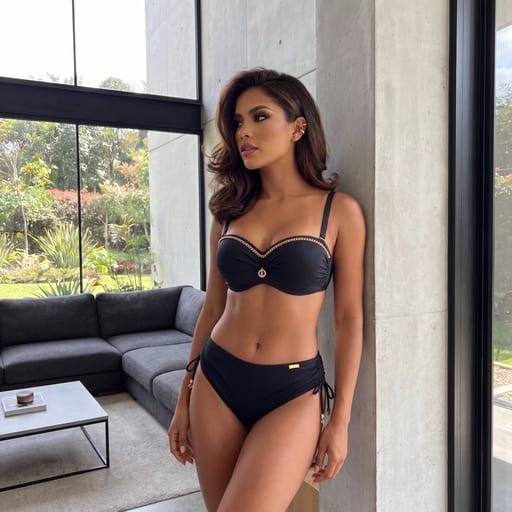
Apartment Hi-fashion Poses
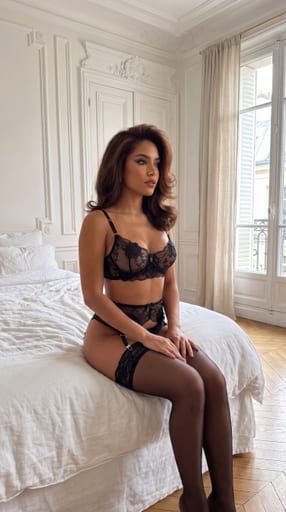
Bielizna w cichej sypialni
Spokojna, prywatna sypialnia w miękkim świetle jednego okna — rejestr quiet-luxury dla bielizny premium. Intymność bez glamouru: wyciszona poza, pozy leżące i naturalna relacja z meblem, len i blady tynk zamiast buduarowej scenografii.
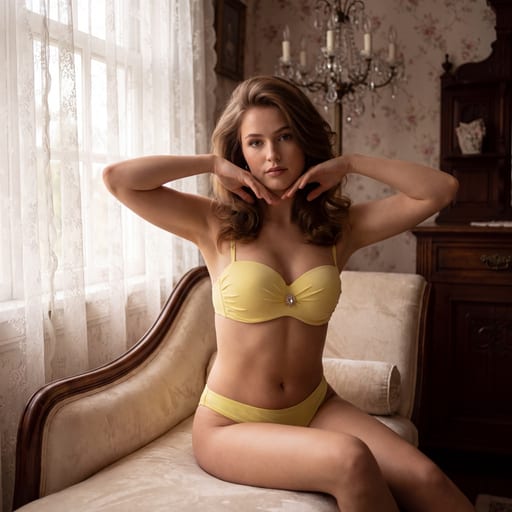
Buduar glamour
Zmysłowy glamour w klasycznym buduarze: ciepłe światło lamp, bogaty „glossy" grade obrazu i wysoka amplituda pozy budowana na relacji z meblem. Rejestr pewny siebie i zapraszający dla bielizny zmysłowej — z własnym, spójnym wnętrzem w komplecie.
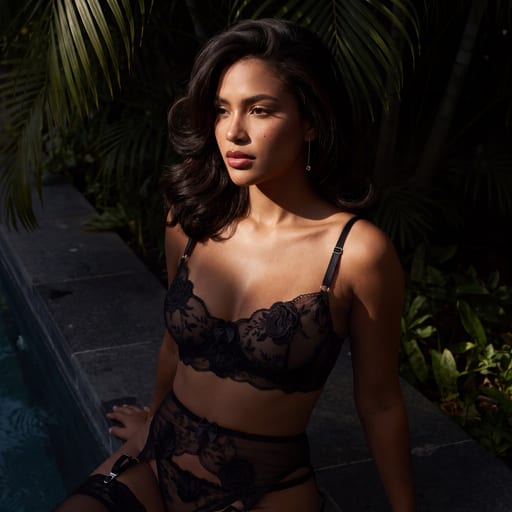
Chiaroscuro low-key
Rejestr low-key dla bielizny premium: jedno twarde kierunkowe światło, zero wypełnienia, większość kadru w głębokiej czerni. Światło wycina fragment sylwetki i wyciąga koronkę, taśmy i szwy w relief — produkt zawsze stoi w strefie światła.
Czysty fason PDP
Czysty katalogowy styl PDP: modelka na jasnym neutralnym tle, kontrolowane światło, pół-statyczna poza. Fit, proporcje i konstrukcja produktu przed nastrojem — powtarzalna siatka zdjęć na kartę produktu.
Hero z miejscem na tekst
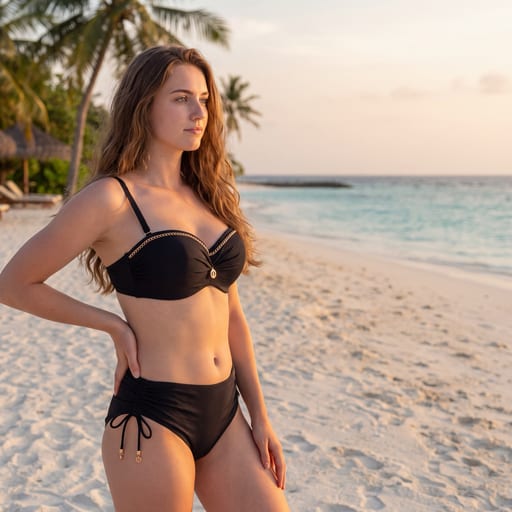
Kadr projektowany pod layout: sylwetka po jednej stronie klatki, druga strona zostaje cicha i pusta — realne miejsce na nagłówek, CTA albo logo. Jasne, ciepłe tło studyjne, kontrolowane światło i pełna czytelność produktu w części kadru przypadającej modelce.
Gotowy, aby rozbudować swoją bibliotekę kreacji?
Dodaj ten styl do swojego konta i zacznij tworzyć lepsze kampanie w kilka minut.