

Chiaroscuro low-key
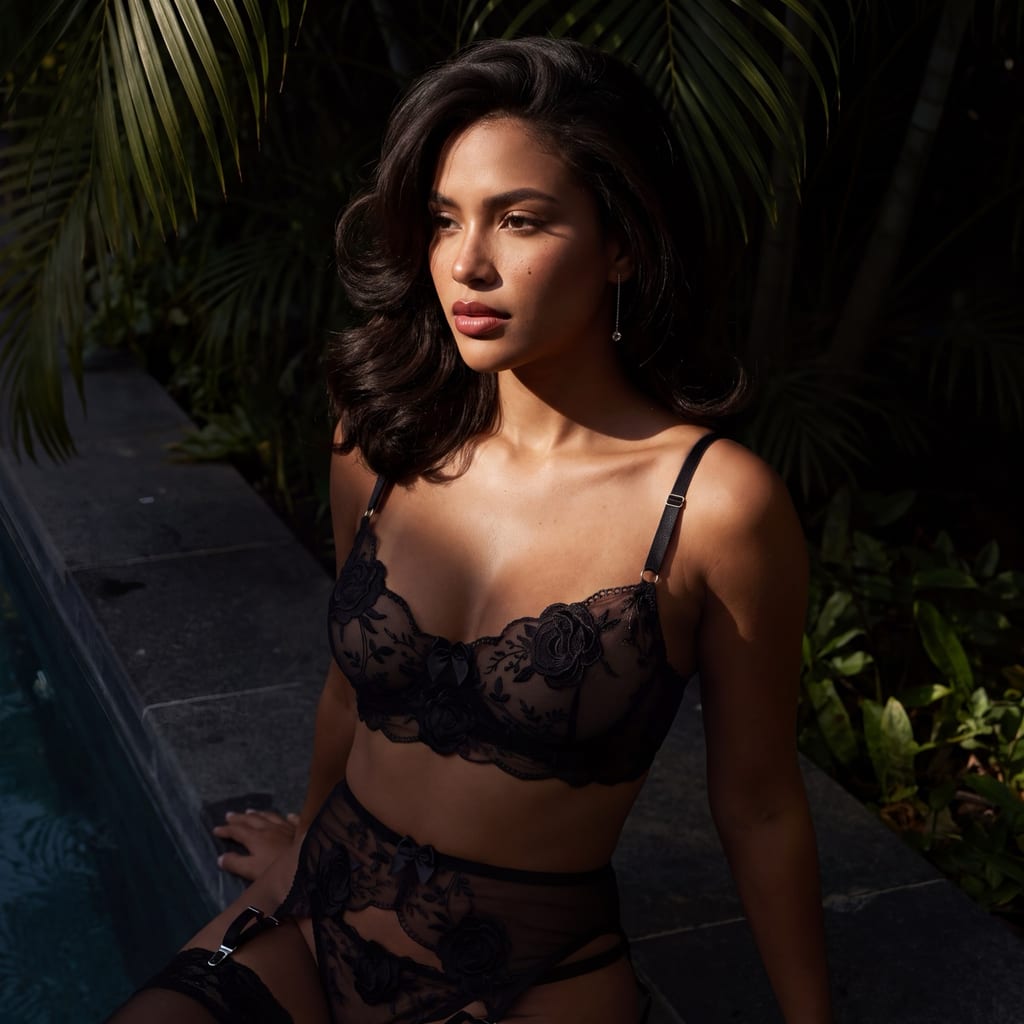
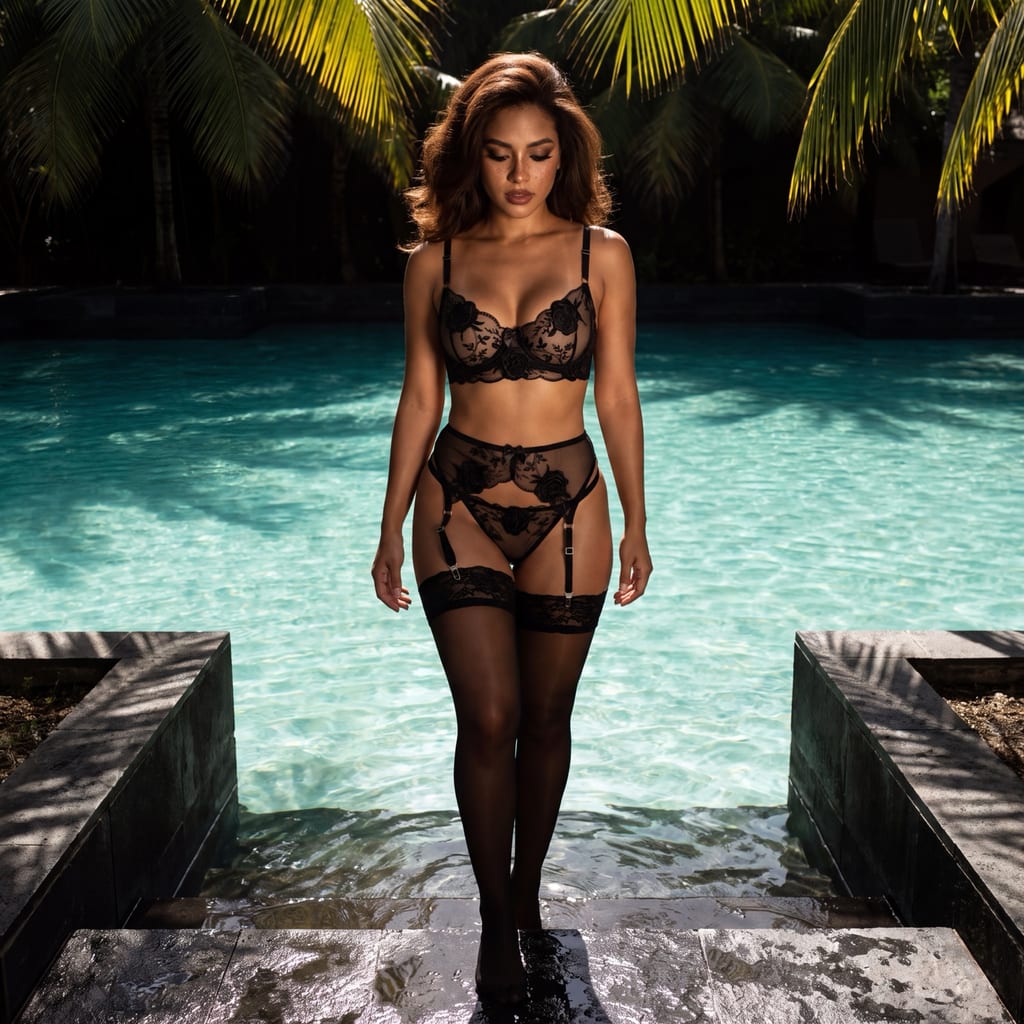
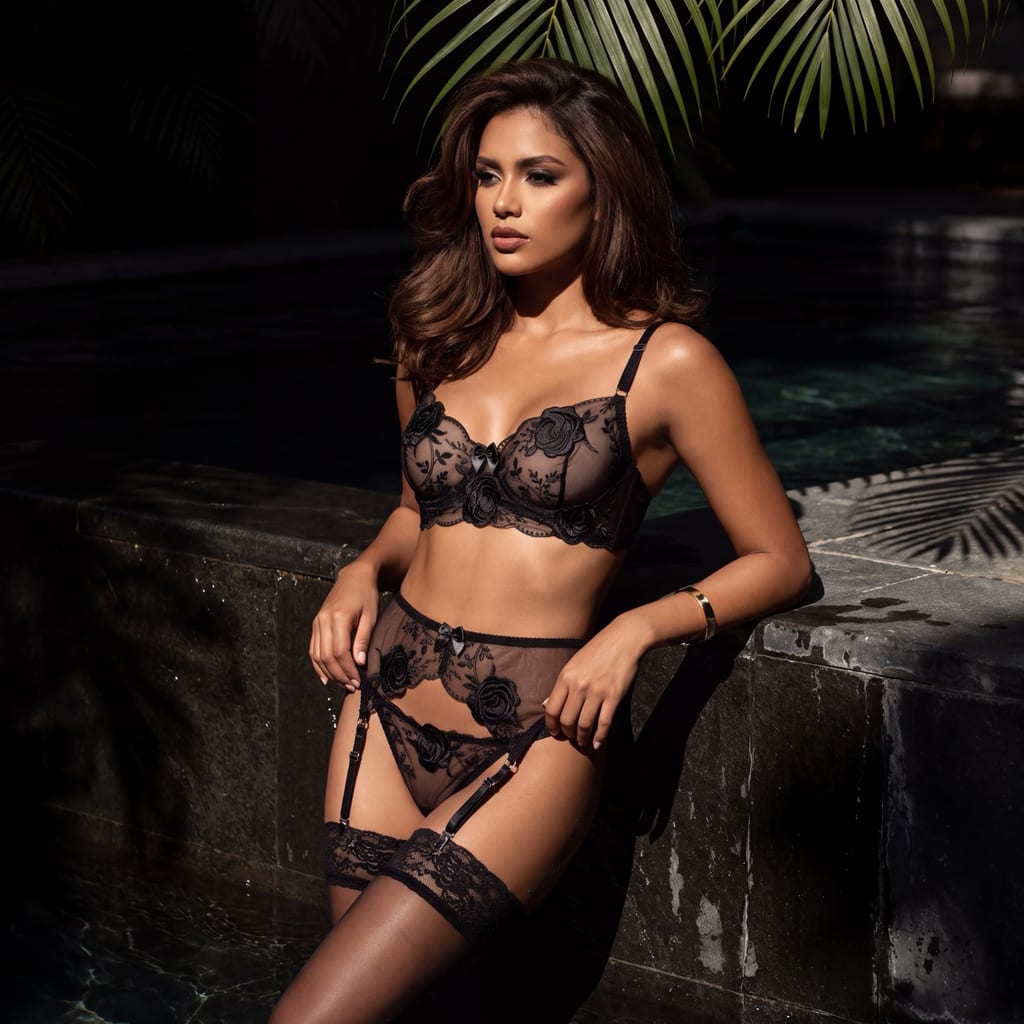
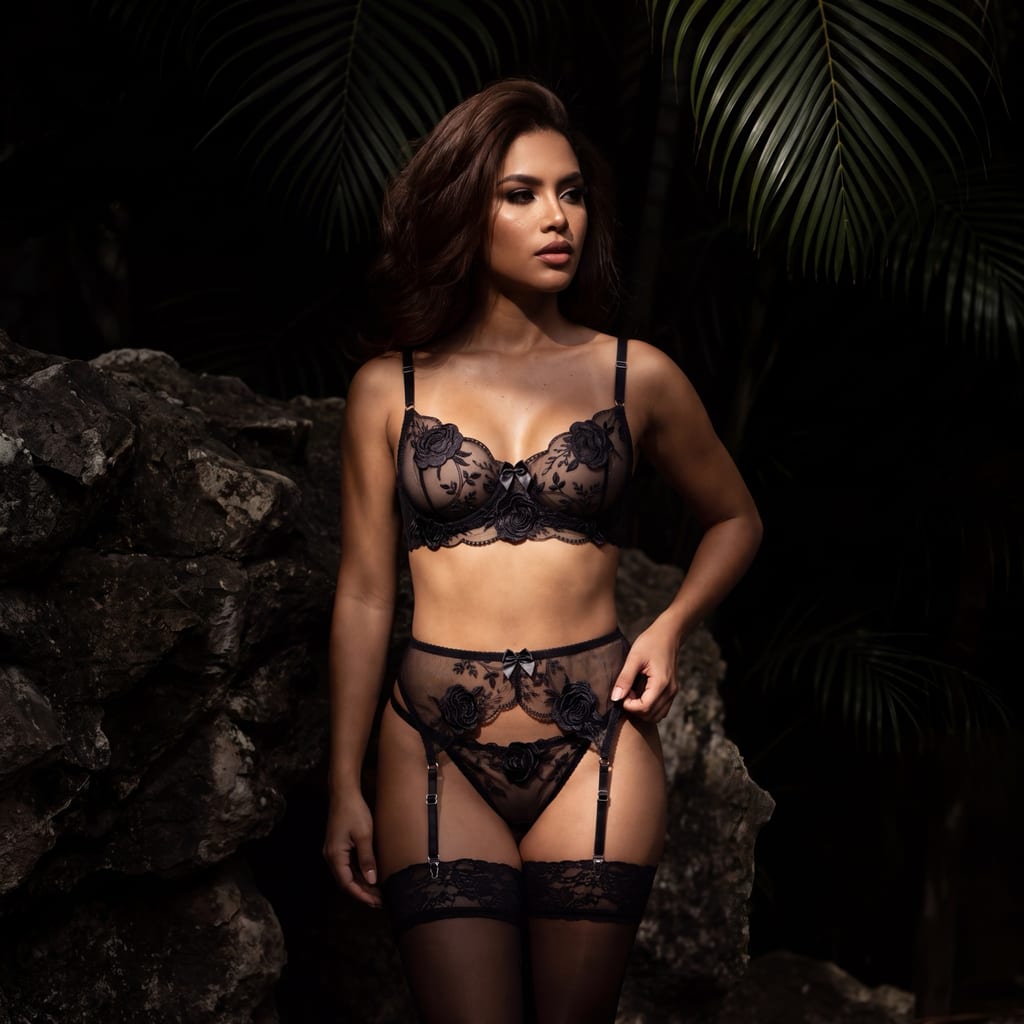
Rejestr low-key dla bielizny premium: jedno twarde kierunkowe światło, zero wypełnienia, większość kadru w głębokiej czerni. Światło wycina fragment sylwetki i wyciąga koronkę, taśmy i szwy w relief — produkt zawsze stoi w strefie światła.
Pokaż kolekcję tak, jak pokazuje ją marka we własnej kampanii: jedno twarde światło w ciemnym pokoju, reszta kadru w głębokiej czerni. Światło nie oświetla sceny — ono wybiera, co ma być widoczne, i wybiera produkt. Koronka, gumy, taśmy i szwy stają w reliefie, bo twarde źródło pada pod kątem grabiącym i rysuje każdą krawędź własnym cieniem. Dziesięć kadrów wygląda jak jedno cięcie światła obejrzane z dziesięciu stron.
Galeria
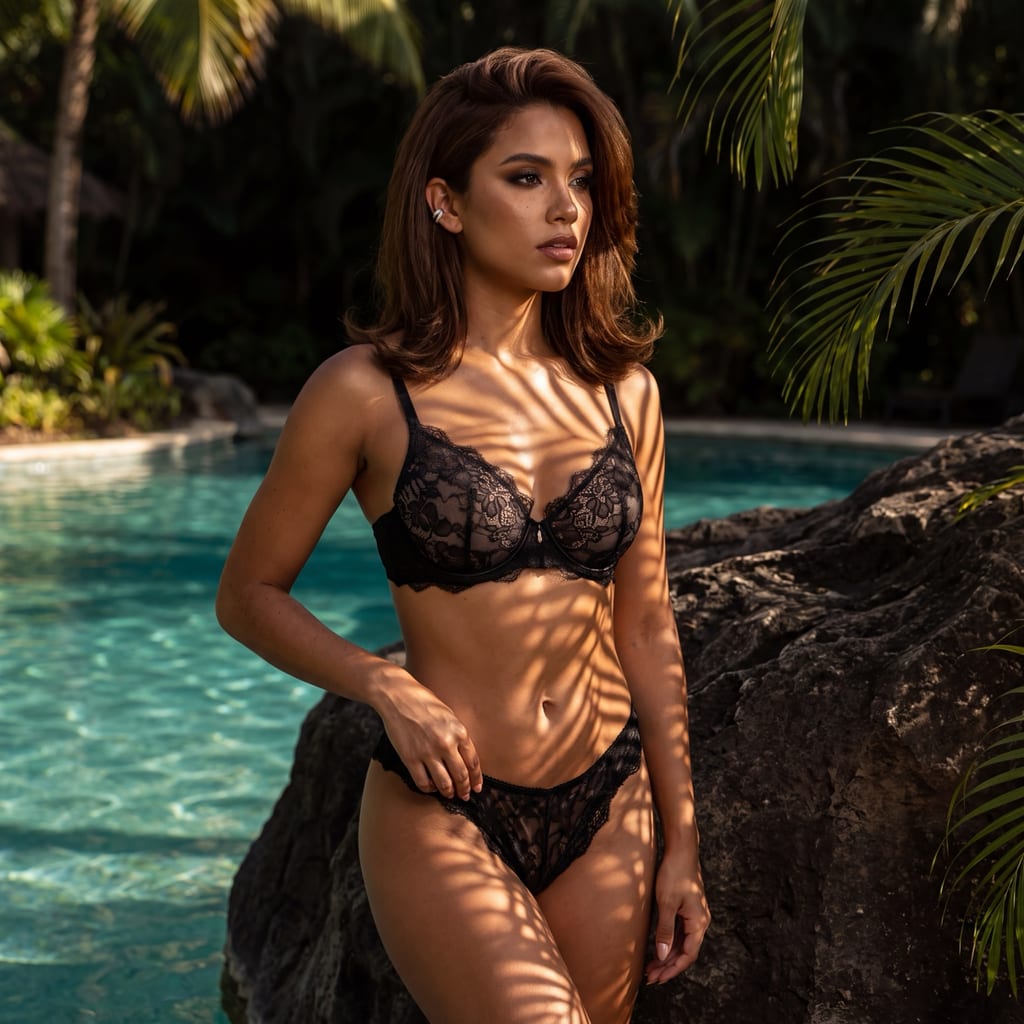
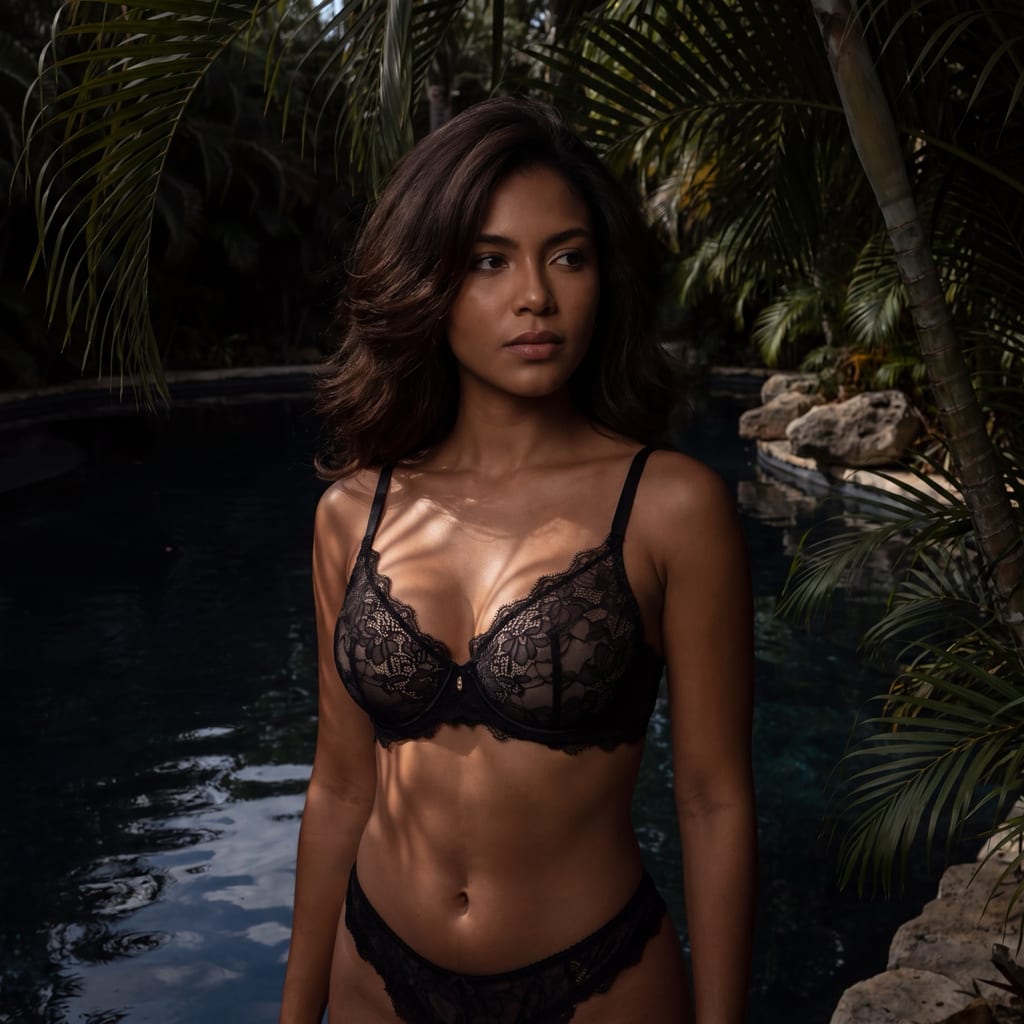
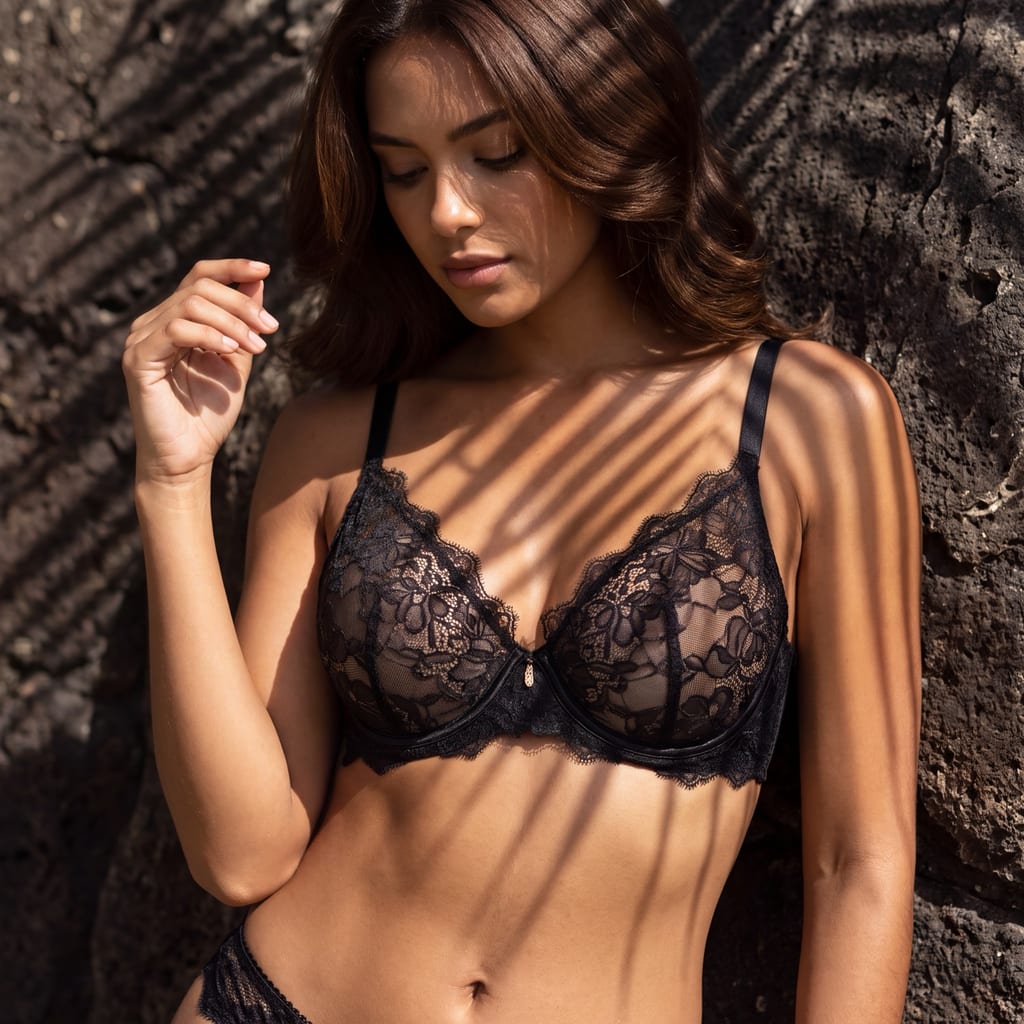
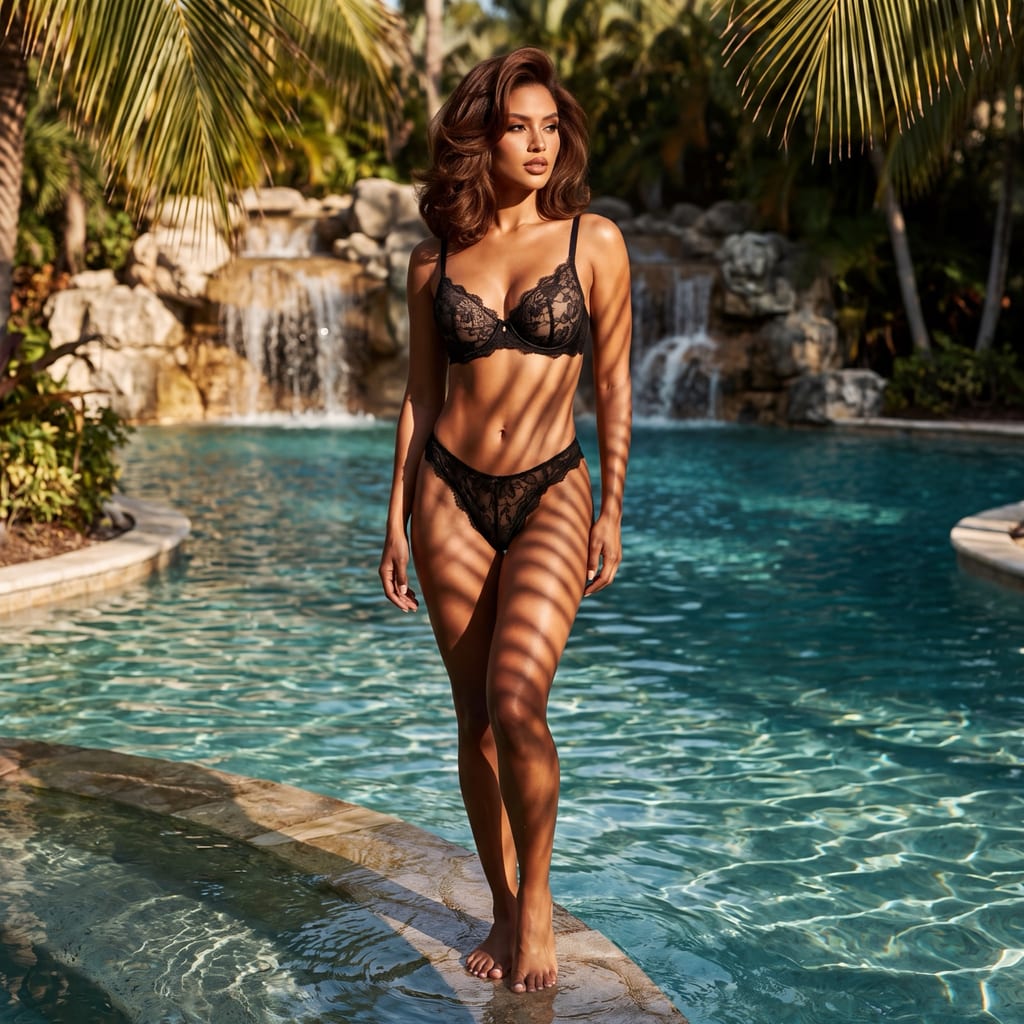
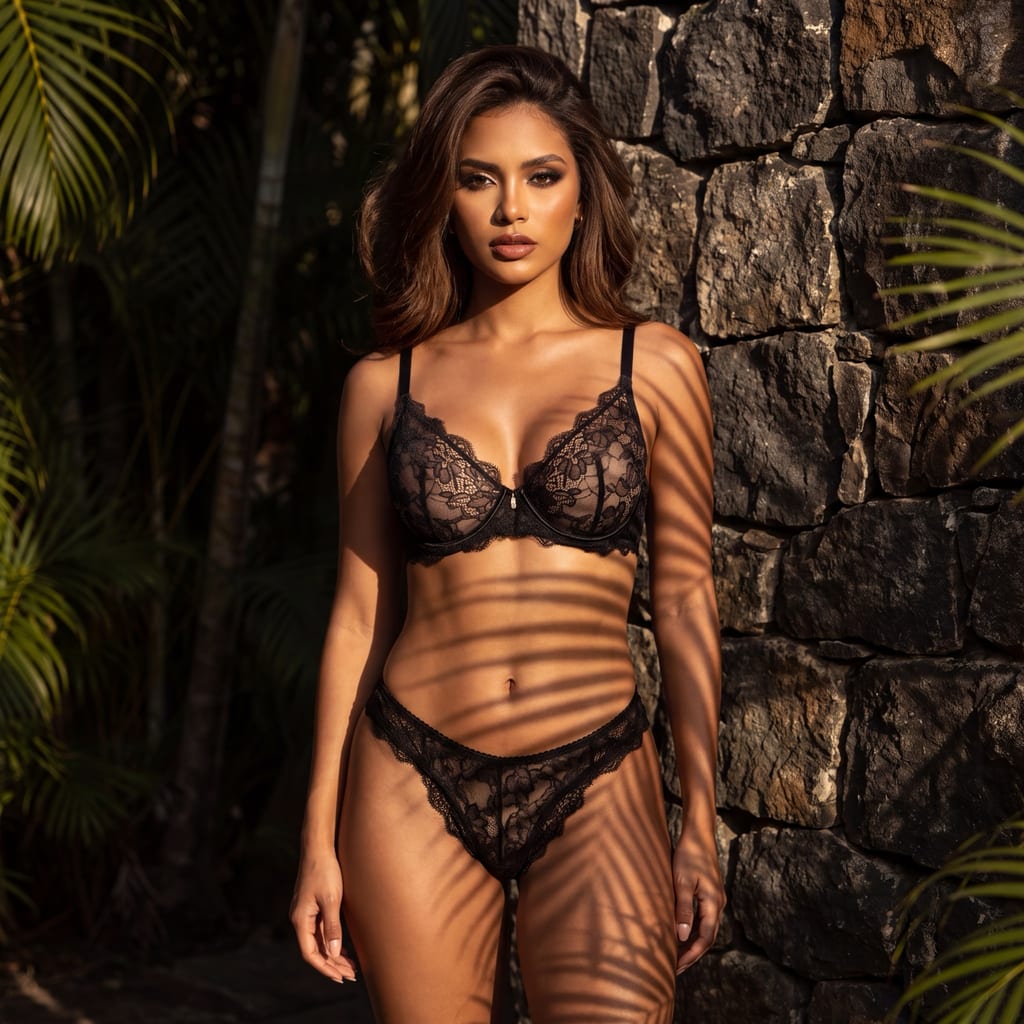
Najlepsze do
Najlepszy dla bielizny premium w rejestrze kampanijnym i brandowym — kampania, hero strony głównej, otwarcie lookbooka, materiały PR i mocne assety wizerunkowe. Szczególnie dobrze wypada tam, gdzie sprzedaje się konstrukcja: koronka, ramiączka, taśmy, gumy i wykończenia — twarde grabiące światło wyciąga je w relief mocniej niż jakiekolwiek miękkie źródło. Świadomie nie jest to styl na kartę produktu ani na siatkę kategorii.
Wymagania wejściowe
Wgraj packshot tej strony produktu, którą chcesz pokazać — sesja fotografuje jedną stronę (przód ALBO tył) i trzyma ją w świetle przez całą paczkę. Modelka jest wymagana; jej karnację, budowę i niedoskonałości skóry ustawiasz w modelce — styl ich nie nadpisuje. Sceneria nie jest potrzebna: styl ma własny domyślny ciemny, pusty pokój. Jeśli podpinasz scenerię, wybierz **wnętrze ciemne albo wieczorne** — sceneria jasna, dzienna lub plenerowa walczy z rejestrem.
Wytyczne jakościowe
## Quality guidelines ### Style core A low-key, graphic editorial register for premium lingerie photographed inside a dark, almost empty room — images that read like a brand's own campaign opener: one hard directional source cuts a slice of light across the figure, the garment's construction stands in relief inside that slice, and everything else falls to deep, unlifted black. The subject of the frame is not the room and not the pose — it is **what the light chooses to show**. Most of the frame surface carries no information at all, and that is the point: the black is the compositional material, the lit fragment is the drawing on it. The register is adult, composed and still — the body is placed into the beam and held there, not moved through it. This is decidedly NOT a catalog frame, NOT a warm evening interior and NOT a soft window-lit bedroom: there is no fill, no ambient lift, no furniture, no narrative. Sophistication here comes from restraint and from one precisely aimed instrument — never from adding light, colour or objects. - Commerciality level: `editorial` leading, with campaign usefulness — strong art direction, still built to sell a garment - Dominant character: low-key, graphic, sculptural, restrained, adult, cool-neutral, reductive - Image priority: the light leads every frame; the garment is what the light is aimed at, and the silhouette is the line it draws - Directional references: single-source chiaroscuro portraiture, a lingerie campaign opener built on one hard cut of light, graphic low-key studio work where the black field carries the composition - Style-anchoring words: one hard cut of light, unlifted black field, selective reveal, lace in relief, product always in the lit zone, held and still ### Product role in frame The product (lingerie) is the hero of the lit zone and the reason the beam is aimed where it is. **The garment is always inside the light** — in every frame, without exception. The black is the background and the material of the composition, never a veil over the product: what is lit is readable, and what the light reaches first is the garment. This is also where the hard source earns its place commercially: a small, hard instrument grazing across lace, elastic edges, straps, bands, cups and seams draws every one of them as a **relief line with its own small cast shadow**, which is a stronger read of construction than any tonal difference. When the garment's own hue sits close to the model's skin tone (nude, blush, ivory, tan), the edge therefore holds by relief rather than by brightness — the garment never dissolves into the body even inside a single narrow slice of light. When the input shows the back of the garment, the back is the readable subject and the beam is aimed at it. The presentation character is graphic, adult and composed — the product is revealed, never merely displayed. - Product role: hero inside the lit zone — the beam exists to show the garment; the silhouette line and the black field amplify it, never bury it - Visibility level: the whole loaded side of the garment inside the beam and fully readable in the core of the pack; a partial-reveal share where the beam holds a fragment of the garment; a construction/material detail layer in raking relief - What the style exposes: cut and construction (lace pattern, elastic edges, straps, bands, cups, seams, closures) drawn in relief by the grazing hard light, the fabric's surface at a grazing angle, and the line the garment builds on the body - Skin-to-garment separation: the hard grazing source draws every garment edge as its own small cast shadow, so edges hold against close-toned skin by relief, not by brightness - Acceptable obscuring: the unlit black may hide body and context freely; it may never hide the garment — in a minority of frames the reveal is partial (a cup edge, a band, a strap line), and even then the lit fragment is garment plus body line - Product presentation character: graphic, adult, composed, clearly sellable inside its register - The garment never falls into the unlit black: interior darkness is a compositional device here, never a reason to lose the product ### Light Default light — applied when no scenery is linked, or when the linked scenery does not name a directional light, a time of day or weather: ONE small, hard, off-frame source, reading as a single narrow shaft entering an otherwise dark room. It sits at **~80° azimuth off the camera–model axis, on the camera side** (the azimuth is measured from the camera–subject axis, not from the walls), with **its centre roughly 45° above the model's eye line, angled down onto her** — a high side cut. The source is small, so the shadow edge is drawn crisp with a very narrow transition and every irregularity the beam crosses casts its own hard little shadow. **There is no fill of any kind.** Nothing else in the room emits or returns light: the matte dark surfaces give back almost nothing, so everything outside the beam falls to the preset's near-black. Contrast is the highest in the library — the lit slice carries full detail, the unlit field carries none. Discipline — always, whatever the light source: ONE hard directional source, zero fill, a crisp drawn shadow edge, and an unlifted black outside the beam; this discipline applies on top of whichever source is resolved, so a linked scenery may set WHERE the light enters, and the preset keeps the single-source, no-fill, hard-edged CHARACTER. White balance follows the resolved light source; the preset's neutral-with-a-faint-cool-bias value applies only when the preset's default light is the source, and the grade never recolours a linked scenery. The beam's placement is a composition decision, not an accident: **the source is aimed, and the pose is built inside the beam, so the garment's readable zone sits in the light.** The hard shadow line MAY fall across the face and across the body as a deliberate graphic device — that is the register, and a half-lit face is on-register here — but it does not fall across the garment's readable zone in the core of the pack. The beam may also draw its own hard-edged patch on the wall plane or the floor as a second graphic element. - Source type: one small, hard, off-frame directional source; a qualifying scenery may resolve another single source (a night window, a practical), and it stays the only one - Default source direction: ~80° azimuth off the camera–model axis, on the camera side — applied when no scenery is linked, or when the linked scenery does not name a directional light, a time of day or weather - Default source elevation: centre roughly 45° above the model's eye line, angled down — a high side cut, never a low uplight - Hardness: hard; the shadow edge is drawn crisp, the transition very narrow - Role of fill: none — the room's matte dark surfaces return almost nothing, and everything outside the beam falls to the preset's near-black - Light-to-shadow contrast: very high (discipline) — full detail inside the beam, no information outside it - Shadow quality: hard, drawn, graphic; the shadow line is a compositional element in its own right and may cross the face and body - Falloff: fast and physical — the beam ends where it ends, and every surface it does not reach sits at the preset's near-black - Colour temperature: neutral with a faint cool bias; the preset's value applies only when the preset's default light is the source, otherwise white balance follows the resolved source - White balance count: exactly one per frame; no second source and no competing cast - What the light should model: first the garment's construction in relief (lace, elastic edges, straps, bands, seams), then the line of the silhouette it carves out of the black, then the surface of the wall plane where the beam lands - Light discipline (always, whatever the source): one hard directional source, zero fill, crisp drawn shadow edge, unlifted black outside the beam, garment inside the beam ### Color and tonality Cool-neutral, near-monochrome by consequence rather than by conversion: the frame holds one deep black field plus one lit slice, so the only strong hue in the image is the garment's own. **This is a full-colour low key, not a black-and-white conversion** — inside the beam, skin tone stays accurate and the garment's hue stays true; the low key never desaturates or recolours it. The default background (used only when no scenery is linked) is ONE deep near-black to which the whole unlit field resolves — sRGB **#0E0F12 ≈ CIELAB L\* 4 / a\* 0 / b\* -2** — a faintly cool, unlifted black, clearly NOT a lifted filmic grey, NOT a warm brown-black, NOT a mid grey, NOT pure `#000000` (which reads as a digital cutout rather than a photographed dark room). Whites: only the specular points inside the beam, held with detail — the hard source blows easily and the brightest point on skin or fabric stays inside its texture. Blacks: deep and unlifted, but carrying fine grain so they read as a photographed dark room. Contrast very high; saturation restrained everywhere except the garment. - Palette: black field + one lit slice; real skin and the garment's true hue are the only colour in the frame - Background tone (default, closed axis): sRGB **#0E0F12 ≈ CIELAB L\* 4 / a\* 0 / b\* -2** — one single value for the unlit field, never a family, never drifting toward a lifted grey, a warm black or an absolute `#000000` between frames - White balance: neutral with a faint cool bias; follows the resolved light source; the preset's value applies only when the preset's default light is the source; the grade never recolours a linked scenery - Saturation: restrained across the scene; the garment's own hue stays true and full inside the beam - Contrast: very high — the register's defining value - Exposure: exposed for the lit slice; the unlit field resolves to the pinned near-black - Highlights character: held with detail — the specular point on skin or fabric keeps its texture - Shadows character: there is no intermediate shadow to speak of; the transition is narrow and the fall is fast - Blacks: deep and unlifted, carrying fine grain — a photographed dark room, not a flat digital fill - Whites: none as a field; whites exist only as held speculars inside the beam - Overall tonal character: cool-neutral graphic low key, contemporary, reductive - Faithfulness of the product's own hue takes precedence over the grade; the low key darkens the scene, it never falsifies the garment's colour - Black and white: not required and not the register — the pack stays in colour ### Lens and perspective feel One pinned focal length: **~85mm in feel, fixed for the whole session and written identically on EVERY frame**, so facial geometry and the proportions of the garment stay constant across a stateless pack. The short-portrait length also does the register's own work: it compresses, it keeps the empty room out of frame without needing a wider view, and it lets the camera stand far enough back that the small hard source stays off frame. A wider length (down to ~50mm in feel) is allowed ONLY when the idea explicitly calls for a full-figure hero carved out of the black, never as a per-frame default; always resolve to ONE concrete focal value per frame, never a range (never write "50–85mm in feel"). Aperture / depth of field is a closed axis resolved once for the whole session: ONE moderately closed value (**~f/5.6 in feel**). The reasoning is specific to this preset — the background is black, so nothing needs to be melted away and shallow depth buys nothing; the aperture exists solely to hold the entire lit slice of the garment sharp from strap to hem, because relief that goes soft stops being a read of construction. Never take focal length or aperture / DoF from the scenery. Eye level is the base; a deliberate low angle is a strong accent because a figure carved from black gains monumentality from below. - Focal length: PIN ~85mm in feel — one single value for the entire session, no ranges; a wider ~50mm in feel ONLY when the idea explicitly calls for a full-figure hero, never as a per-frame default; never taken from the scenery - Aperture / depth of field: ONE moderately closed value (~f/5.6 in feel) for the whole session; the full lit slice of the garment stays sharp; never sourced from the scenery - Camera distance: medium for figure frames, close for the construction detail layer — same focal length throughout - Perspective: eye level as the base; a deliberate low angle as a strong accent (monumentality); a high angle sparingly - Sharpness character: as a real lens renders it inside the beam — the relief is carried by the light, not by sharpening - Gear character: a full-frame camera with a short-portrait prime and one hard instrument, fine film-like grain - Aspect ratio: no rigid requirement; the prompter picks (campaign/e-commerce usually 2:3 / 4:5, social 4:5 / 9:16); the format should let a large black field sit around the lit shape ### Composition language The lit shape IS the composition. The frame is built around a single bright form — a slice, a wedge, a carved edge of shoulder, hip and garment — placed against a large black field with clear geometric intent. Placement is deliberately offset far more often than centred: the figure emerges from the black at one side, the beam runs diagonally, the empty field carries the balance. Negative space is high, but it is **black material, not reserved layout space** — a headline may land on it, and that is a by-product, not the brief. One plane as the rule (the figure inside the beam, nothing behind it); a second graphic plane appears when the beam draws its own hard-edged patch on the wall plane or the floor. Separation from the background is total and tonal: a lit body against an unlifted black field is the strongest separation available, so no rim light and no shallow depth of field are used to achieve it. The frame may crop the figure with darkness rather than with the frame edge — a shoulder that simply ends in black is a legitimate, on-register crop. - Frame type: leads with portrait / bust and 3/4-length frames (the beam covers the upper body and the garment well); full silhouette carved out of black as a supporting hero share; a construction / material detail layer in raking relief - Object placement: deliberately offset as the rule, centred when the lit shape is symmetrical; always with clear geometric intent - Negative space: high, and it is black — compositional material, not a designed copy zone - Symmetry: controlled asymmetry; the lit shape usually reads as a diagonal or a vertical slice - Open / closed composition: mixed — closed frames where the black holds the figure, open frames where the lit shape runs off the frame edge - Number of planes: one as the rule (figure in the beam against black); two when the beam's own patch reads on the wall plane or floor - Separation from background: total and tonal — lit body against unlifted black; no rim light, no shallow-depth trick needed - Cropping by darkness: allowed and on-register — the figure may end in black rather than at the frame edge - Room for copy: an incidental by-product of the black field in a minority of frames; never a designed layout zone - Overall composition character: graphic, reductive, editorial, light-led ### Pose language Posing is **held, sculptural and composed** — the body is placed into the beam and holds its line there. This is the opposite of a suggested-motion register: a moving body drifts out of a narrow beam and the frame loses both the drawing and the product, so stillness here is a functional requirement, not a mood. Shapes are strong and simple, built to read as a silhouette edge against black: a turned shoulder, a lifted chin, a long diagonal through the torso, an arm framing the line of the garment, a seated line on the floor. Contact with the room is minimal because the room is nearly empty — a palm or a shoulder against the plain wall plane, a seated line on the floor — and it is structural, never domestic. Expression is composed, self-possessed and quiet: the face often reads half-lit or wholly outside the beam, and that is intended; where it reads, it is adult and unhurried rather than sweet, coy or performative. Sensuality in this register is carried by light and line, not by exposure. When the input shows the back of the garment, the same held, light-led stance reads from behind. - Expression: composed, self-possessed, quiet and adult; reads whenever the face is inside the beam; defaults away from smiling sweetness, coyness and campaign melodrama - Pose dynamics: static and held — set shapes carried for the frame, with only micro-adjustments inside the beam - Body openness: mixed — the body may turn, fold and present a profile edge, whichever keeps the garment inside the light - Line tension: medium-high and controlled — long, simple lines that read as a silhouette edge, not sculptural overload - Posing character: light-led `editorial` — the pose is designed around where the light falls, not the other way round - Contact with the room: minimal and structural — a palm or shoulder against the plain wall plane, a seated line on the floor; never a domestic action, never a narrative object - Eye contact: mixed — a quiet direct gaze when the eyes are inside the beam, otherwise off-camera into the dark or down along the body line - Spontaneity level: directed — every shape is placed; the register is precision, not a caught moment - Body-to-product relationship: the pose serves the beam and the beam serves the garment; the lit fragment is always garment plus body line ### Movement and physics The style is still. There is no walking, no jumping, no hair flip, no flowing-fabric device and no wind — indoors there is nothing to move the air, and more importantly a body in motion leaves the beam. At most a slow, contained gesture completed inside the light. Everything is frozen and sharp; motion blur has no role here, least of all on the garment. Hair sits as it sits and stays clear of the garment's lit zone; it may catch the beam as a bright edge, which is a light effect, not a styling instruction. Fabric behaves under real gravity, and where a hand or shoulder braces on the wall plane or floor the contact reads as real, load-bearing weight. - Static vs movement: static and held — set shapes, micro-adjustments only inside the beam - Frozen vs blur: fully frozen and sharp; no motion blur anywhere - Hair/body: settled and natural; hair may catch the beam as a bright edge, and stays clear of the garment's lit zone - Contact physics: load-bearing and believable where the body braces on the wall plane or floor - Elements: none — no wind, no water, no atmospheric device; any visible beam structure comes from the light itself, not from added haze ### Relation to scenery The world of this style is the light, and the room is deliberately the least interesting thing in it. Default world — applied when no scenery is linked, or when the linked scenery does not name a directional light, a time of day or weather: ONE dark, unfurnished room — a single plain matte-plaster wall plane and a matte dark floor, no window in frame, no furniture, no objects, no narrative. It is one concrete room, not a family of rooms; but because the light never reaches most of it, it reads as an undefined dark volume, and the unlit field resolves to the preset's near-black **#0E0F12 ≈ CIELAB L\* 4 / a\* 0 / b\* -2**. The scene is flat to shallow: the figure stands close to the wall plane or free in the dark, and there is no layered depth to render because there is nothing lit behind her. A linked scenery owns the location and backdrop when the user supplies one; this preset is at its best with a dark or after-dark interior scenery, or with none at all, and the low-key discipline (one hard source, zero fill, unlifted black outside the beam) applies on top of whichever source is resolved. - Relationship to space: a dark, plain, non-narrative interior — present physically, absent visually - Scene depth: flat to shallow; one plane, fast falloff, no layered depth - Background activity: none — the room carries no information outside the beam - Space scale: intimate to human (a room), never monumental - Default background: the unlit field resolves to ONE deep near-black — sRGB #0E0F12 ≈ CIELAB L\* 4 / a\* 0 / b\* -2 — one value, not a range, not a family; used only when no scenery is linked - Default world (locked): one dark, unfurnished room — a plain matte-plaster wall plane, a matte dark floor, no window in frame, no furniture, no objects; the same room for the whole pack - What the scenery brings: the place, the backdrop and — when it names a directional light, a time of day or weather — the light source. What it never brings: focal length, aperture / DoF, render character or grade; those stay preset-owned, and the low-key discipline always applies on top of whichever source is resolved ### Props and styling behavior The style supplies no objects and wants none, and the reason is mechanical rather than aesthetic: **the beam is a scarce resource.** Anything that enters it competes with the garment for the only light in the frame, and anything outside it is invisible. So the room stays empty and the frame carries the body and the product. Accessories are minimal: at most a single sculptural piece (a fine chain, one strong-lined earring) in a small minority of frames, and only where it reinforces the lit line rather than breaking it. Footwear: bare feet as the native default; a strong-lined heel only as a rare accent in full-figure frames. Accessories are a SESSION styling layer added in a minority of frames, NOT part of the base model identity — accessories baked into the model return in every frame and break the register. The preset does not set the model's hair styling, make-up or skin finish; these come from the casting card (Mannequin input) and the preset must not override them. - Props: none supplied by the preset; the default room is empty - Accessories: at most a single sculptural piece in a small minority of frames, placed to reinforce the lit line - Footwear: bare feet as the native default; a strong-lined heel as a rare accent - Accessories = session styling layer, not the model's identity — the model is a separate, clean input (frequency is set in Quantity) - Hair, make-up and skin come from the card; the preset only asserts non-override (it does not restyle or beautify them) - Avoid (Prompter instruction — formulate final values positively): objects placed inside the beam, set dressing, atmospheric haze added to make the shaft visible, anything that spends the frame's only light on something other than the garment and the silhouette ### Post-production and finish Finish is graphic and physically honest — the image should read as a real photograph of a real dark room lit by one instrument, not as a darkened version of a brighter frame. Fine, film-like grain is present and stays present **inside the black field**: this is load-bearing, because an absolutely clean black reads as a flat digital fill and instantly betrays the render, while a grained black reads as a photographed dark room. Clarity medium-high inside the beam — enough that lace, elastic edges and seams read fully — and the relief is carried by the light, not by post. No shadow lifting: the black stays where the exposure put it. No vignette as an effect; any edge darkening is the real falloff of the beam. Retouch minimal, natural texture and features preserved. Colour exact inside the beam: the garment's hue as true as the file allows. - Grain: fine and film-like, present across the frame and specifically inside the black field; not heavy, not wiped to zero - Texture: as recorded; the plaster of the wall plane shows its surface wherever the beam grazes it - Clarity: medium-high inside the beam; the relief comes from the grazing light - Vignette: none as an effect; edge darkening is the beam's real falloff - Shadow handling: no lifting — the unlit field stays at the pinned near-black - Retouch: minimal — light cleanup only, never at the cost of skin or fabric texture - Skin: the preset does not specify the model's skin, make-up or hair; it only requires that the render not smooth away or override the skin realism and identity supplied by the Mannequin input - Overall finish: graphic, restrained, physically honest low key - Avoid (Prompter instruction — formulate final values positively): tone-mapped shadow lifting, sharpened advertising micro-contrast, resolution or quality tokens — they flatten the black field and push the render toward a synthetic surface ### Style render properties - Render character: true-to-life photographic rendering. The frame must read as a real photograph taken with a real camera in a real dark room — a full-frame camera, a short-portrait prime, one hard instrument, fine film-like grain. Carry this into `Rendering_Style` as its own value — `True-to-life photographic rendering.` — and resolve it identically on every frame of the session. The style's register (low-key, graphic, editorial) belongs in `Session_Concept` and `Output_Goal`; `Rendering_Style` carries ONLY the photographic character, never a genre label, never a quality or fidelity adjective. - Light must read as ONE hard directional source with zero fill — by default a small, hard, off-frame source at ~80° azimuth off the camera–model axis, on the camera side, its centre roughly 45° above the model's eye line and angled down; the shadow edge drawn crisp with a very narrow transition; contrast very high. This single-source, no-fill, hard-edged discipline applies on top of whichever light source is resolved, and each frame resolves to exactly one white balance. - The majority of the frame surface carries no light. The unlit field reads as ONE deep near-black — sRGB #0E0F12 ≈ CIELAB L\* 4 / a\* 0 / b\* -2 — faintly cool and unlifted, never a lifted filmic grey, never a warm brown-black, never a mid grey, never an absolute `#000000` cutout, and never a different value between frames. When a scenery is linked, the scenery owns the location; the unlifted black outside the beam stays. - The garment is ALWAYS inside the lit zone — in every frame, without exception. The beam is aimed and the pose is built inside it so the garment's readable zone sits in the light; the garment never disappears into the unlit black. The black is background and compositional material, never a veil over the product. - The hard shadow line may fall across the face and across the body as a deliberate graphic device — a half-lit face is on-register — and it does not fall across the garment's readable zone in the core of the pack. - The lit fragment is always the garment plus the line of the silhouette; the light leads the reveal, and what it shows is construction and line. - The grazing hard source draws the garment's construction in relief: lace pattern, elastic edges, straps, bands, cups and seams each cast their own small hard shadow, so every edge holds against close-toned skin (nude, blush, ivory, tan) by relief rather than by brightness. - Focal length is PINNED at ~85mm in feel and aperture at ~f/5.6 in feel for the whole session — one value each, never a range, never taken from the scenery — so facial geometry and garment proportions stay constant and the whole lit slice of the garment stays sharp. - White balance is neutral with a faint cool bias and follows the resolved light source; the preset's value applies only when the preset's default light is the source. Skin tone stays accurate and the garment's own hue stays true inside the beam; the low key never desaturates or recolours the product, and the pack stays in colour rather than converting to black and white. - Fine, film-like grain is present across the frame and specifically inside the black field, so the unlit area reads as a photographed dark room rather than a flat digital fill; the black is never lifted in post. - Pose reads held, sculptural and composed — the body is placed into the beam and holds its line, with only micro-adjustments; there are no motion devices, no steps, no hair flips and no flowing fabric, because a moving body leaves the beam. - The preset does not specify the model's skin, make-up or hair; it only requires that the render not smooth away or override the skin realism and identity supplied by the Mannequin input. - The room stays plain, dark and empty: a matte-plaster wall plane and a matte dark floor, no furniture and no objects, with nothing lit behind the figure. Body proportions stay believable; a deliberate low angle is allowed as a graphic device, without deformation. - The session photographs the one side of the product supplied in the input; the whole pack keeps that side toward the lens and inside the beam. - Overall the image must feel like a single hard cut of light in a dark room — reductive, graphic and adult — not a darkened version of a brighter frame, not a warm lamp-lit evening interior, not a soft window-lit bedroom, and not a monochrome conversion. ### Allowed variability Variability applies only to the open axes. What stays disciplined across frames is the preset's own DNA: the single hard source with its pinned azimuth and elevation, the zero fill, the unlifted #0E0F12 black field, the pinned ~85mm focal and ~f/5.6 aperture, the cool-neutral grade, the grain in the black, the held pose register and the rule that the garment stands in the light. The single largest open axis is deliberately generous and carries most of the pack's variety: **which fragment of the figure and of the garment the beam reveals in a given frame.** - Which fragment the light reveals may change strongly between frames — a shoulder and cup line, a torso and band, a hip and hem, a profile edge, a lit hand along the garment — as long as the garment stays inside the beam and the lit fragment is garment plus body line. - The exact held shape, the turn of the body, the arm placement and the micro-adjustment inside the beam may vary. - Head and face angle may vary freely, including a face wholly outside the beam; model identity is carried by the Mannequin input regardless of the face angle. - Frame / crop (full silhouette ↔ 3/4-length ↔ bust/portrait ↔ construction detail) and micro-composition may change — always at the pinned 85mm. - Camera angle and height may move: eye level as the base, a deliberate low angle as a strong accent, a high angle sparingly. The source does NOT move with the camera — the instrument stays where it is and the camera works around it. - Gaze direction may change (quiet direct when the eyes are lit, off-camera into the dark, downward along the body line). - Whether the beam's own hard-edged patch reads on the wall plane or the floor is open. - Whether a single sculptural accessory appears is open (session layer, a small minority of the pack). - What may NOT vary: the black field value, the single-source no-fill light character and its geometry, the focal length, the aperture, the held pose register, or the rule that the garment stands in the light. ### Session-level consistency Across the whole pack these stay constant, because the Prompter is stateless: the same ONE hard directional source at the same azimuth and elevation with the same zero fill, the same unlifted near-black for every unlit field (**#0E0F12 ≈ CIELAB L\* 4 / a\* 0 / b\* -2** — never a different value between frames) whenever no scenery is linked, the same one dark empty room, the same cool-neutral grade with one white balance per frame, the same pinned ~85mm focal length and ~f/5.6 aperture, the same fine grain including inside the black, the same held and composed pose register, the same minimal-retouch skin realism from the card, and the same rule that the garment stands in the light. The pack must read as one session under one instrument that never moved: ten frames in which only the revealed fragment changes. It must not mix a low-key graphic frame with a filled or ambient-lit one, must not lift the black in some frames and not in others, must not swing between a hard and a soft source, and must not drift the focal length. Ten images must look like one hard cut of light explored ten times, not ten separate attempts. ### Conflict resolution Declared hierarchy shift, with a business reason: this is an editorial low-key preset whose entire value is the graphic world. Raising fill or lifting the black to make more of the garment visible would destroy the only thing the preset sells, so **the coherence of the low-key world is deliberately raised above full product readability** — but the product keeps a hard, countable floor, because it still sells lingerie. 1. Realism and render believability: a real photograph of a real dark room under one real instrument, real textured skin from the card (non-override), true proportions at the pinned focal, believable physics and load-bearing contact; the product's own hue not twisted. 2. Consistency of the low-key graphic world: one hard source at one geometry, zero fill, one unlifted black field, one grade, one camera — the series signature. 3. Product readability inside the lit zone: the garment stands in the light in 10/10 frames, and the whole loaded side reads fully in at least 55% of the pack, with a further construction-detail layer. What may be traded is the REACH of the reveal, never the presence of the garment in the light. 4. Any further graphic or expressive accent, permitted only inside the margins left by 1–3. When a linked scenery's own space conflicts with the preset's default room, the scenery wins the location (below product readability, render realism and model identity, which stay higher). The preset's default light and default black field apply for sessions without a scenery, or when the linked scenery does not name a directional light, a time of day or weather; a qualifying scenery's light leads WHERE the light comes from, and the preset's single-source, no-fill, hard-edged discipline always applies on top — a scenery may say where the light enters, never that the room is filled. The focal and aperture pins are never overridden by the scenery; only a per-batch Idea/suggestion may move them. If a composition would put the garment outside the beam, the composition gives way — the beam is re-aimed or the pose is rebuilt inside it. There is no frame in this preset in which the product is not lit. If a pose requires a surface the room does not contain, the pose gives way — the preset never invents furniture or a room feature to accommodate it.
Wytyczne ilościowe
## Quantity guidelines ### Session goal By default 10 images in the pack. Main use: campaign, hero section, brand assets, lookbook openers and PR material for premium lingerie. The pack's goal is a series that reads as one hard cut of light explored ten times inside one dark room — reductive, graphic and adult — while keeping the garment in the light in every frame and fully readable across the core of the pack. The pack photographs the one loaded side of the product supplied in the input. ### Shot mix About 30% portrait / bust (the beam across shoulders, collarbone and the upper garment — the register's most natural frame), 30% 3/4-length / American frame (garment line plus the silhouette edge carved from black), 20% full silhouette (a whole figure emerging from the black — the strongest hero shape of the pack), 20% construction or material detail (lace pattern, strap, band edge, seam or closure in raking relief). The detail share is deliberately larger than in a campaign studio pack: a small hard source grazing across lace is the strongest read of construction the library has, so the detail layer is proof of the register rather than filler. When the input shows the product's back, the same shot mix reads from behind (rear bust framing, 3/4-length back, full rear silhouette, back-construction detail). Every frame at the pinned 85mm. ### Perspective mix Product orientation = input, not preset. The input always shows one side of the product — the front or the back — and that loaded side dictates whether the model is posed facing the camera or with her back to it. The preset does NOT redistribute or assign this (no "X% front / Y% back"); it takes the orientation from the input and only varies the camera angle and height within it. The distribution concerns the camera setup with the loaded side kept to the lens and inside the beam: about 30% straight on (camera frontal to the loaded side), 30% a slight 3/4 camera swing (the loaded side still readable), 25% closer to profile (a profile edge lit against black is a signature of this register, and the loaded side stays visible), 10% a deliberate low angle (monumentality of a figure carved from black), 5% a high angle as a sparing accent. Angles do not deform proportions, rotate the silhouette so the loaded product side leaves the beam, or kill construction readability. **The source stays fixed regardless of the camera setup — the instrument does not move between frames, only the camera does.** ### Gaze distribution About 20% quiet direct gaze to camera (used where the eyes sit inside the beam — a single lit eye or the lit half of the face makes this a strong, rationed accent), 50% off-camera into the dark (the register's home — the gaze leaves the lit zone), 30% downward or along the body line. Every gaze stays composed and unhurried. This applies to frames where the face reads; in a real share of frames the face falls wholly or partly outside the beam, which is on-register and is not a gaze value — those frames read by the lit line of jaw, shoulder and garment. ### Interaction distribution About 60% no contact (the body holds its line free in the beam — the room is nearly empty and there is little to touch), 25% structural contact with the room (a palm or shoulder against the plain wall plane, a seated line on the floor), 15% a held self-contact gesture (a hand at the collarbone, an arm along the line of the garment) — always completed inside the light. There is no environmental narrative and no prop to interact with. ### Product visibility distribution About 55% the whole loaded side of the garment inside the beam and fully readable (the sales floor of this preset), 20% the garment readable with the silhouette line leading (a larger share of the body falling into black), 20% construction or material detail in raking relief, 5% partial reveal where the beam holds a fragment of the garment (a cup edge, a band, a strap line) while the rest falls to black. The garment is inside the lit zone in 10/10 frames — the partial share trades the reach of the reveal, never the presence of the product in the light, and even there the lit fragment is garment plus body line. ### Composition openness distribution About 65% closed compositions (the figure composed inside the frame, the black field holding it), 35% open compositions (the lit shape runs off the frame edge, or the figure is cropped so the beam continues past the frame). Openness here is a property of the lit shape, not a narrative device; the frame may also be closed by darkness rather than by its edge. ### Safe vs expressive ratio About 25% safe (the garment fully lit and readable — frames that can sit next to a product page without betraying the register), 65% expressive (graphic low-key frames where the reveal leads and a large share of the body sits in black), 10% copy-ready (a large unbroken black field a headline or logo can sit on — a by-product of the light, never a designed layout zone; that job belongs to the layout-first preset of this batch). Expression works through what the light chooses to show, never through losing the garment from the beam. ### Spatial and depth mix About 70% the figure against the undefined near-black field (one plane, no readable room), 20% two graphic planes where the beam's own hard-edged patch reads on the wall plane or the floor behind or beside the figure, 10% a tight detail frame where the black is total. The style has no layered depth by design — there is nothing lit behind the figure — and the separation comes from the tonal gap between the lit slice and the unlifted black, identically across the pack. ### Recurring motifs or accessories frequency No props and no props supplied by the preset. The recurring motif is the light itself: one hard directional source at one fixed azimuth and elevation + zero fill + the unlifted #0E0F12 black field + the pinned 85mm / f/5.6 camera + the garment standing in the beam — present in 10/10 frames. Deep black covering the majority of the frame surface in 10/10. A held, sculptural pose in 10/10. A readable relief of the garment's construction drawn by the grazing beam in at least 7/10. A hard shadow line falling across the face or body as a deliberate graphic device in roughly 6/10. The beam's own hard-edged patch on the wall plane or floor in roughly 2–3/10. A single sculptural accessory in at most 1–2/10 (session styling layer, never baked into the model identity). The recurring theme is the cut of light, not any added element. ### Energy mix About 40% calm (held, quiet, contemplative — the register's home), 30% sensual (composed body awareness carried by light and line rather than by exposure), 25% strong / campaign (hero graphic shapes, the boldest lit forms of the pack), 5% active (a contained held gesture — never literal motion). Even the strongest frames stay still and composed; the pack's power comes from restraint and from one precisely aimed instrument.
Wskazówki dla użytkownika
Wybierz modelkę. Wgraj packshot jednej strony produktu. Nie podpinaj scenerii albo podepnij jedną ciemną, wieczorną — tę samą na całą paczkę. Generuj 8–10 zdjęć, żeby dostać pełny zakres tego, co światło może odsłonić.
Rób
Uruchamiaj bez scenerii — ciemny, pusty pokój jest częścią stylu i domyka rejestr. Jeśli już podpinasz scenerię, wybierz jedną ciemną albo wieczorną na całą sesję. Wybieraj fasony, w których sprzedaje się konstrukcja — koronka, taśmy, gumy, szwy — bo to one najwięcej zyskują na twardym grabiącym świetle. Pozwól czerni pracować: duże puste pole kadru jest tu materiałem kompozycji i dobrze przyjmuje nagłówek. Konkretny kadr albo fragment do odsłonięcia wpisz w sugestiach sesji — sugestie są nadrzędne. Generuj 8–10 zdjęć naraz.
Nie rób
Nie oczekuj równomiernie oświetlonego kadru — brak wypełnienia i czerń w większości kadru są tu sygnaturą, nie błędem. Nie licz na czytelne wnętrze: pokój świadomie zostaje niewidoczny, a jedynym rekwizytem jest światło. Nie używaj tego stylu do karty produktu ani siatki kategorii — na to są style katalogowe. Nie mieszaj w jednej paczce kadrów low-key z jasnymi ani nie podpinaj scenerii dziennej czy plenerowej. Nie oczekuj przodu i tyłu z jednej sesji — strona produktu idzie z wgranego packshotu. Nie generuj bez modelki.
Powiązane style
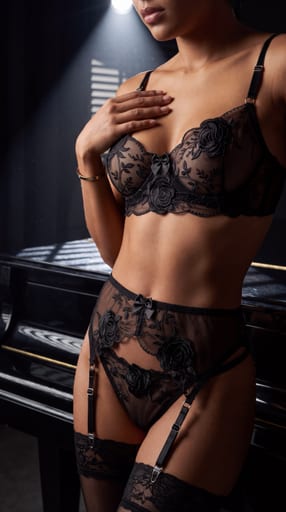
Nokturn z fortepianem
Elegancki apartament hotelowy po zmroku: jedna ciepła lampa jako jedyne światło, głęboka ciepła czerń w głębi pokoju i fortepian, o który modelka się opiera, a którego lakier oddaje sylwetkę. Wieczorny, dorosły rejestr dla bielizny premium i kompletów wieczorowych.
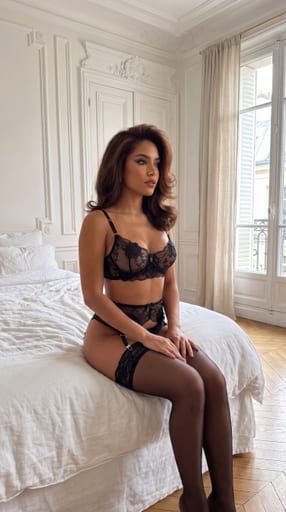
Bielizna w cichej sypialni
Spokojna, prywatna sypialnia w miękkim świetle jednego okna — rejestr quiet-luxury dla bielizny premium. Intymność bez glamouru: wyciszona poza, pozy leżące i naturalna relacja z meblem, len i blady tynk zamiast buduarowej scenografii.
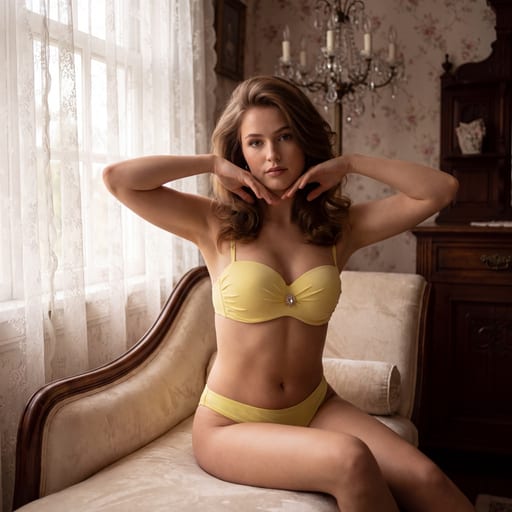
Buduar glamour
Zmysłowy glamour w klasycznym buduarze: ciepłe światło lamp, bogaty „glossy" grade obrazu i wysoka amplituda pozy budowana na relacji z meblem. Rejestr pewny siebie i zapraszający dla bielizny zmysłowej — z własnym, spójnym wnętrzem w komplecie.
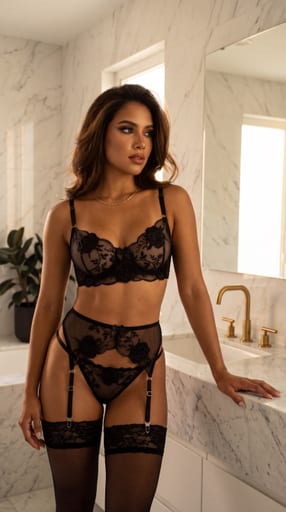
Marmurowa łazienka
Jasna łazienka premium jako świat sesji: marmur, kafel, chrom i duże lustro oddają światło, więc kadr jest wysokim kluczem z trzymanymi refleksami. Lustro pracuje jako element kompozycji, satyna pokazuje, jak układa się w świetle odbitym, a produkt zostaje czytelny w każdym kadrze.
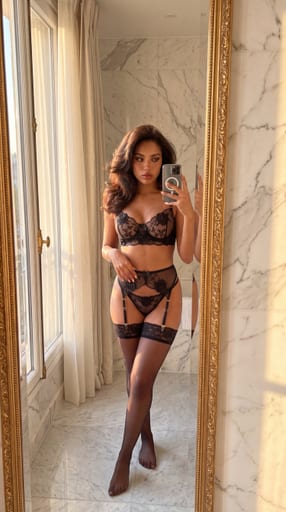
Natywny social w lustrze
Natywne treści social: pionowy kadr 4:5, lustro, telefon w dłoni i światło zastane prywatnego wnętrza. Zdjęcia wyglądają jak zrobione przez samą modelkę — ale są ostre, prawidłowo naświetlone i pełnowymiarowe, bez fejkowych artefaktów telefonu.
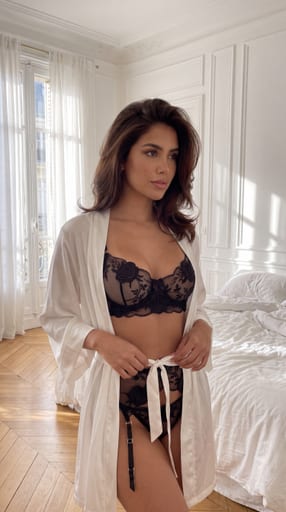
Poranek panny młodej
Jasny, romantyczny styl ślubny: poranek panny młodej w jasnym pokoju przygotowań, w miękkim świetle jednego okna. Wysoki klucz i kremowe biele — zawsze z trzymanym detalem, żeby biała koronka na białym tle wciąż czytała się krawędzią i fakturą.
Gotowy, aby rozbudować swoją bibliotekę kreacji?
Dodaj ten styl do swojego konta i zacznij tworzyć lepsze kampanie w kilka minut.