

Poranek w domu
Poranek w domu dla sleepwearu i loungewearu: jeden jasny, ciepły salon, miękkie światło z okna i produkt noszony tak, jak nosi się go naprawdę — przy kawie, w podkulonych nogach na sofie, w kroku przez pokój. Rejestr codziennego komfortu, nie intymności.
Pokaż odzież domową w jej naturalnym środowisku — w jasnym, ciepłym mieszkaniu, w miękkim porannym świetle z okna. Ten styl nie robi kampanii ani buduaru: robi zwykły poranek, w którym piżama, szlafrok albo komplet dresowy wygląda dokładnie tak, jak będzie wyglądał u klientki. Dziesięć kadrów, jeden pokój, jedno światło — paczka czyta się jak jeden realny dzień.
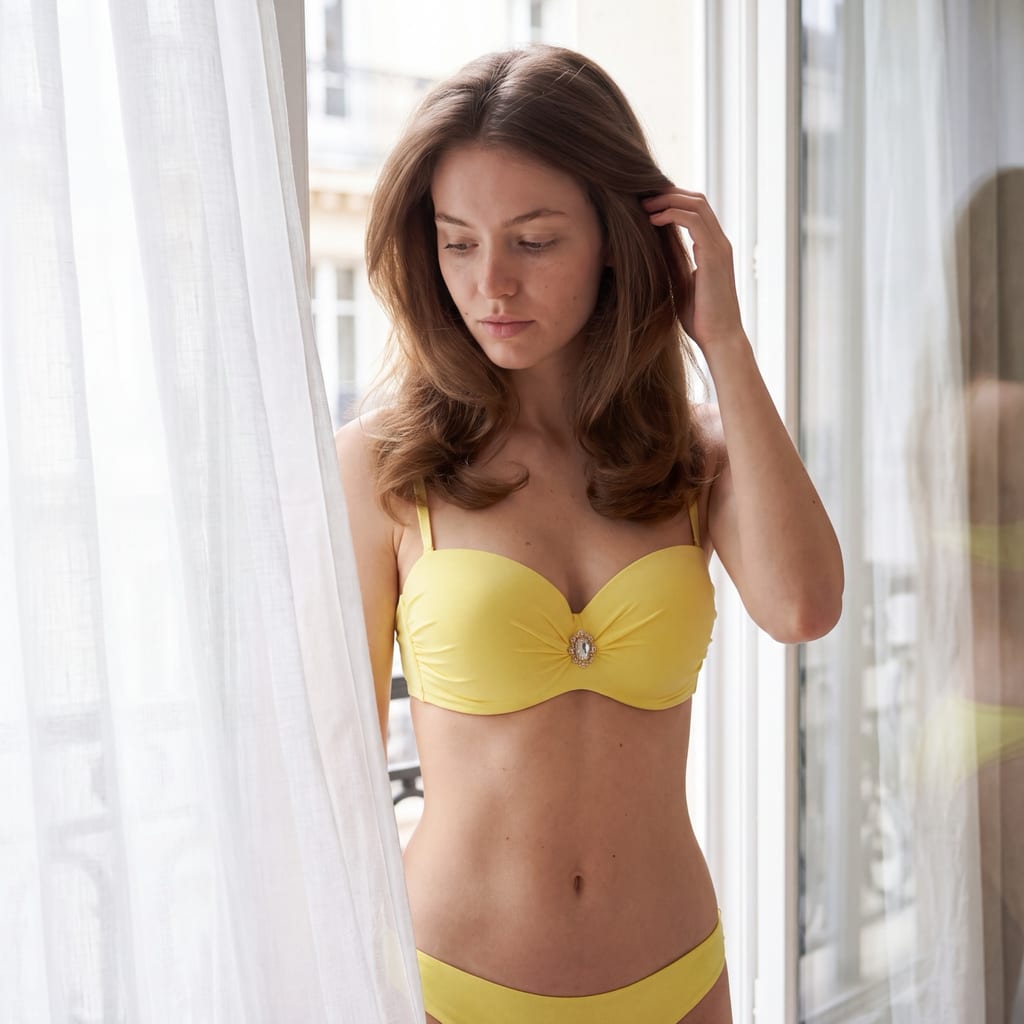
Galeria
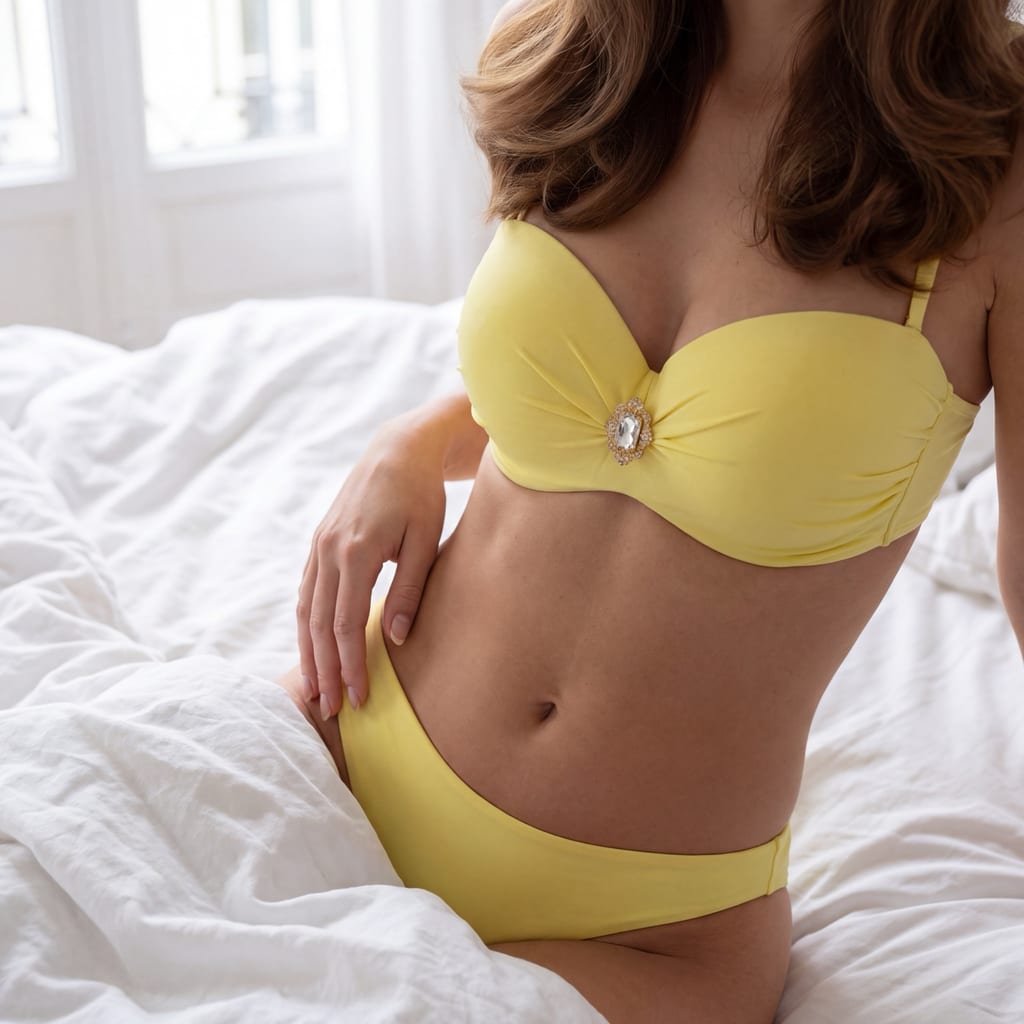
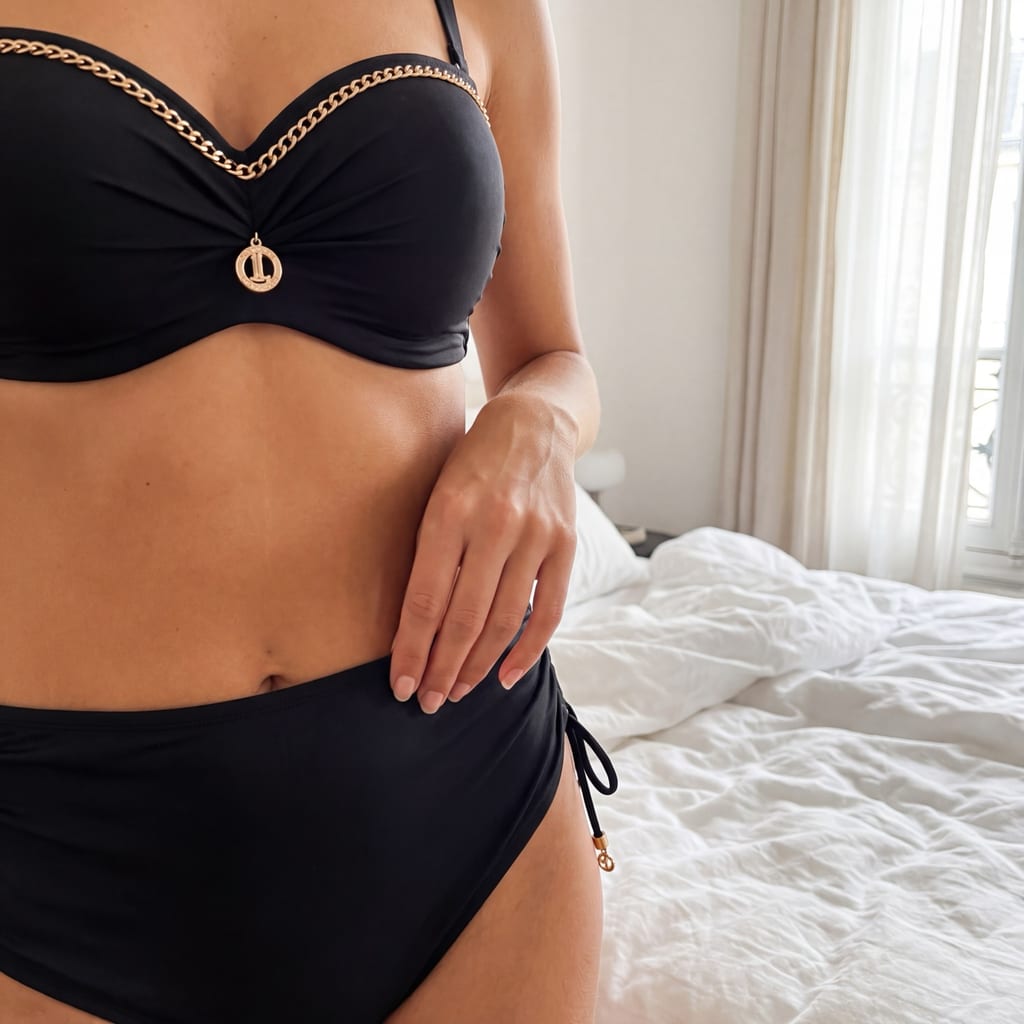
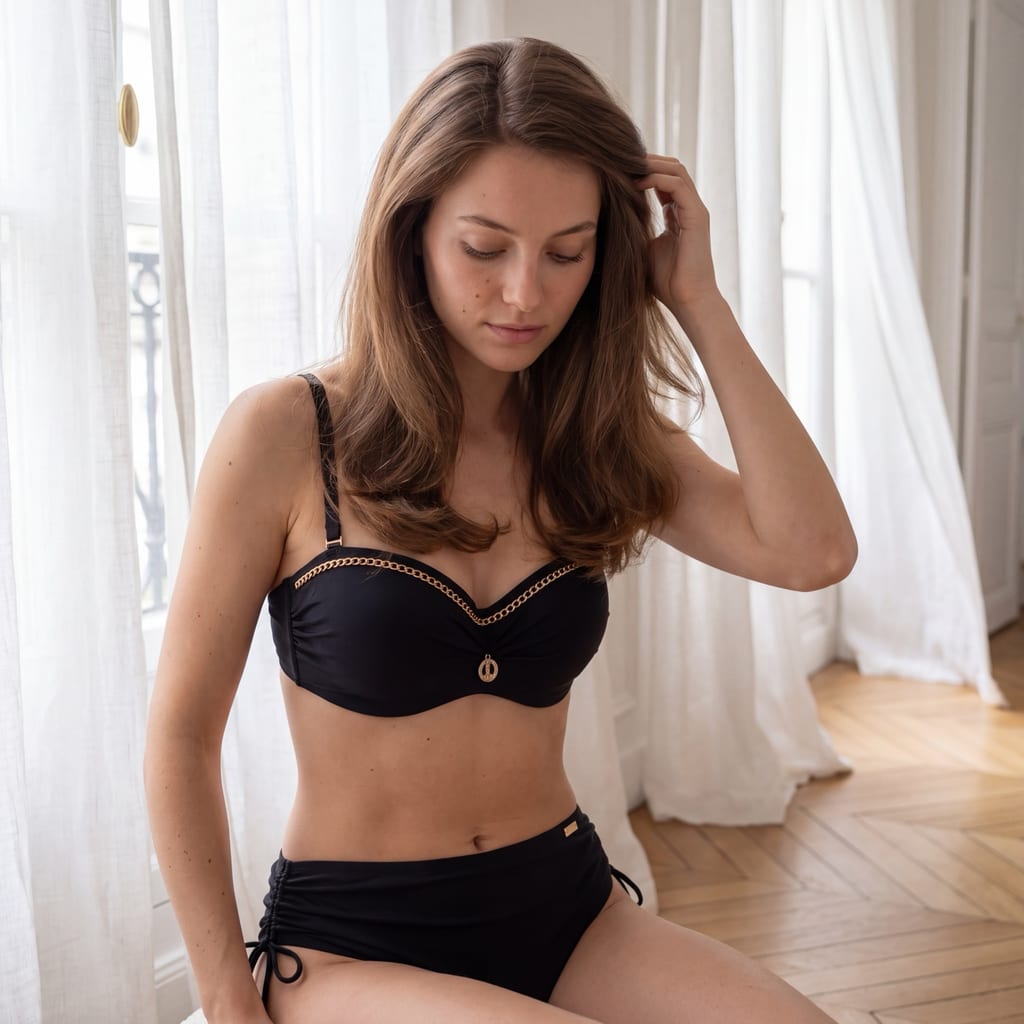
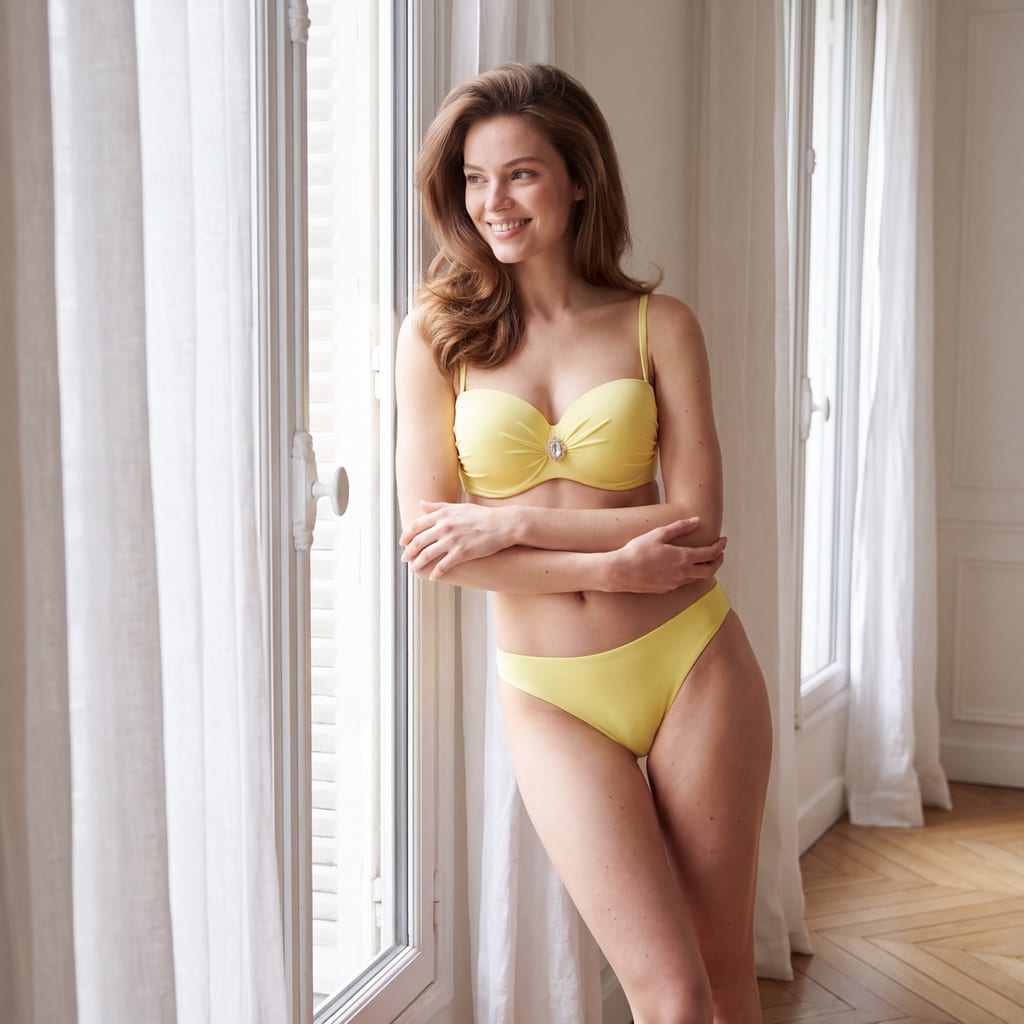
Najlepsze do
Najlepszy dla sleepwearu, piżam, loungewearu i homewearu — kart produktu, lookbooków kolekcji domowych i treści social, w których sprzedaje się wygoda, miękkość materiału i sposób noszenia. Sprawdza się szczególnie przy fasonach ocenianych przez układ i długość: szerokie nogawki, dzianiny, szlafroki, komplety z lamówką i mankietem. Do bielizny intymnej wybierz styl bieliźniany — ten preset celowo prowadzi rejestr komfortu, nie intymności.
Wymagania wejściowe
Wgraj packshot tej strony produktu, którą chcesz pokazać — sesja fotografuje jedną stronę (przód ALBO tył); komplet przód + tył to dwa wsady, po jednej sesji na stronę. Modelka jest wymagana — to styl na ciele. Modelkę (karnację, budowę, niedoskonałości skóry) ustawiasz w modelce; styl jej nie wygładza. Sceneria nie jest potrzebna: preset ma własny jasny, ciepły salon poranny jako świat domyślny. Jeśli chcesz inne wnętrze (np. kuchnię albo własne mieszkanie), podepnij JEDNĄ scenerię domową na całą sesję — to ona poprowadzi miejsce, a styl dołoży swoje światło, kadr i rejestr.
Wytyczne jakościowe
## Quality guidelines ### Style core An everyday-comfort register for sleepwear, pyjamas, loungewear and homewear, photographed inside one bright, warm, lived-in apartment in the morning — images that read like an ordinary morning that would have happened with or without a camera: someone awake at home, in the clothes they actually sleep and lounge in, in soft daylight coming through one window. The world is a day space, not a bedroom: a warm living room with a sofa, soft textiles, pale wood and one large window. The register is comfort, not intimacy — the garment is worn as clothing, the body is simply at ease in its own home, and the picture sells softness, drape and the ease of wearing rather than mood, allure or fashion form. This is decidedly NOT a campaign, NOT an editorial and NOT an intimate-lingerie register: no worked fashion shapes, no camera-aware seduction, no styled narrative set. What makes the frame good is believability — a real room, real morning light, real fabric behaving like fabric on a relaxed body. - Commerciality level: `lifestyle` with a firm `catalog` floor — natural and everyday, but the garment stays readable and sellable in the core of the pack - Dominant character: warm, soft, bright, domestic, unhurried, unselfconscious, ordinary - Image priority: the product and the everyday moment in balance — the garment leads as the readable subject, the morning behaviour of a relaxed person gives it its meaning - Directional references: contemporary sleepwear and loungewear lookbooks shot at home, soft-daylight interior lifestyle photography, a warm residential morning documented plainly; NOT a boudoir session, NOT a fashion campaign, NOT a styled set - Style-anchoring words: ordinary morning at home, one warm room, soft window daylight, comfort worn rather than performed, unselfconscious ease - Register fence: the whole point is everyday comfort; a frame that starts to read as intimate, alluring or camera-aware has left this preset (that register is a different style and a different product category) ### Product role in frame The product (a pyjama set, a nightdress worn as everyday sleepwear, a robe over a sleep set, a knit or brushed-cotton lounge set, homewear separates) is the readable hero of the pack and the reason the frame exists — but it is photographed the way this category is actually judged: how it hangs, how it moves, how soft it looks, how it creases when someone sits down. Fit here means drape and volume, not tension: sleeve and hem length, the fall of a wide trouser leg, the weight of a knit, the way a robe belts, the set of a collar, the piping along a placket, the cuff, the pocket, the drawstring, the elastic waist. The body is relaxed, so the garment is shown at rest — and that is exactly the information the customer wants. When the garment's own hue sits close to the model's skin tone (cream, oatmeal, blush, pale grey), the light and the grade must preserve the edge between fabric and skin: the outline of every hem, cuff, placket and collar stays visible and the garment never dissolves into the body. The session photographs the one side of the product supplied in the input: when the input shows the back of the garment, the model is seen from behind and the back becomes the readable subject of the whole pack. - Product role: hero on the relaxed body — the garment leads as the readable subject; the room and the morning moment frame it and never bury it - Visibility level: fully readable in the clear majority of frames, with a minority where a throw, a raised arm, a held mug or hair crosses part of it, plus a material / construction detail layer - What the style exposes: drape and volume at rest, softness and weight of the fabric, sleeve / hem / trouser-leg length, collar and placket, piping, cuffs, pockets, drawstrings and elastic waists, the natural creasing of a worn soft garment - Skin-to-garment separation: when the garment's hue is close to the skin tone, the soft directional key and the warm-neutral grade keep every edge of the garment readable against the body - Acceptable obscuring: moderate and only from ordinary causes — a blanket pulled over the knees, an arm folded across, a mug held at chest height, hair falling forward; never in the core of the pack, and never over the piece the frame exists to show - Product presentation character: honest, soft, everyday, believable — the garment as clothing being lived in, never a staged presentation and never a styling illusion (nothing tucked, clipped or pinned to fake a fit that the fabric does not have) ### Light Default light — applied when no scenery is linked, or when the linked scenery does not name a directional light, a time of day or weather: ONE large window as the only key, off frame, carrying diffused morning daylight through a sheer curtain. The window sits at ~30° azimuth off the camera–model axis, on the camera side, its centre just above the model's eye line (the ~30° is azimuth measured from the camera–subject axis, not from the walls; the source sits above the eyes, never a low uplight). Because the source is large and veiled, the shadow edge is wide and the transition long; contrast is medium-low and every part of the garment stays readable. The only fill is the room's own bounce off the warm off-white walls, the pale floor and the textiles. Discipline — always, whatever the light source: one soft, diffused daylight source that still holds a plainly readable direction and a gentle falloff — the lit side of the body and the near part of the room sit brighter, the far side and the depth of the room step down softly and stay open and warm. The key stays on the camera side of the subject, so separation comes from tone and from that falloff rather than from a contour light behind the figure; the frame carries no rim, no kicker and no second source competing with the window. This discipline applies on top of whichever source is resolved. Softness is a property of the SOURCE, not the absence of a source. A large veiled window is soft because it is broad and close, and it still draws a small directional shadow under every fold, cuff, hem and knit rib — that micro-shadow is what makes fabric read as fabric and skin read as skin. The light is softened by diffusion, never by removing its direction: a flat, sourceless, shadowless wash is what this preset is built to avoid (Prompter instruction — formulate final values positively: state the window, its side, its height and its falloff; never state an even ambient fill). - Source type: natural daylight through one large window, veiled by a sheer curtain or by an overcast sky; one dominant source, no second key, no artificial fixture as a key - Default source direction: one window at ~30° azimuth off the camera–model axis, on the camera side, its centre just above the model's eye line — applied when no scenery is linked, or when the linked scenery does not name a directional light, a time of day or weather - Hardness: soft — the source is broad and veiled; shadow edges are wide, transitions long - Light-to-shadow contrast: medium-low (discipline) — enough modelling for volume, drape and the weave of the fabric; never dramatic, never graphic, never crushed - Role of fill: only the room's own bounce off the warm walls, pale floor and textiles; the bounce keeps the shadow side open and warm and never flattens the direction away - Shadow quality: soft, open, warm — a gentle gradient across the body and along the wall, plus small directional micro-shadows under folds, cuffs, hems and knit ribs - Falloff: gentle and physical — the room grows softly darker away from the window; this quiet gradient is the signature of the style and stays present in every spatial frame, never lifted into an even ambient glow - White balance: follows the resolved light source; the preset's warm-neutral morning daylight white balance applies only when the preset's default light is the source; the grade never recolours a linked scenery - Time of light: morning — a bright, gentle, early-day quality of daylight, held identical across the pack; it is a quality of light, not a location statement - What the light should model: the fabric's surface and drape first (weave, rib, brushed nap, the fall of a hem), then the volume of the relaxed body so the fit reads, then the soft depth of the room - Light discipline (always, whatever the source): one soft, broad, directional daylight source with a readable direction and a gentle falloff, medium-low contrast, key on the camera side, no rim or kicker, one white balance per frame ### Color and tonality Warm-neutral, bright and airy tonality — the tonality of a room that faces the morning. The palette is deliberately low-chroma so the garment carries the only real colour in the frame: warm off-white walls, oatmeal linen, pale wood, warm greys and soft naturals in the textiles, plus the product's own hue as the strongest note. The default background — used only when no scenery is linked — is the wall plane of the preset's own room, held at ONE warm off-white value: sRGB #EFE7DA ≈ CIELAB L* 92 / a* 1 / b* 7 — a bright, softly warm plaster tone with a gentle falloff away from the window, clearly NOT pure white, NOT the bright neutral grey of the catalog studio, NOT beige-orange, NOT cool-grey and NOT blue-shifted. Exposure is bright and airy with highlight detail held: the veiled window reads as luminous fabric, not as a blown white hole. Blacks stay open and warm — an interior shadow that still carries the surface of the room. Contrast medium-low, saturation natural and restrained; no creative grade, no film character, no tint. The product's own hue is the most protected value in the frame and takes precedence over the grade. - Palette: warm-neutral and low-chroma — real skin + the true product hue + the room's warm off-white, oatmeal, pale wood and soft naturals; two or three coherent tones plus the garment - Background tone (default, closed axis): sRGB #EFE7DA ≈ CIELAB L* 92 / a* 1 / b* 7 — one single value with a gentle falloff away from the window, used only when no scenery is linked; never a family, never a range, never drifting toward white, cool grey, orange or blue between frames - White balance: warm-neutral; follows the resolved light source; the preset's warm-neutral value applies only when the preset's default light is the source; never a cream-orange cast, never icy; the grade never recolours a linked scenery - Saturation: natural and restrained — true to the product, unmuted and unpushed - Contrast: medium-low — soft, readable, comfortable; the whole frame stays legible - Exposure: bright and airy; the garment correctly exposed; the window's own highlight held with detail; shadows open and readable - Highlights character: soft, warm-clean, controlled — the veiled window keeps its texture - Shadows character: soft, open, warm; the room's surfaces stay visible inside them - Blacks: open and warm — real interior blacks, not crushed and not a studio cutout - Whites: warm-clean — a white or cream garment separates from the #EFE7DA wall through the soft contact of light and shadow, never by recolouring the background - Overall tonal character: warm, bright, airy, contemporary domestic — quiet enough to be invisible, warm enough to read as morning - Faithfulness of the product's own hue takes precedence over the grade ### Lens and perspective feel One pinned focal length: **~50mm in feel, for the whole session** — one single value, no ranges. The choice is deliberate and is the natural anchor for a lifestyle register: a standard length reads the room the way a person standing in it does, keeps the sofa, window and wall present as context without a wide real-estate distortion, and holds believable proportions for a relaxed, seated or walking body. It also keeps face geometry stable across a stateless pack — a drifting focal length re-models the face and reads as a different woman between frames. Detail frames stay at the same 50mm and simply move the camera closer; the pin never bends for a crop. Aperture / depth of field is a closed axis resolved once for the whole session: one moderately open value (~f/4 in feel). The figure separates gently from the room, while the room itself stays legible as warm context — the sofa reads as upholstered linen, the wall as plaster, the floor as wood. This is a deliberate middle: a deeper value would flatten the room into a wall and lose the domestic air, a shallower one would melt away the textures that make a home read as a home. In a material-detail frame the fabric plane is kept parallel to the sensor, so the whole detail sits inside the focal plane at this aperture. Neither focal length nor aperture is ever sourced from the scenery. - Focal length: PIN ~50mm in feel — one single value for the entire session, no ranges (never write "35–50mm in feel"); written identically on EVERY frame and never taken from the scenery - Aperture / depth of field: ONE moderately open value (~f/4 in feel) resolved for the whole session and held identical across every frame; the garment is sharp, the room stays legible behind it; never sourced from the scenery - Camera distance: medium for the 3/4 and full-figure frames (the room enters the frame around the figure), closer for portrait and material detail — all at the same 50mm - Perspective: eye level as the base — a person's own view of the room; a gentle high angle when the subject is seated or curled on the sofa, a gentle low angle as a rare accent; never a dramatic or deforming angle - Sharpness character: as a real lens renders it — true detail without synthetic over-crispness and without a soft dreamy haze - Gear character: a full-frame camera with a standard prime lens, available window light, fine film grain - Aspect ratio: no rigid requirement; the prompter picks (product pages usually 2:3 / 4:5, social 4:5); the format should hold the figure with some of the room around it ### Composition language Composed but unforced — the frame is arranged, the moment inside it is not. The figure sits naturally within the room rather than being placed against it: centred or gently offset, with the architecture of the space (the window reveal, the wall corner, the line of the sofa back, the edge of a doorway) giving quiet geometry. Two to three planes: an optional near plane taken from the room itself (the arm of the sofa, the edge of a curtain, a foreground cushion) as a passive foreground, the figure, and the soft depth of the room behind. Verticals stay vertical and the room's perspective stays physically believable. The area behind the head and shoulders stays clear — no lamp, plant, frame edge or furniture line growing out of the head, and the room's horizontal lines do not cut the body at a joint. Negative space is medium and unforced: a warm wall plane or the light around the window gives the frame air, and a minority of frames leave that air usable for a headline. Separation from the background comes from gentle tonal contrast plus the window's falloff — never from a contour light and never by recolouring the wall. - Frame type: leads with 3/4-length / American frames and full figure (a soft set is judged by its whole length), a strong portrait / bust share for the ease of the expression and the top of the set, plus a material / construction detail layer - Object placement: centred or gently offset, with the room's own lines giving the geometry; nothing about the placement should read as art-directed - Architectural discipline: verticals vertical, the room's perspective believable, the window reveal and door edges straight - Background hygiene: the area behind the head and shoulders stays clear of intersecting objects and lines - Negative space: medium and unforced — a warm wall plane or the air around the window - Symmetry: incidental — the register is relaxed, not composed for symmetry - Open / closed composition: mixed, leaning slightly open — the morning continues past the frame; closed frames hold the intimacy of a small domestic moment - Number of planes: two to three — an optional near plane from the room's own furniture, the figure, the soft depth of the room - Separation from background: gentle tonal contrast plus the window's falloff - Room for copy: optional, in a minority of frames, usually the warm wall plane or the bright zone beside the window - Overall composition character: domestic, relaxed, believable, quietly ordered ### Pose language There is posing here only in the sense that a stance is chosen — the language is **behaviour**, not shape. The model does what a person does in their own home on a slow morning: stands by the window with a mug, sits on the sofa with her legs folded under her, curls into a corner of it with a throw over her knees, pushes her hair back mid-stretch, walks across the room, leans against the window reveal, pulls a sleeve down over her hand, sits on the floor with her back to the sofa. The body line is relaxed and honest, with low tension: no elongation, no worked contrapposto, no sculptural overload, no held editorial shapes. The register is upright, seated or curled — the ordinary postures of being awake at home. Expression is calm, content and unselfconscious: a soft, real smile is welcome and is the natural home of this register, an occasional genuine laugh is welcome too, and a quiet, neutral, thinking face is equally right. The gaze is soft and unworked — an easy meeting of the lens, a look toward the window, a look at what her hands are doing. Contact with the room is comfort-based: furniture is something to sit in, lean on and pull around you, never a structure to build a fashion line against. When the input shows the back of the garment, the same ordinary domestic behaviour reads from behind. - Expression: calm, content, unselfconscious; a soft real smile is the natural default, a genuine laugh a welcome accent, a quiet thinking face equally right; reads whenever the face is visible - Pose dynamics: semi-static with light everyday motion — set, comfortable stances plus small real actions (a stretch, a step, settling into the sofa, drawing the curtain, lifting a mug) - Body openness: open, natural and relaxed — whatever a person's body does at ease; no worked fashion axis - Line tension: low — soft shoulders, settled weight, unforced limbs - Posing character: `lifestyle` / `natural` — behaviour first, stance second; never `fashion`, never `sensual`, never camera-worked - Eye contact: mixed and quiet — an easy direct look, a glance toward the window or into the room, or eyes on her own hands; all soft and unperformed - Spontaneity level: directed but natural — the stance is chosen, the moment inside it reads real; the frame should look like something that was happening, not something that was arranged for the lens - Relation to furniture and objects: comfort-based — sitting, leaning, folding legs under, pulling a throw over the knees, holding a mug; furniture supports the body, it never becomes a device for a worked line - Body-to-product relationship: the relaxed body shows the garment at rest, which is exactly how this category is worn; hands, arms and hair stay clear of the piece the frame exists to show - Avoid (Prompter instruction — formulate final values positively): camera-aware allure, reclining or bed-bound framing, worked fashion shapes, an arched or presented body line, a smized or coy expression — this register is comfort, and its poses are ordinary domestic behaviour stated positively ### Movement and physics The style is quietly alive. Movement is the ordinary kind that belongs to a morning — a stretch on waking, a step across the room, a sleeve pulled down, a throw drawn up over the knees, sitting down into the sofa, a hand pushing hair back — and it is the source of the liveliness this register needs. The image stays sharp and believable: everything is essentially frozen, with at most a subtle motion cue at the ends of hair or fabric, and never any blur on the product. Indoors there is no wind: a curtain may breathe only if the scenery supplies an open window, and even then it stays a small cue. Physics are fully real and matter more here than in most registers, because soft fabric is the product: knit, brushed cotton, jersey and linen fall under real gravity, crease where a body has sat, gather at a cuff and hang from a shoulder with real weight; a throw drapes with mass; where the body settles into upholstery, the cushion takes the weight and deforms. - Static vs movement: semi-static with light everyday motion — set stances plus a real small action; movement is behaviour, never a device - Frozen vs blur: essentially frozen and sharp; at most a subtle cue at the ends of hair or fabric, never on the product - Hair / body: natural and settled, or moved by a real gesture (a stretch, a turn, a hand pushing it back); believable, never styled-static and never chaotic - Fabric physics: soft garments fall, gather and crease as they truly do; the natural creasing of a lived-in soft garment is wanted, not a flaw to be smoothed out - Contact physics: real weight — cushions and blankets deform under the body, a leaned shoulder presses into the window reveal - Elements: indoor-only and subtle — settling fabric, a curtain breathing at an open window supplied by the scenery; no wind, no water, no environmental drama ### Relation to scenery The style's world is ONE bright, warm, lived-in day room in the morning — locked as a single set, not as a family of homes. Default world, used only when no scenery is linked: a living room with walls in one warm off-white plaster (sRGB #EFE7DA ≈ CIELAB L* 92 / a* 1 / b* 7), a low sofa upholstered in oatmeal linen with two settled cushions and a light wool throw over one arm, a pale wood floor with a soft flat-weave rug, one large window with a sheer curtain drawn across it, a low wooden side table beside the sofa holding an ordinary morning object or two (a ceramic mug, a couple of books), and clear warm wall behind. That is the whole set: lived-in and plain, with nothing decorative, nothing styled and nothing narrative added to it. The space reads as somebody's actual home, not as a set dressed to look like one. Which elements of that room enter a given frame is the open axis — the sofa, the window, the rug, the side table, a corner of clear wall, a foreground cushion. What never varies is the room itself: no second location, no jump between a living room and a kitchen or a bedroom inside one pack, no change of time of day, no change of the wall tone. When a scenery IS linked it owns the location and the backdrop — including a bright kitchen, a sunroom or another day space — and the preset's morning-light discipline, its camera and its comfort register apply on top; the preset never re-imagines the linked flat and never substitutes its own room for it. - Relationship to space: warm, soft, residential, lived-in, human-scale — a room somebody lives in, never a studio plane and never a decorated set - Scene depth: layered and gentle — an optional near plane from the room's own furniture, the figure, the soft depth of the room falling away from the window - Background activity: supporting and non-narrative — the room's own surfaces and textiles are visible and welcome, its objects stay passive - Space scale: intimate to human — one room, never a hall, never an open-plan expanse - Default background tone: the warm off-white wall plane #EFE7DA (CIELAB L* 92 / a* 1 / b* 7) — one value, not a range, not a family; used only when no scenery is linked - Default world (used only when no scenery is linked): the one bright morning living room described above, identical in every frame — one room, one time of day, one set of materials - What a linked scenery brings: the place, the backdrop, its surfaces and furnishings, and — when it names a directional light, a time of day or weather — the light source. What it never brings: focal length, aperture / DoF, render character or grade; those stay preset-owned, and the preset's light discipline always applies on top of whichever source is resolved ### Props and styling behavior Unlike a fashion register, this style **wants** a small amount of ordinary domestic material in the frame — it is part of what makes a comfort register believable, and the context of use is a selling argument in this category. The allowed family is narrow and plain: a ceramic mug, a folded wool throw or blanket, a book, a cushion, a pair of soft socks, a plain glass. They enter as a SESSION styling layer in a share of the frames (the frequency is set in Quantity), never as part of the model's identity and never as a narrative device — nobody is cooking, cleaning or acting out a story. Objects stay off the garment's readable zone: a mug is held below or beside the piece the frame is showing, a throw covers the knees rather than the placket. Everything else in the room comes from the world (or from the linked scenery) and stays passive. Accessories on the body are minimal: at most one simple everyday piece in a small minority of frames, no jewelry statement, no eyewear, no headwear. Footwear: bare feet are the native default, soft socks a welcome accent. The preset does not set the model's hair styling, make-up or skin finish — these come from the casting card (Mannequin input); the register only asks that hair sit naturally and stay clear of the garment's readable zones. - Props: allowed and wanted, from a narrow everyday family — mug, throw or blanket, book, cushion, plain glass, soft socks - Role of props: mostly active-but-ordinary (held, wrapped around, settled into) and otherwise passive in the room; never used to tell a story and never the subject of a frame - Prop discipline: an object never crosses the garment's readable zone in the core of the pack, and never more than one held object at a time - Props = session styling layer, not the model's identity — the model is a separate, clean input (frequency is set in Quantity) - Accessories on the body: minimal — at most one simple everyday piece in a small minority of frames; no jewelry statement, no eyewear, no headwear - Footwear: bare feet as the native default; soft socks as an accent - Hair, make-up and skin come from the card; the preset only asserts non-override (it does not smooth, restyle or beautify them) - Hair movement as a POSE cue stays available: hair may be pushed back mid-stretch or fall forward when the body leans (motion, not a hairstyle spec) - Avoid (Prompter instruction — formulate final values positively): styled set dressing, decorative clutter, breakfast-scene storytelling, glamour or editorial accessories, anything that turns the room into a narrative set competing with the garment ### Post-production and finish Finish warm, bright and believable — the image should read as a real photograph of a real morning, not as a graded creative asset. Warm-neutral grade: medium-low contrast, natural restrained saturation, blacks open and warm, whites warm-clean, the window's highlight held with detail. A fine, film-like grain is present and stays light and consistent across the pack: in a bright interior it is one of the cheapest carriers of photographic character, and wiping it to zero is what makes an interior frame start to read as a render. It stays light enough that the weave of a knit is never confused with noise. Clarity medium — enough for the rib of a knit, the nap of brushed cotton and the line of a hem to read, without HDR and without sharpened advertising micro-contrast. Retouch minimal: natural skin texture and features preserved, and the natural creasing of a worn soft garment preserved along with them. No vignette. Colour honest: the garment's hue as true as the file allows. - Grain: fine, film-like, present and light; consistent across the pack, never wiped to zero and never heavy - Texture: as recorded — the room's surfaces, the fabric's weave and the garment's real creases all stay visible - Clarity: medium — fabric structure fully readable, without HDR and without sharpened advertising micro-contrast - Vignette: none - Retouch: minimal — light cleanup only, never at the cost of skin texture, fabric texture or the natural creasing of a soft worn garment - Skin: the preset does not specify the model's skin, make-up or hair; it only requires that the render not smooth away or override the skin realism and identity supplied by the Mannequin input - Overall finish: warm, bright, believable, everyday — a photograph of a morning, resolved plainly ### Style render properties - Render character: true-to-life photographic rendering. The frame must read as a real photograph taken with a real camera in a real apartment — a full-frame camera, a standard prime lens, available window light and fine film grain. Carry this into `Rendering_Style` as its own value — `True-to-life photographic rendering.` — and resolve it identically on every frame of the session. The register (everyday comfort, domestic lifestyle) belongs in `Session_Concept` and `Output_Goal`; `Rendering_Style` carries ONLY the photographic character, never a genre label, never a quality or fidelity adjective. - Light must read as ONE soft, broad, directional daylight source with a gentle falloff — by default one large veiled window off frame at ~30° azimuth off the camera–model axis, on the camera side, its centre just above the eye line, with the room's own bounce as the only fill; medium-low contrast; the lit side brighter, the depth of the room stepping down softly and staying open and warm. The key stays on the camera side and the frame carries no rim, kicker or second source; separation comes from tone and falloff. This discipline applies on top of whichever light source is resolved, and each frame resolves to exactly one white balance. - Soft does not mean sourceless: the direction stays readable and a small directional micro-shadow sits under every fold, cuff, hem and knit rib. Never an even, shadowless ambient fill. - The default background — used only when no scenery is linked — is the wall plane of the preset's own morning room and reads as ONE warm off-white plaster tone: sRGB #EFE7DA ≈ CIELAB L* 92 / a* 1 / b* 7, with a gentle falloff away from the window; never pure white, never a cool grey, never orange-beige, never blue-shifted, and never a different value between frames. When a scenery is linked, the scenery owns the background. - The world is ONE bright, lived-in day room in the morning, identical across the pack — one living room, one time of day, one set of materials (warm plaster, oatmeal linen sofa, pale wood, soft textiles, one veiled window). Which of its elements enter a given frame may vary; the room, the time of day and the wall tone may not. Never jump between a living room, a kitchen and a bedroom inside one pack, and never substitute a studio plane when a scenery is missing. - Focal length is PINNED at ~50mm in feel and aperture at ~f/4 in feel for the whole session — one value each, never a range, never taken from the scenery — so face geometry and body proportions stay constant and the room stays legible as warm context behind a gently separated figure. - White balance is warm-neutral and follows the resolved light source; the preset's value applies only when the preset's default light is the source. Contrast medium-low; saturation natural and restrained; blacks open and warm; the window's highlight held with detail. The grade never recolours a linked scenery. - The product (sleepwear / pyjamas / loungewear / homewear on the body) stays the readable hero in the majority of frames — drape, volume, hem and sleeve length, collar, placket, cuffs, piping and fabric surface must read, and every edge of the garment stays visible against the skin even when their tones are close. The room, the morning moment and any held object amplify it and never cover it. - The register is everyday comfort: the garment is worn as clothing, the body is at ease in its own home, the postures are the ordinary ones of being awake (standing, walking, sitting, legs folded under, curled with a throw), the expression is calm and content with a soft real smile welcome, and the gaze is soft and unworked. The frame must read as something that was happening, not as something arranged for the lens — and never as an intimate, alluring or camera-aware register. - Ordinary domestic objects (a mug, a throw, a book, a cushion, soft socks) belong to this style as a session layer and are welcome in a share of the frames; they stay plain, passive-to-ordinary in use, never narrative, and never on the garment's readable zone. - The preset does not specify the model's skin, make-up or hair; it only requires that the render not smooth away or override the skin realism and identity supplied by the Mannequin input. - Fabric physics must read as real: soft knits and cottons fall under real gravity, gather at a cuff, crease where the body has sat, and hang with real weight; cushions and blankets deform where the body settles into them. The natural creasing of a lived-in soft garment is wanted. - Interior geometry stays believable: walls, window reveals and door edges stay straight, verticals stay vertical, and the space stays a room-sized residential interior. The area behind the head and shoulders stays clear of intersecting objects and lines. - A fine, light film grain is present and consistent across the pack; the frame reads as recorded, not as cleaned. - Body proportions stay true — eye-level base, at most a gentle high angle over a seated figure; no deforming angles. - The session photographs the one side of the product supplied in the input; the whole pack keeps that side toward the lens. - Overall the image must feel like a warm, ordinary morning in somebody's home, photographed plainly — not a campaign, not an editorial, not a bedroom-intimate frame, and not a studio shot with a room behind it. ### Allowed variability Variability applies only to the open axes. What stays disciplined across frames is the preset's own DNA: the one morning room and its #EFE7DA wall tone, the soft directional window key with its gentle falloff, the pinned ~50mm focal and ~f/4 aperture, the warm-neutral grade, the fine grain character, the everyday-comfort register and the product-readability floor. Everything below is open. - The exact stance, gesture, small action and micro-moment may vary — standing at the window, sitting with legs folded under, curling into the sofa corner, a stretch, a step across the room, a sleeve pulled down, sitting on the floor against the sofa — as long as they stay ordinary domestic behaviour and hold the readability floor. - Which elements of the room enter the frame may vary (the sofa, the window and its curtain, the rug, the side table, a corner of clear wall, a foreground cushion) — the room itself, the time of day and the wall tone do not. - Whether an ordinary object is present, and which one (a mug, a throw, a book, a cushion, soft socks), may vary between frames (session layer, a share of the pack). - Frame / crop may move along the ladder (full figure ↔ 3/4-length ↔ portrait / bust ↔ material detail) — always at the pinned 50mm, with the camera moving instead of the lens. - Camera position within the room may move — a different corner, a different axis, a gentle high angle over a seated figure — while the window keeps its place and its direction. - Gaze direction may change (an easy direct look, toward the window, into the room, down at her own hands), as long as it stays soft and unperformed. - Head angle may vary gently (frontal, three-quarter, a natural turn) while the body keeps the loaded product side toward the lens. - Expression may move within the calm register — from a quiet thinking face to a soft smile to a genuine laugh. - The degree of partial product obscuring may vary within "fully readable in the core of the pack". - What may NOT vary: the room, the time of day, the wall tone, the light character and its direction, the focal length, the aperture, the grade, the grain character, the comfort register or the readability floor. ### Session-level consistency Across the whole pack these stay constant, because the Prompter is stateless: the same ONE bright morning living room whenever no scenery is linked — including its wall plane at sRGB #EFE7DA ≈ CIELAB L* 92 / a* 1 / b* 7, never a different value between frames — or the same ONE linked domestic scenery for the entire session; the same soft veiled window key at ~30° azimuth on the camera side, its centre just above the eye line, with the same gentle falloff and no rim or second source; the same one warm-neutral white balance per frame; the same medium-low contrast and warm-neutral grade; the same pinned ~50mm focal length and ~f/4 aperture on every frame, so facial geometry, body proportions and the rendering of the room do not shift; the same fine light grain; the same minimal-retouch skin realism from the card; and the same everyday-comfort register with its calm, content expression. The pack must read as ONE morning in ONE home: no jump to a second room, no second time of day, no drift from a soft window key to a harder or flatter one, and no mixing of comfortable domestic frames with intimate, glamour or fashion ones. Ten images must look like one real morning, not ten separate attempts. ### Conflict resolution Default hierarchy, unchanged — this preset serves a product page and a lookbook for a category people buy for comfort, so the default order is exactly right for it: 1. Product readability and fidelity: the garment readable in the core of the pack, its hue true, drape, hem, sleeve, collar and construction legible; edges hold against close-toned skin; nothing — hand, object, throw, hair or crop — covers the piece the frame exists to show. 2. Realism and render believability: true-to-life photographic rendering, real skin from the card (non-override), real fabric physics and real weight against furniture, true proportions at the pinned focal length. 3. Consistency of the warm morning world AND of the comfort register: one room, one time of day, one soft window key, one grade, one camera, one behavioural pose language across the pack — this is the series signature. 4. Any expressive accent — permitted only inside the margins left by 1–3. One fence sits above the fourth slot and is not an artistic trade: the everyday-comfort register never yields to a more alluring frame. A pose, crop or expression that would make the image read as intimate, camera-aware or fashion-worked does not belong to this preset at any share — that register is a different style and a different product category, and losing this one dissolves the reason the preset exists. When a linked scenery's own space conflicts with the preset's default room, the scenery wins the location (below product readability, render realism and model identity, which stay higher) — the linked scenery is the sole owner of the place. The preset's default light and default room apply for sessions without a scenery, or — for the light — when the linked scenery does not name a directional light, a time of day or weather; a qualifying scenery's light leads, and the preset's soft directional discipline with its gentle falloff always applies on top. The camera pins are never moved by the scenery: the ~50mm focal length and the ~f/4 aperture come from the preset and only an explicit per-batch Idea or suggestion may change them. If holding the 50mm anchor would crop the room out of a frame entirely, the frame is recomposed from further back across the room; the pin does not bend on its own. If a pose requires furniture the linked scenery does not contain, the pose gives way — the preset never invents furniture or architecture to accommodate it. If a held object would cross the garment's readable zone, the object is lowered, set down or dropped from the frame; readability wins over the prop every time.
Wytyczne ilościowe
## Quantity guidelines ### Session goal By default 10 images in the pack. Main use: product page and category imagery for sleepwear, pyjamas, loungewear and homewear, collection lookbooks for the same category, and organic or paid social where the appeal is comfort and everyday use. The pack's goal is a set that reads as ONE real morning in ONE home — the same room, the same soft window light, the same relaxed person — while every frame still does its selling job: the drape, softness, length and construction of the garment read, and roughly half the pack is directly PDP-usable. The session photographs the one loaded side of the product supplied in the input; a complete front-plus-back product card is TWO sessions, one per loaded side. ### Shot mix About 30% full figure (the whole set at its full length — how the trousers fall, where the hem sits, how the robe belts), 35% 3/4-length / American frame (the workhorse: the garment zone large in frame with the room still around it), 25% portrait / bust (the ease of the expression and the top of the set — collar, placket, shoulder, sleeve), 10% material or construction detail (knit rib or brushed nap, a cuff, a hem, a piped edge, a button placket, a drawstring, a pocket). Every frame at the pinned 50mm, with the camera moving closer rather than the lens changing. When the input shows the product's back, the same shot mix reads from behind (rear full figure, 3/4-length from behind, rear bust framing, back-construction detail). ### Perspective mix Product orientation = input, not preset. The input always shows one side of the product — the front or the back — and that loaded side dictates whether the model is seen facing the camera or from behind. The preset does NOT redistribute or assign this (no "X% front / Y% back"); it takes the orientation from the input and only varies the camera angle within it. The distribution concerns the camera setup with the loaded side kept to the lens, all at 50mm and with eye level as the base: about 40% straight on (camera frontal to the loaded side — the readable standard), 30% a slight 3/4 camera swing (the loaded side still fully readable, the room gaining a little depth), 15% closer to profile as far as the loaded side stays visible (a seated figure by the window, the fall of a sleeve along the arm), 10% a gentle high angle over a seated or curled figure (the natural way you look at someone on a sofa), 5% a gentle low angle as a rare accent. No dramatic angles: nothing may deform proportions, bend the room's architecture, rotate the figure so the loaded product side disappears, or cost fit readability. The direction of the light stays constant regardless of the camera setup — the window does not move between frames. ### Gaze distribution About 30% an easy direct look to camera (soft and unworked — presence, not intensity), 50% off-camera (toward the window, into the room, at whatever her hands are doing — the natural mode of this register), 20% downward or eyes closed inside a real moment (mid-stretch, over a mug, looking at a sleeve she is adjusting). Every gaze stays quiet and unperformed; the direct look is a person meeting your eye at home, never a worked camera gaze. This applies to frames where the face is visible; in material-detail frames the face may fall outside the crop. ### Interaction distribution About 60% comfortable contact with the room (sitting on the sofa with legs folded under, curled into its corner with a throw, leaning on the window reveal, sitting on the floor against the sofa, standing with a hand on the sofa back), 25% passive presence in the space (standing or walking through the room without touching it), 15% neutral standing with no relation to the surroundings. Contact is the home of this register — it is what separates a comfort frame from a studio frame — but it stays comfort-based behaviour, never a structural device for a fashion line and never a domestic chore acted out for the camera. ### Product visibility distribution About 45% garment fully readable on the body (the sales floor of this preset — the whole loaded side legible at a glance), 30% garment on the body inside an everyday moment (a stretch, a step, settling into the sofa — still clearly readable), 15% partial obscuring from an ordinary cause (a throw over the knees, a folded arm, a held mug, hair falling forward), 10% material or construction detail. Full readability stays a hard floor across roughly 45% of frames; neither the room, nor a held object, nor the falloff ever pushes the product below that floor. ### Composition openness distribution About 45% open frames (the room breathes around the figure, the morning continues past the edge, a crop naturally cuts the figure), 55% closed frames where the figure sits fully composed inside the frame. Openness here comes from the room and the moment, not from a designed layout; closedness carries the small, quiet intimacy of a domestic frame and guards fit readability. ### Safe vs expressive ratio About 60% safe (readable, sellable, PDP-grade — the garment fully legible in a calm, composed frame), 30% expressive (the morning moment leads: a stretch, a laugh, a figure against the window light, a curled silhouette under a throw — still readable), 10% copy-ready (a warm wall plane or the bright zone beside the window left usable for a headline or a badge). Expression in this preset means "more alive and more human", never "more editorial" and never "more intimate" — the expressive frames are the ones where the behaviour is strongest, not where the pose is boldest. ### Spatial and depth mix About 50% the figure against a simple plane of the room (a warm wall, minimal depth, separation by tone and the window's falloff), 35% embedded in the room with layered depth (a near plane from the sofa arm, a curtain edge or a foreground cushion, the figure, the soft depth of the room falling away from the window), 15% a tighter portrait or detail frame where the room falls softly behind. The gentle falloff into the depth of the room is present in every spatial frame. When a scenery is linked, the spatial mix follows that scenery for the whole pack; the comfort discipline stays. ### Recurring motifs or accessories frequency The recurring motif is the morning-home signature itself: one warm lived-in day room + one soft veiled window key with its gentle falloff + the warm off-white wall + the warm-neutral grade + the relaxed, unselfconscious register — present in 10/10 frames. Soft daylight reading as a plainly directional gradient across body and room: 10/10. The room's soft textiles (sofa, cushions, throw, rug) visible in at least 7/10. An ordinary domestic object present in the frame in 4–5/10 and actually held or wrapped around the body in about 3/10 (a mug in roughly 2–3/10, a throw or blanket in roughly 3/10, a book or a plain glass at most 1/10 — one held object at a time). Bare feet or soft socks in most full-figure frames. A light everyday action (a stretch, a step, a sleeve pulled down, a curtain drawn) in roughly 3–4/10. A simple everyday accessory in at most 1–2/10 (session styling layer, never baked into the model identity); no jewelry statement, no eyewear, no headwear. The recurring theme is the ordinariness of the morning, not an abundance of objects. ### Energy mix About 55% calm (quiet, settled, unhurried presence — the register's home), 25% warm and content (an easy smile, visible ease of being at home, the comfort of a soft garment), 15% active (a real small action: a stretch, a step across the room, drawing the curtain, sitting down into the sofa), 5% brighter (the pack's most alive frame — a genuine laugh or a fuller morning gesture). This register carries NO sensual share by design: the slot the library usually gives to sensual warmth is carried here by unselfconscious, contented ease, and that substitution is deliberate — it is the axis that separates this preset from the intimate interior register. The pack's strength is warmth and ordinariness, never drama, never allure.
Wskazówki dla użytkownika
Wybierz modelkę i wgraj packshot jednej strony produktu. Nie podpinaj scenerii, jeśli chcesz domyślny ciepły salon; jeśli podpinasz — jedna sceneria domowa na całą sesję, nigdy dwie. Na komplet przód + tył uruchom dwie sesje. Generuj 8–10 zdjęć.
Rób
Uruchamiaj bez scenerii — ciepły poranny salon jest częścią stylu i trzyma spójność paczki. Wybieraj fasony, w których sprzedaje się układ i miękkość: dzianiny, szerokie nogawki, szlafroki, komplety piżamowe. Pozwól, żeby codzienny przedmiot (kubek, koc) wszedł w kadr — w tej kategorii kontekst użycia sprzedaje; styl pilnuje, żeby nie zasłonił produktu. Konkretną pozę albo kadr wpisz w sugestiach sesji; sugestie są nadrzędne nad stylem. Generuj 8–10 zdjęć naraz.
Nie rób
Nie oczekuj rejestru intymnego ani buduarowego — to styl o wygodzie, nie o zmysłowości; do bielizny intymnej są inne presety. Nie oczekuj kampanijnych, rzeźbiarskich póz ani mocnego światła — tu poza jest zachowaniem, a światło miękkie i jednokierunkowe. Nie mieszaj w jednej paczce salonu, kuchni i sypialni: jedna przestrzeń na sesję. Nie oczekuj przodu i tyłu z jednej sesji — strona produktu idzie z wgranego packshotu. Nie generuj bez modelki.
Powiązane style
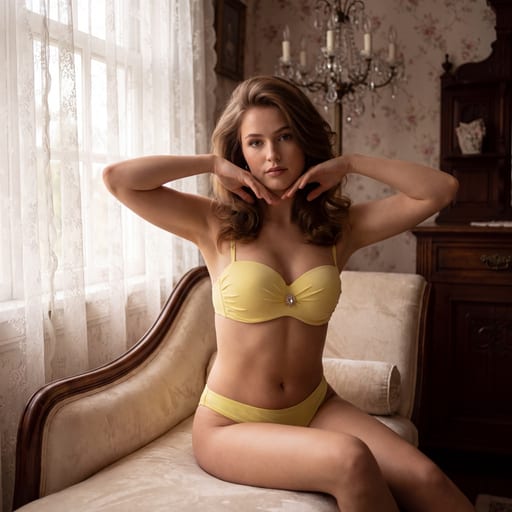
Buduar glamour
Zmysłowy glamour w klasycznym buduarze: ciepłe światło lamp, bogaty „glossy" grade obrazu i wysoka amplituda pozy budowana na relacji z meblem. Rejestr pewny siebie i zapraszający dla bielizny zmysłowej — z własnym, spójnym wnętrzem w komplecie.
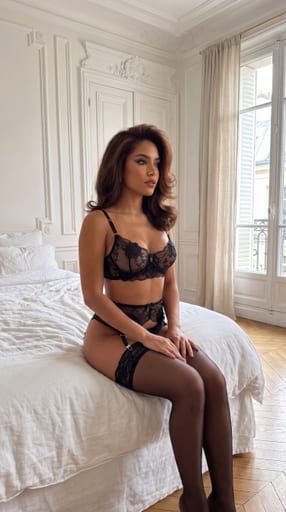
Bielizna w cichej sypialni
Spokojna, prywatna sypialnia w miękkim świetle jednego okna — rejestr quiet-luxury dla bielizny premium. Intymność bez glamouru: wyciszona poza, pozy leżące i naturalna relacja z meblem, len i blady tynk zamiast buduarowej scenografii.
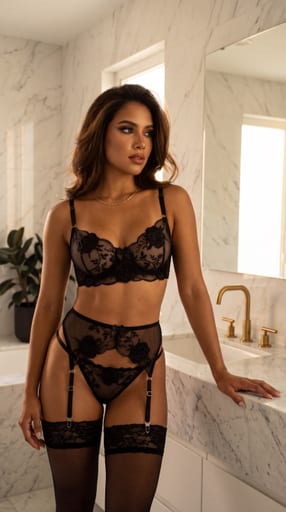
Marmurowa łazienka
Jasna łazienka premium jako świat sesji: marmur, kafel, chrom i duże lustro oddają światło, więc kadr jest wysokim kluczem z trzymanymi refleksami. Lustro pracuje jako element kompozycji, satyna pokazuje, jak układa się w świetle odbitym, a produkt zostaje czytelny w każdym kadrze.
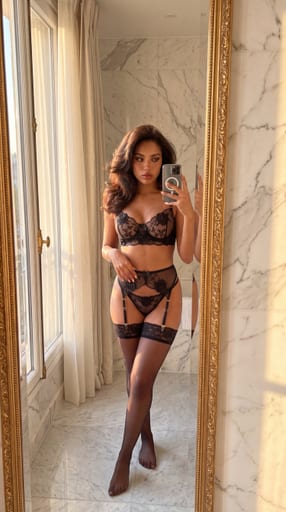
Natywny social w lustrze
Natywne treści social: pionowy kadr 4:5, lustro, telefon w dłoni i światło zastane prywatnego wnętrza. Zdjęcia wyglądają jak zrobione przez samą modelkę — ale są ostre, prawidłowo naświetlone i pełnowymiarowe, bez fejkowych artefaktów telefonu.
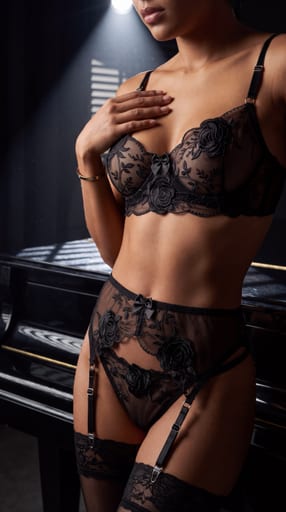
Nokturn z fortepianem
Elegancki apartament hotelowy po zmroku: jedna ciepła lampa jako jedyne światło, głęboka ciepła czerń w głębi pokoju i fortepian, o który modelka się opiera, a którego lakier oddaje sylwetkę. Wieczorny, dorosły rejestr dla bielizny premium i kompletów wieczorowych.
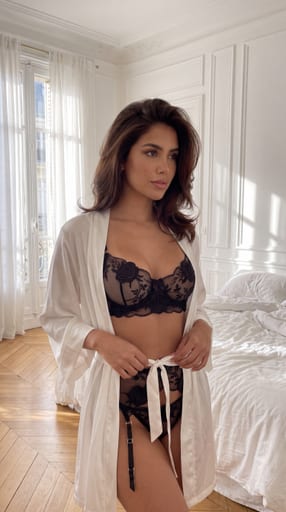
Poranek panny młodej
Jasny, romantyczny styl ślubny: poranek panny młodej w jasnym pokoju przygotowań, w miękkim świetle jednego okna. Wysoki klucz i kremowe biele — zawsze z trzymanym detalem, żeby biała koronka na białym tle wciąż czytała się krawędzią i fakturą.
Gotowy, aby rozbudować swoją bibliotekę kreacji?
Dodaj ten styl do swojego konta i zacznij tworzyć lepsze kampanie w kilka minut.