

Poranek panny młodej
Jasny, romantyczny styl ślubny: poranek panny młodej w jasnym pokoju przygotowań, w miękkim świetle jednego okna. Wysoki klucz i kremowe biele — zawsze z trzymanym detalem, żeby biała koronka na białym tle wciąż czytała się krawędzią i fakturą.
Pokaż kolekcję ślubną w świetle, w którym naprawdę się ją ogląda — w jasnym pokoju, godzinę przed dniem, przy jednym dużym oknie przesłoniętym woalem. Styl trzyma powietrzną, jasną ekspozycję i kremowe biele, ale nigdy nie kupuje jasności kosztem detalu: koronka, tiul, haft i satynowe krawędzie zachowują splot i rysunek, a biel produktu nie ginie w bieli tła. Dziesięć kadrów, które czytają się jak jeden spokojny poranek.
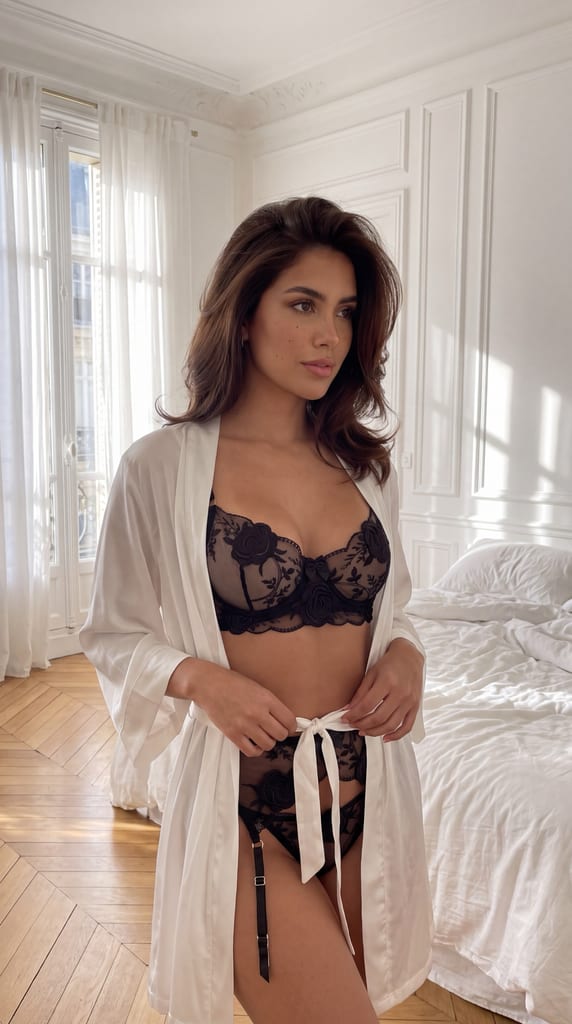
Galeria
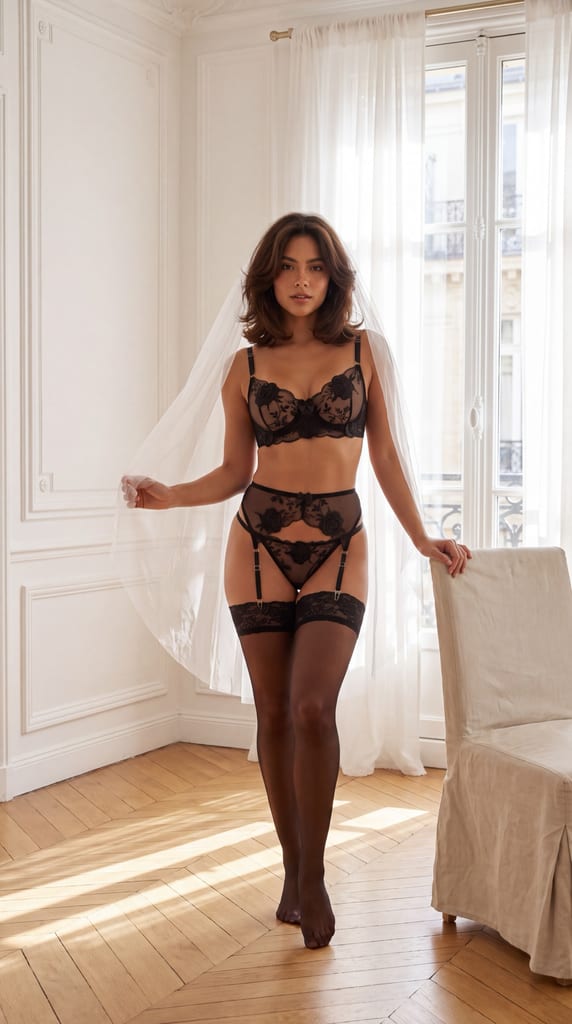
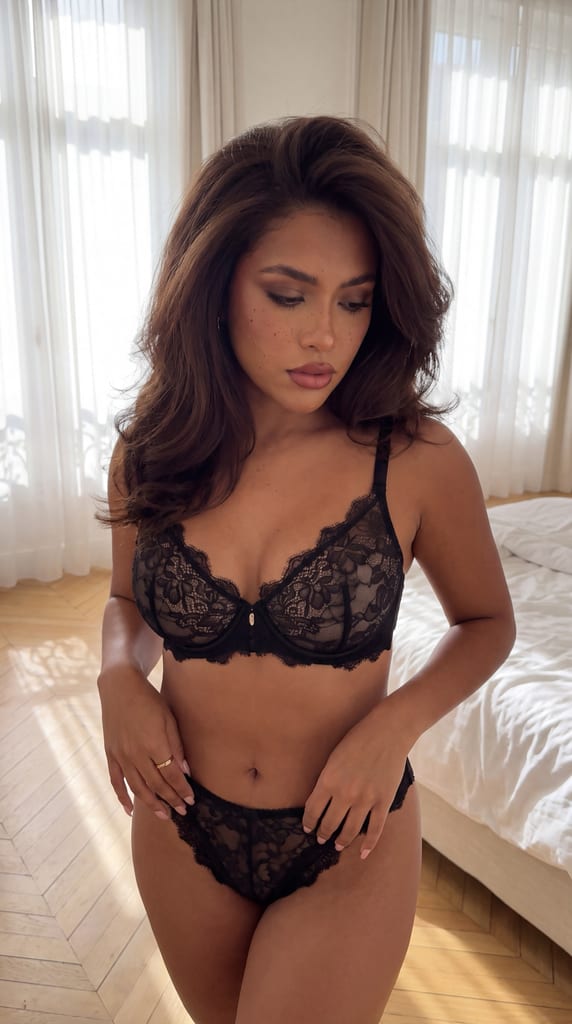
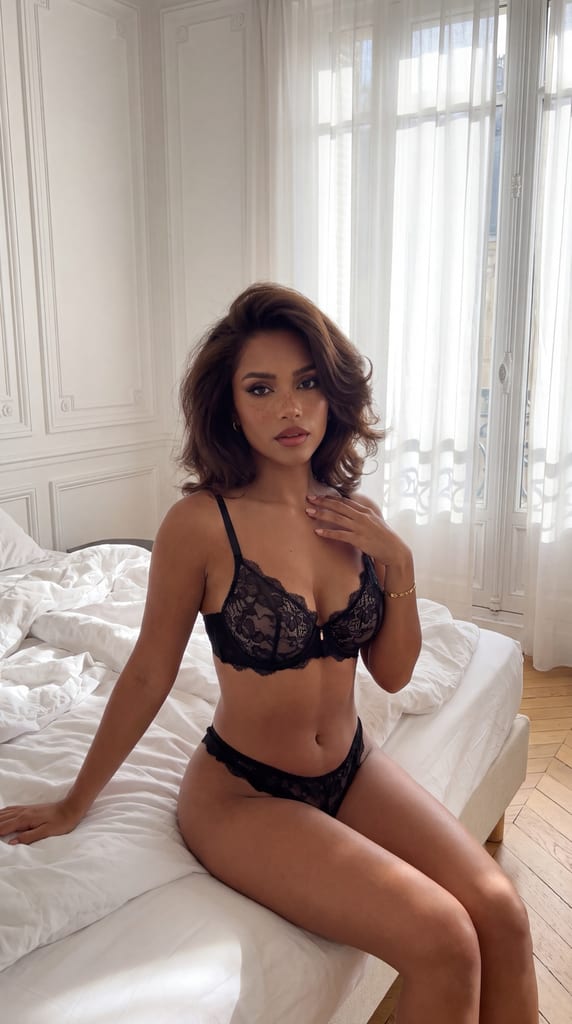
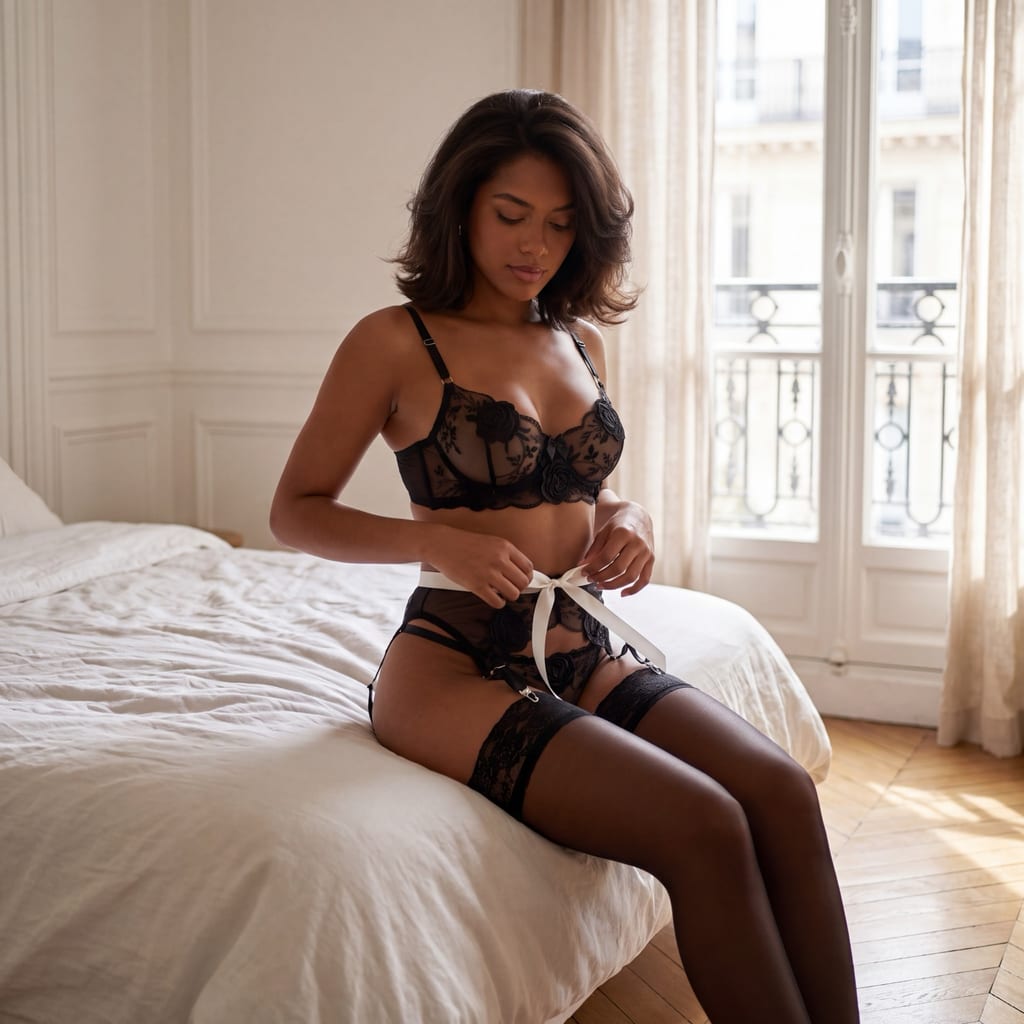
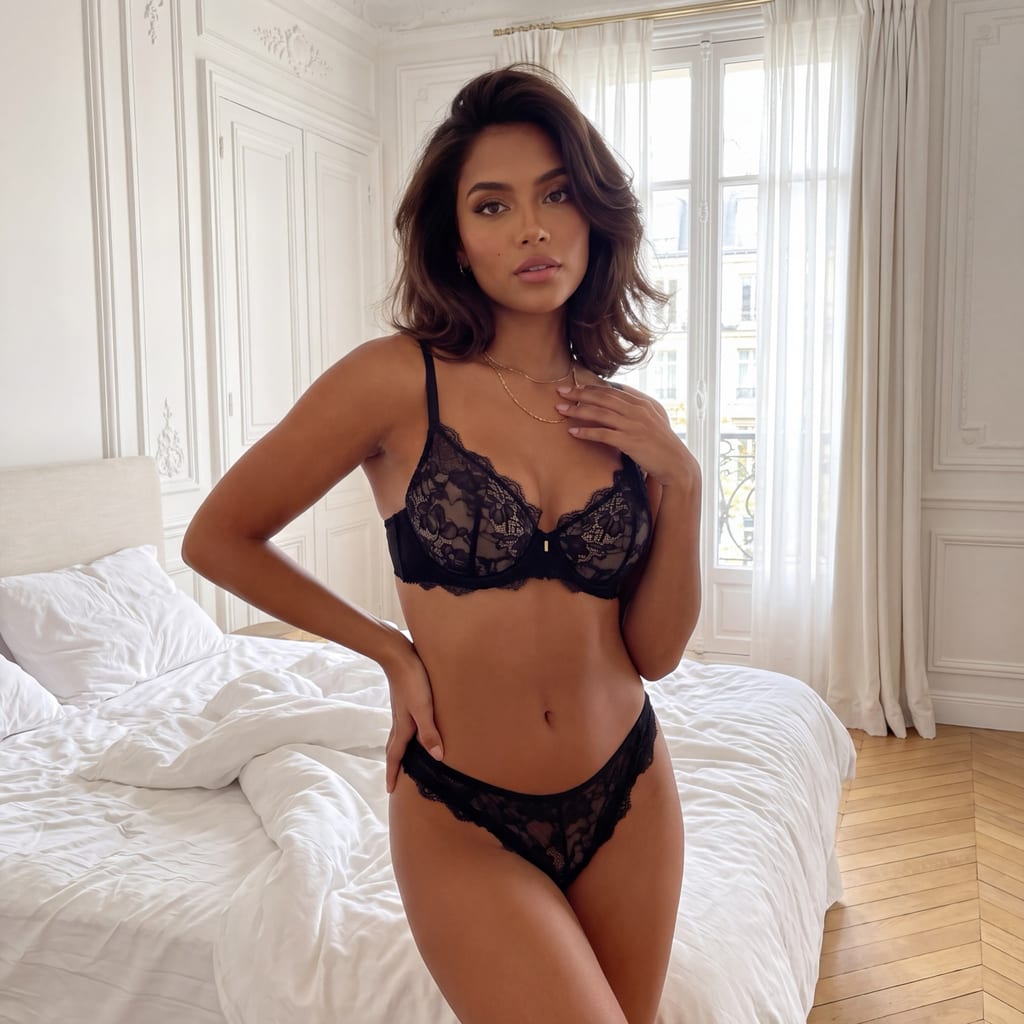
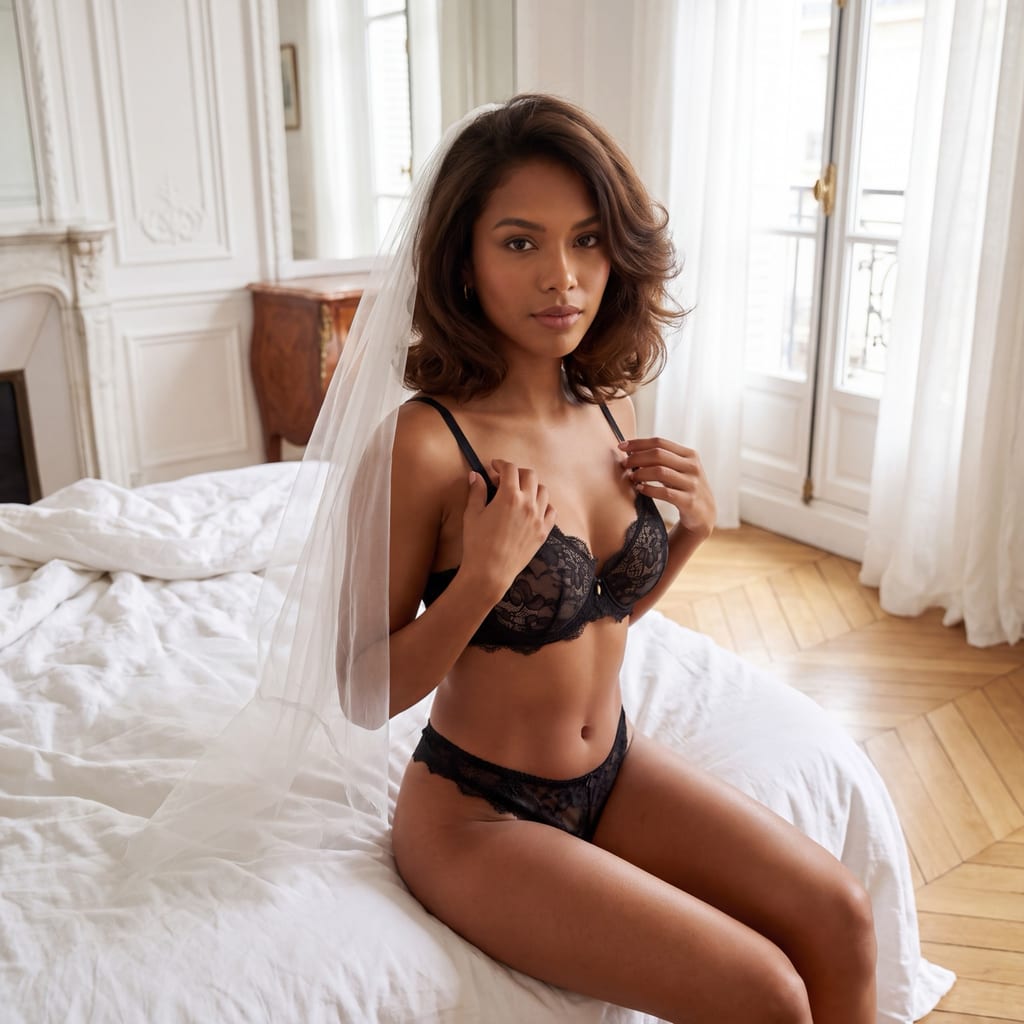
Najlepsze do
Najlepszy dla bielizny ślubnej, gorsetów pod suknię, szlafroków i peniuarów — lookbook kolekcji ślubnej, karta produktu linii bridal, kampania sezonu weselnego (wiosna i lato, produkowana przez cały rok) oraz social i assety prezentowe. Szczególnie dobrze wypada tam, gdzie sprzedaje biel i koronka: haft, ząbkowana krawędź, tiulowy panel, satynowa wstążka, fiszbina, zapięcie.
Wymagania wejściowe
Wgraj packshot tej strony produktu, którą chcesz pokazać — sesja fotografuje jedną stronę (przód ALBO tył); komplet przód + tył to dwa wsady. Modelka jest wymagana; karnację, budowę i niedoskonałości skóry ustawiasz w modelce — styl jej nie wygładza. Sceneria nie jest potrzebna: styl ma własny jasny pokój przygotowań i własne światło okna. Jeśli podpinasz scenerię, wybierz **jasne wnętrze dzienne** (pokój przygotowań, jasna sypialnia z dużym oknem) i użyj tej samej scenerii w całej paczce.
Wytyczne jakościowe
## Quality guidelines ### Style core A bright, romantic bridal register for bridal lingerie, corsetry, robes and peignoirs, photographed inside one quiet, light-filled preparation room on the morning of a wedding — images that read like a bridal collection's own lookbook shot in real window light, tender and composed, carried by ivory tonality and by fabric that keeps its texture in the brightest part of the frame. The world is a locked default of this preset: one bedroom-scale room with pale plaster walls, cream and white linen, a light floor and one large window dressed with a sheer white voile; a linked scenery leads the place when the user supplies one. High key is the anchor: airy exposure, creamy-clean whites, low-to-medium contrast — and it is always paid for with held detail, never with a blown field. This is decidedly NOT a campaign, NOT a glamour boudoir and NOT a wedding reportage: no ceremony, no guests, no event narrative, no worked fashion drama. The register is tender, quiet and ceremonial-bright, and its whole technical point is that white lace on a white ground still reads by its edge and its weave. - Commerciality level: mix of `lookbook` and `catalog` — a collection register that stays sellable frame by frame, with a real product-readability floor - Dominant character: bright, ivory, romantic, tender, airy, textile, composed, unhurried - Image priority: the light and the emotional register set the world; the product stays readable and its construction legible in the clear majority of frames; the face carries the tenderness - Directional references: a bridal lingerie lookbook shot in a bright preparation room, a wedding-morning interior editorial for robes and corsetry, light-filled interior portraiture on ivory and linen — never a wedding reportage, never a glamour boudoir session, never a studio campaign - Style-anchoring words: bright preparation room, one voile-diffused window, ivory high key with held detail, white lace that reads white-on-white, tender and composed ### Product role in frame The product (bridal lingerie, corsetry, bridal sets, garters, robes and peignoirs) is worn and stays readable in the clear majority of frames — cut, coverage, fit, lace pattern, embroidery, boning lines, satin edges, ties, hooks and closures are what the bridal customer buys, and this register exists to show them in the brightest possible light without losing them in it. Bridal is the extreme case of the close-tone problem: the garment is usually white, ivory, champagne or blush, the background is ivory and the skin may sit close to both. The garment therefore holds its edge by three positive mechanisms, present in every frame: the key grazes along the fabric so every scalloped edge, gather, seam and appliqué draws its own fine shadow; the garment's white and the room's ivory sit at different values, with the wall behind the figure one step down through the light's falloff; and the body's own volume gives the garment a shaded side. A robe or peignoir is either the product itself — in which case it is the fully readable subject — or a session layer worn open so the piece underneath stays legible. When the input shows the back of the product, the back of the garment is the readable subject and the model is posed from behind. The presentation character is tender, honest and collection-grade, never staged glamour and never clinical. - Product role: hero on the body — the garment leads as the readable subject; the light, the room and the tender register amplify it, never bury it - Visibility level: fully readable in the clear majority of frames, with a minority where a turn, an open robe or a near textile partially obscures it, plus a substantial construction/material detail layer - What the style exposes: lace pattern and its scalloped edges, tulle and mesh panels, embroidery and appliqué, boning and seam lines in corsetry, satin edges, ribbon ties, hooks and closures, and how the piece actually sits on the body - Garment-to-ground separation: white, ivory, champagne and blush pieces hold every edge against the ivory room and against close-toned skin — through the grazing component of the key, through the value difference between garment and wall, and through the body's own shaded side; the garment never dissolves into the background or into the skin - Acceptable obscuring: light — a hand, an open robe, the voile crossing the frame or a turn may partially cover the piece in a minority of frames if cut and construction still read; never unreadable in the core of the pack - Product presentation character: tender, bright, collection-grade, clearly sellable; the piece's own white / ivory / champagne / blush stays exactly its own ### Light Default light — applied when no scenery is linked, or when the linked scenery does not name a directional light, a time of day or weather: ONE large window as the only key, dressed with a sheer white voile that broadens it. Morning daylight enters from one side at roughly 55° azimuth off the camera–model axis, on the camera side, the window's centre just above the model's eye line (the azimuth is measured from the camera–subject axis, not from the walls; the source sits above the eyes, never as a low uplight). Soft: shadow edges are gentle and wide, but drawn — the direction survives the diffusion. The only fill is the room's own bounce off pale walls, a light floor and white textiles; that bounce is what makes the high key, not a second lamp. Falloff is present but gentle: the model stands in the brightest zone and the far side of the room sits one readable step darker, which is what keeps a bright frame from flattening into a white void. Discipline — always, whatever the light source: one soft, directional, edge-preserving source — soft enough for the tender register, directional enough that lace, tulle, satin edges, embroidery and seams each draw their own fine shadow along the surface of the fabric. Highlights are held: the brightest surfaces in the frame — the garment's white, the voile, the bed linen, the wall — keep a readable value and a readable texture, and the brightest field always resolves a step below paper-white. Low-to-medium contrast; exactly one white balance per frame, following the resolved light source (the preset's neutral daylight value applies only when the preset's default light is the source). This discipline applies on top of whichever source is resolved: a linked scenery may set where the light comes from, and the soft directional, edge-preserving, highlight-holding character stays. - Source type: daylight through one large voile-dressed window by default; a qualifying scenery may resolve another bright interior source. Always one dominant directional source - Default source direction: one window at ~55° azimuth off the camera–model axis, on the camera side, its centre just above the model's eye line — applied when no scenery is linked, or when the linked scenery does not name a directional light, a time of day or weather - Hardness: soft — the voile widens the source, shadow edges stay gentle with a wide transition, and the direction stays legible in every fold of fabric - Light-to-shadow contrast: low to medium — bright and airy, while the shaded side of the body and the garment keeps its own reading - Role of fill: the room's own bounce off pale walls, a light floor and white textiles; broad and generous, never a second key, never a frontal wash that erases the modelling - Shadow quality: soft, open, luminous — grounding and edge-drawing, never graphic, never crushed - Falloff: gentle and physical — the far side of the room sits one readable step below the model; this small gradient is a signature of the style and stays in every frame - Highlight behaviour: held — no field of the frame resolves to paper-white; the whitest surface keeps its value a step below it, so lace, tulle and satin keep their weave - Color temperature: neutral daylight; the preset's neutral daylight white balance applies only when the preset's default light is the source. The warmth of the frame comes from the room's ivory surfaces, not from the white balance - White balance count: exactly one per frame; a lamp named by a scenery never introduces a second, competing cast - What the light should model: the relief of the garment's construction first — lace, embroidery, boning, seams, satin edges — then the body's volume so fit reads, then the depth of the room - Direct sun: the voile keeps the sun diffused by default. A hard-edged window patch appears only when a linked scenery names direct sun, a time of day or weather implying it; when it does, the patch falls on the wall and floor and never crosses the garment or cuts the face ### Color and tonality Ivory, airy, textile tonality whose one job is to make a near-white world hold its differences. The default background (used only when no scenery is linked) is ONE warm ivory — sRGB #F7F0E7 ≈ CIELAB L* 95 / a* 1 / b* 5 — the plaster of the room's walls, echoed by cream linen and a light floor, with the gentle falloff of the window key across it. It is deliberately NOT pure white (#FFFFFF is the flat-lay compliance register), NOT the neutral-cool bright grey of the catalog studio, NOT beige, NOT sand, NOT cool-blue. Against this ivory the product's own hue is the most protected value in the frame: in bridal, the difference between pure white, ivory, champagne and blush is a purchase decision, so the grade never shifts a white piece toward the room's warmth, never pushes an ivory piece toward blue, and never flattens champagne into cream. Saturation is naturally low because the world is near-neutral; the product's hue is the only place saturation matters, and it stays exactly true. Contrast low to medium. No tint, no creative grade, no pastel push, no bleaching. - Palette: ivory, cream and white plus real skin and the product's own hue — two to three coherent tones and no fourth - Background tone (default, closed axis): sRGB #F7F0E7 ≈ CIELAB L* 95 / a* 1 / b* 5, one single value carried by the room's plaster walls, with a gentle falloff — never a family, never a range, never drifting toward pure white, beige, sand or cool-blue between frames; used only when no scenery is linked - White balance: neutral daylight; follows the resolved light source; the preset's neutral daylight value applies only when the preset's default light is the source; the grade never recolours a linked scenery - Saturation: natural and low by nature of the world; the product's hue true and untouched - Contrast: low to medium — airy, with the shaded side and the falloff keeping the frame three-dimensional - Exposure: bright and airy, exposed for the lit side of the garment and the skin; the brightest fields sit high but hold their texture and never clip - Highlights character: creamy, held, textured — never blown, never chalky - Shadows character: soft, open, luminous, faintly warm from the room's bounce - Blacks: this world has almost no true blacks; its darkest values are the soft shadow in the folds of linen and in the depth of the room, and they stay open and carry their surface — never crushed, never lifted into fog - Whites: creamy-clean and separated — a white garment reads against the ivory wall by value, edge shadow and texture, never by recolouring the background - Overall tonal character: bright, ivory, textile, contemporary bridal — airy without being empty - Faithfulness of the product's own hue takes precedence over everything else in this section; the grade never recolours a linked scenery ### Lens and perspective feel One pinned focal length: **~85mm in feel, for the whole session** — a single value, never a range (never write "50–85mm in feel"). The short-portrait anchor does three things this register needs: it holds the model's face geometry constant across a stateless pack, it compresses the room into a soft ivory backdrop instead of a real-estate view, and it holds the pull that an interior description otherwise exerts toward a wide, architectural framing. A wider length (down to ~50mm in feel) is allowed ONLY when the idea explicitly calls for a full-length hero showing the whole room — never as a per-frame default, and still resolved to one concrete value. Aperture / depth of field is a closed axis resolved once for the whole session: ONE moderately open value (~f/4 in feel). The model and the plane of the garment stay sharp edge to edge — lace, embroidery and seams are the subject and are never softened — while the depth of the room, the voile and the far textiles fall gently soft. This is the deliberate difference from the catalog register's deep, everything-sharp look: the softness of this style lives in depth, never in the rendering of the product. Focal length and aperture are never taken from the scenery. Camera at eye level as the base; a gentle high angle is a tender accent (looking down at hands, at a ribbon, at the fall of a robe), a gentle low angle a rare one — never a dramatic device, never deforming. - Focal length: PIN ~85mm in feel — one single value for the entire session, no ranges (never write "50–85mm in feel"); a wider ~50mm value ONLY when the idea explicitly calls for a full-length hero showing the whole room, never as a per-frame default; never sourced from the scenery - Aperture / depth of field: ONE moderately open value (~f/4 in feel) resolved for the whole session and held identical across every frame — the garment plane sharp, the room's depth and the voile gently soft; never sourced from the scenery - Camera distance: medium for the fit and register frames, close for the construction detail layer, medium-far along the room's long axis for full-length frames — all at the same pinned focal length - Perspective: eye level as the base; a gentle high angle as a tender accent; a gentle low angle rarely — no dramatic fashion angles, no deformation - Sharpness character: as a real lens renders it — real photographic sharpness on the garment, natural softness in depth; neither clinical nor dreamy blur - Gear character: a full-frame camera with a short-portrait prime lens, available window light, very fine film grain - Aspect ratio: no rigid requirement; the prompter picks (lookbook and e-commerce usually 2:3 / 4:5, social 4:5 / 9:16); the format should hold a bright field of the room next to the figure ### Composition language Airy, composed, unhurried composition — a bright field of the room breathes next to the figure, and the geometry stays quiet. Two to three planes: an optional near plane taken from the room itself (the edge of the voile, a corner of cream linen, the frame of the window, the back of the slipcovered chair) as a passive foreground, the figure, and the soft depth of the room behind. Placement centered or gently offset with clear intent; the window frame and the wall's edges are compositional tools and stay geometrically true, verticals vertical. The area behind the head and shoulders stays a plain field of wall, voile or linen — nothing grows out of the model's head, and the room's horizontal lines do not cut the body at a joint. Negative space medium to high — this is a bright world and the air is part of it — which incidentally leaves a usable field for a headline in a minority of frames, but the frame is never designed as a layout: reserving copy space is another preset's job, and here the light field exists for the register, not for the overlay. Separation from the background is the garment's edge shadow plus the value step between the piece and the ivory wall. - Frame type: leads with portrait / bust (the tender register lives in the face and the upper garment) and 3/4-length / American frame (fit and the piece on the body); full silhouette a supporting share taken along the room's long axis or at the window; a substantial construction/material detail layer for lace, embroidery, ties and closures - Object placement: centered or gently offset, always with clear geometric intent - Architectural discipline: verticals stay vertical, the window frame and wall edges stay straight, the room stays a room-sized interior - Background hygiene: a plain field of wall, voile or linen behind the head and shoulders; the room's horizontal lines never cut the body at a joint - Negative space: medium to high — bright fields of wall, voile and linen are part of the register; a usable copy field appears incidentally in a minority of frames and is never a designed layout zone - Symmetry: welcome and quiet where the window and the wall offer it; otherwise a soft, balanced asymmetry - Open / closed composition: mixed and even — open, breathing frames carry the air of the room, closed body-led frames carry the piece and the expression - Number of planes: two to three — an optional near textile or architectural plane, the figure, the soft depth of the room - Separation from background: the garment's own edge shadow plus the value step between the piece and the ivory wall, helped by the gentle falloff — never a rim-light effect, never background recolouring - Room for copy: incidental in a minority of frames, on a bright field of wall or voile - Overall composition character: airy, composed, tender, interior-aware ### Pose language Posing is quiet, semi-static and tender — the register of a bride in the last calm hour before the day begins. The body is at ease and upright or softly seated; the line is natural and unforced, with no sculptural elongation, no held editorial tension and no glamour performance. Contact with the room is soft and inhabited rather than structural or choreographed: sitting on the edge of the made bed, standing into the window light with a hand on the frame, holding the voile aside, resting a forearm on the back of the chair, turning slowly in the bright field. Self-directed gestures are the signature of the register and are wanted: adjusting a ribbon tie, closing a robe at the waist, a hand at the collarbone, fingertips reading the edge of the lace, lifting the edge of a veil. Hands stay articulate and stay clear of the garment's readable zones. Expression leads with warmth and tenderness: calm, inward, at ease, with a soft, unforced smile welcome and a quiet direct gaze as an accent — never worked fashion attitude, never coy glamour, never played-up sweetness, never laughter as a device. When the input shows the back of the garment, the same quiet, tender stance reads from behind. - Expression: tender, calm, inward, warm; a soft unforced smile welcome; reads whenever the face is visible — never worked, never coy, never dramatic - Pose dynamics: semi-static — settled stances with small natural adjustments; a slow turn or a step toward the window is the largest movement in the register - Body openness: open and soft — the body squared or gently angled so the loaded side of the garment reads fully - Line tension: low and natural — settled shoulders, an easy spine; no elongation overload, no worked contrapposto - Posing character: `lifestyle` and `natural` in a composed frame — directed, but reading as an unhurried private moment - Contact with the room: soft and inhabited — sitting on the edge of the bed, standing into the window, a hand on the window frame or the back of the chair, the voile held aside; never a household action, never a narrative use of an object - Self-directed gesture: a core device — adjusting a ribbon, closing a robe, a hand at the collarbone, fingertips at the lace edge, lifting a veil edge; always clear of the garment's readable zones - Eye contact: mixed, leading off-camera — toward the window, into the depth of the room, or down along the hands and the garment; a quiet direct gaze as a warm accent - Spontaneity level: directed with a natural finish — composed, but reading as a caught private moment rather than a placed pose - Body-to-product relationship: the body presents the piece gently and the register carries the mood; the product stays readable, never dropped below the sales floor ### Movement and physics The style is essentially still. Movement is one register-defining cue and nothing more: the sheer voile breathing at the window, and light fabric — a robe's hem, a satin ribbon, a veil's edge — settling under its own weight after a turn. Hair may be moved gently by that same air. No wind device, no choreographed motion, no jumps, no flowing-fabric drama. The frame is sharp and believable; motion blur is not a tool here and never touches the product. Physics are fully real: silk, satin and tulle fall with their true weight, lace holds its shape, linen creases where a body has rested on it, and where the model sits or leans the surface takes her weight and yields slightly. - Static vs movement: essentially still — settled stances, a slow turn, a step toward the window - Frozen vs blur: fully frozen and sharp; at most an imperceptible softness on a lifted veil edge, never on the product - Hair/body: natural and settled, gently moved by the air at the open window; kept clear of the garment's readable zones - Fabric physics: silk, satin, tulle and lace fall with true weight and true drape; no invented tension, no clipped-and-tucked styling illusions - Contact physics: real weight against a real surface — linen creases, upholstery yields, the window frame takes the hand's load - Elements: indoor and subtle only — the voile breathing at the window, fabric settling; no wind, no water, no drama ### Relation to scenery The style's world is a locked default of this preset, and a linked scenery leads the place when the user supplies one. The default world is ONE bright preparation room and always the same one: a bedroom-scale room with pale plaster walls in the preset's ivory tone, a light wood or pale stone floor, one large window dressed with a sheer white voile curtain, a bed or daybed made up in cream and white linen, one slipcovered chair or small upholstered stool, and a plain mirror or simple framed pane on the wall. Nothing else furnishes it. It reads as a real, inhabited room caught in the quiet hour of a wedding morning — lived-in and physically present, not a decorated set and not a hotel suite. The whole pack happens in that one room: no jumping between rooms, no change of hour, no second interior. What may vary is only WHICH elements of the room enter a given frame — the window and voile, a corner of the bed, the chair, the mirror, a stretch of plain wall. Scale is intimate to human. Depth is present and gentle, because the falloff from one window makes depth visible whether or not the composition uses it. - Relationship to space: one bright, quiet, textile interior — intimate and inhabited; a linked scenery leads the location and backdrop when supplied - Scene depth: layered but gentle — an optional near textile or architectural plane, the figure, the soft depth of the room falling one step away from the key - Background activity: supporting and non-narrative — the room frames the figure and the piece; its surfaces are visible and welcome, its furnishings stay passive - Space scale: intimate to human (one room), never monumental — this style does not do halls, suites or event spaces - Default background: the warm ivory tone #F7F0E7 (CIELAB L* 95 / a* 1 / b* 5) carried by the room's plaster walls — one value, not a range, not a family; used only when no scenery is linked - Default world (applied when no scenery is linked, or when the linked scenery does not name a directional light, a time of day or weather): the one bright preparation room described above under the preset's default window light. A linked scenery owns the location and backdrop; the preset's light discipline, its camera pins, its grade discipline and its register then apply on top. What a scenery never brings: focal length, aperture / DoF, render character or grade - One space per pack: the same room (or the same linked scenery) holds across all ten frames ### Props and styling behavior The room supplies its own furnishings and they stay passive — bed, chair, mirror, window and textiles enter the frame as architecture and surface, never as objects the model uses to tell a story. On top of that the preset carries a small bridal styling layer, present in a minority of frames: a veil laid over the back of the chair or lifted in the hand, a length of white satin ribbon, a small bunch of white flowers on the sill, a folded robe, a shallow dish with delicate jewelry. These are session styling, never part of the model's identity, and never placed where they cover the garment's readable zones. The only piece in the frame that reads as a garment is the product itself: a robe is either the product or an open layer over it. Satin here is always a fabric of the product or the styling, never a description of skin. The preset does not set the model's hair styling, make-up or skin — these come from the casting card (Mannequin input) and the preset must not override them; the register only asks that hair sits settled and clear of the piece. - Bridal styling layer: a veil, a white satin ribbon, a small bunch of white flowers, a folded robe, a dish of delicate jewelry — in a minority of frames (frequency is set in Quantity) - Accessories on the model: minimal and delicate — a fine chain, small earrings, a simple band; a session styling layer, never baked into the model identity - Footwear: bare feet as the native default of a preparation room; a delicate heel as a minority accent - Role of props: passive, or lightly interactive through a self-directed gesture (a ribbon tied, a veil edge lifted); never the subject of the frame - Hair, make-up and skin come from the card; the preset only asserts non-override (it does not smooth, restyle or beautify them) - Hair movement as a POSE cue stays available: hair may be gently moved by the air at the open window (motion, not a hairstyle spec) - Avoid (Prompter instruction — formulate final values positively): a wedding dress on a hanger or any second garment competing as a subject, ceremony and reception cues (guests, cake, table settings, signage, confetti, balloons), dense floral decoration, holiday-snapshot clutter, anything that turns the room into an event set ### Post-production and finish Finish bright, airy and honest — the image should read as a real photograph taken in a real bright room, not as a graded creative asset. Very fine, film-like grain is present and even across the frame, including the bright fields, because a near-white image with a wiped surface is exactly where a render starts to read synthetic; the grain is fine enough never to be noise. Clarity medium — enough that lace, tulle, embroidery, seams and satin edges read fully, without sharpened "advertising" micro-contrast and without any resolution or quality tokens. No vignette. Retouch minimal: natural skin texture and features preserved. The preset does not specify the model's skin, make-up or hair; it only requires that the render not smooth away or override the skin realism and identity supplied by the Mannequin input. Colour exact: the piece's own white, ivory, champagne or blush as true as the file allows. - Grain: very fine, film-like, present and even — visible on close inspection, including in the bright fields; never heavy, never wiped to zero - Texture: as recorded — fabric weave, lace, linen and plaster keep their surface - Clarity: medium — full readability of construction, without sharpened advertising micro-contrast and without resolution or quality tokens - Vignette: none — any edge darkening comes from the room's own falloff - Retouch: minimal — light cleanup only, never at the cost of skin or fabric texture - Skin: the preset does not specify the model's skin, make-up or hair; it only requires that the render not smooth away or override the skin realism and identity supplied by the Mannequin input - Overall finish: bright, airy, textile, honest — a photograph of a real morning, not a graded asset ### Style render properties - Render character: true-to-life photographic rendering. The frame must read as a real photograph taken with a real camera in a real bright room — a full-frame camera with a short-portrait prime lens, available window light and very fine film grain. Carry this into `Rendering_Style` as its own value — `True-to-life photographic rendering.` — and resolve it identically on every frame of the session. The bridal register belongs in `Session_Concept` and `Output_Goal`; `Rendering_Style` carries ONLY the photographic character, never a genre label, never a quality or fidelity adjective. - High key is the anchor and it is always paid for with held detail: the image is bright and airy, whites are creamy, and no field of the frame resolves to paper-white. The brightest surface — the garment's white, the voile, the linen, the wall — keeps a value a step below it and keeps its texture, so lace, tulle, embroidery and satin retain their weave and their edge. - The garment holds its edge against a close-toned ground and close-toned skin through three positive mechanisms present in every frame: the key grazes along the fabric so every scalloped edge, gather, seam and appliqué draws its own fine shadow; the garment's white and the room's ivory sit at different values, with the wall behind the figure one step down through the falloff; and the body's own volume gives the piece a shaded side. A white, ivory, champagne or blush piece never dissolves into the background or into the skin. - Light must read as ONE soft, directional, edge-preserving interior source — by default one large voile-dressed window at ~55° azimuth off the camera–model axis on the camera side, its centre just above the eye line, with the room's own bounce off pale walls, a light floor and white textiles as the only fill; low-to-medium contrast, gentle but present falloff (the far side of the room one readable step darker), and exactly one white balance per frame. This discipline applies on top of whichever light source is resolved. - A hard-edged direct-sun patch appears only when the linked scenery names it; when present it falls on the wall and floor and never crosses the garment or cuts the face. - The default background (used only when no scenery is linked) reads as ONE warm ivory — sRGB #F7F0E7 ≈ CIELAB L* 95 / a* 1 / b* 5 — the plaster of the room's walls, with a gentle falloff; never pure white, never a neutral-cool grey, never beige, never sand, never cool-blue, and never a different value between frames. When a scenery is linked, the scenery owns the background. - The world is ONE bright preparation room and it is the same room in every frame: pale plaster walls, a light floor, one large window with a sheer white voile, a bed made up in cream and white linen, one slipcovered chair, a plain mirror. Which of those elements enter a given frame may change; the room, the hour and the character of the light do not. - White balance follows the resolved light source and stays accurate in skin tone; the preset's neutral daylight value applies only when the preset's default light is the source. The product's own hue — white, ivory, champagne or blush — is the most protected value in the frame and is never shifted by the grade; the grade never recolours a linked scenery. - Focal length is PINNED at ~85mm in feel and aperture at ~f/4 in feel for the whole session — one value each, never a range, never taken from the scenery — so face geometry and garment proportions stay constant, the garment plane stays sharp edge to edge, and the depth of the room stays gently soft. - The product (bridal lingerie, corsetry, robes, peignoirs on the body) stays the readable subject in the clear majority of frames — cut, fit, lace, embroidery, boning, seams, ties and closures must read. The light, the room and the tender register amplify it; a robe is either the product itself or an open layer that leaves the piece underneath legible. - Pose reads quiet, semi-static and tender — settled stances, soft contact with the bed, window or chair, and self-directed gestures (a ribbon adjusted, a robe closed, fingertips at the lace edge) that stay clear of the garment's readable zones. Expression is calm, inward and warm, with a soft unforced smile welcome. No worked fashion attitude, no glamour performance, no motion devices. - The preset does not specify the model's skin, make-up or hair; it only requires that the render not smooth away or override the skin realism and identity supplied by the Mannequin input. - Interior geometry stays believable: the window frame and wall edges stay straight, verticals stay vertical, and the space stays one room-sized interior. The area behind the head and shoulders stays a plain field of wall, voile or linen. - The session photographs the one side of the product supplied in the input; the whole pack keeps that side toward the lens. - Overall the image must feel like the quiet, bright morning of a wedding photographed in a real room — tender, airy and physically present — not a campaign, not a glamour boudoir frame, not a wedding reportage, and not a blown-out white void. ### Allowed variability Variability applies only to the open axes. What stays disciplined across frames is the preset's own DNA: the one bright preparation room, the ivory #F7F0E7 default, the soft directional voile-diffused window key with its held highlights and gentle falloff, the pinned ~85mm focal length and ~f/4 aperture, the airy grade with its protected product hue, the very fine grain, the tender semi-static pose register and the product-readability floor. Everything below is open. - The exact stance, settled weight, arm position and self-directed gesture may vary — a ribbon adjusted, a robe closed, a hand at the collarbone, fingertips at the lace edge, a slow turn toward the window — as long as they keep the tender register and stay clear of the garment's readable zones. - Which elements of the room enter the frame is open: the window and voile, a corner of the made bed, the chair, the mirror, or a plain stretch of wall — but never a different room, a different hour or a second interior. - Whether a near plane from the room's textiles or architecture enters the frame, and which one, is open. - Frame / crop (full silhouette ↔ 3/4-length ↔ portrait / bust ↔ construction detail) and micro-composition may change — always at the pinned focal length. - Head and face angle may vary gently (frontal, three-quarter, profile at the window), including poses from behind; model identity is carried by the Mannequin input regardless of face angle. - Camera height may shift gently from eye level to a tender high angle or a rare low one, and the camera may work from another position along the same room. - Gaze may alternate between a quiet direct look, an off-camera glance toward the window or into the room, and a downward look along the hands and the garment. - The construction-detail layer may choose different points (a scalloped lace edge, an embroidery motif, a boning line, a satin tie, a hook-and-eye closure, a tulle panel). - The bridal styling elements (veil, ribbon, flowers, folded robe, delicate jewelry) may appear and disappear between frames (session layer, a minority of the pack). - What may NOT vary: the room, the background value, the light character and its held highlights, the focal length, the aperture, the grade, the pose register or the readability floor. ### Session-level consistency Across the whole pack these stay constant, because the Prompter is stateless: the same ONE bright preparation room (or the same one linked scenery) at the same hour of the morning, the same warm ivory default #F7F0E7 — never a different value between frames — whenever no scenery is linked, the same soft directional voile-diffused window key at ~55° azimuth just above the eye line with the room's bounce as the only fill, the same held highlights and the same gentle falloff, the same airy low-to-medium-contrast grade with the product's own hue protected, the same pinned ~85mm focal length and ~f/4 aperture on every frame so face geometry and garment proportions do not shift, the same very fine grain, the same minimal-retouch skin realism from the card, and the same tender, semi-static pose and expression register. The pack must read as one continuous morning in one room: ten frames that could sit in one bridal lookbook spread without one of them betraying a different room, a different hour or a different camera. The pack must not mix bright tender frames with glamour, campaign or candid ones, must not drift the ivory toward beige or cool grey, and must never trade the held detail of the whites for a brighter exposure. ### Conflict resolution Default hierarchy, unchanged — this is a collection register with a real sales floor, and the default hierarchy is what keeps a very bright world honest: 1. Product readability and fidelity: the garment readable in the clear majority of frames, its construction legible, its own white / ivory / champagne / blush exact; every edge holding against the ivory ground and against close-toned skin. 2. Realism and render believability: true-to-life photographic rendering, real skin from the card (non-override), true proportions at the pinned focal length, real fabric weight and real contact physics. 3. Consistency of the bright world: one room, one window key, one ivory value, one grade, one focal length, one aperture, one grain character across the pack — the series signature. 4. The tender romantic register and any expressive accent, kept inside the margins left by 1–3. The one rule that resolves this preset's own tension — high key is a look, held detail is a requirement. If pushing the exposure brighter would cost a white garment its weave or its edge, the exposure gives way: the frame stays a step darker and the lace stays readable. Never the other way round. When a linked scenery's own space conflicts with the preset's default room, the scenery wins the location (below product readability, render realism and model identity, which stay higher). The preset's default light and background apply for sessions without a scenery, or when the linked scenery does not name a directional light, a time of day or weather; a qualifying scenery's light leads, and the preset's soft directional, edge-preserving light discipline always applies on top. The focal and aperture pins are never moved by the scenery — only an explicit per-batch Idea or suggestion may move them, and then still to one concrete value, never a range. If holding the ~85mm anchor would crop the room out of a frame entirely, the frame is recomposed from further back along the room's long axis; the anchor does not bend on its own. If a pose or a styling element would deepen the register at the cost of covering the garment's readable zones, the readability wins and the element moves out of the piece's way.
Wytyczne ilościowe
## Quantity guidelines ### Session goal By default 10 images in the pack. Main use: bridal collection lookbook, product pages for a bridal line, wedding-season campaign assets (spring and summer, produced year-round), social and gift/wedding-list content for bridal lingerie, corsetry, robes and peignoirs. The pack's goal is a series that reads as one quiet, bright morning in one room — tender, airy and ivory — while every frame keeps the piece and its construction readable enough to sell it. The pack photographs the one product side supplied in the input; a complete front-plus-back card is two sessions, one per loaded packshot side. ### Shot mix About 30% portrait / bust (the tender register lives here — face, expression, the upper piece and the neckline detail), 30% 3/4-length / American frame (the piece on the body with the room in frame), 20% full silhouette (taken along the room's long axis or standing into the window light), 20% construction or material detail (a scalloped lace edge, an embroidery motif, a boning line, a satin tie, a hook-and-eye closure, a tulle panel). The detail share is deliberately large: in bridal, construction and lace are what the customer buys, and they are also what a bright frame most easily loses. Every frame at the pinned focal length. When the input shows the product's back, the same shot mix reads from behind (rear bust framing, 3/4-length back, full rear silhouette, back-closure and back-lace detail). ### Perspective mix Product orientation = input, not preset. The input always shows one side of the product — the front or the back — and that loaded side dictates whether the model is posed facing the camera or with her back to it. The preset does NOT redistribute or assign this (no "X% front / Y% back"); it takes the orientation from the input and only varies the camera angle and height within it. The distribution concerns the camera setup with the loaded side kept to the lens, all at the pinned focal length: about 35% straight on (camera frontal to the loaded side — readable fit), 35% a slight 3/4 camera swing (the loaded side still readable), 15% closer to profile as far as the loaded side stays visible (the profile at the window is a signature framing of this register), 10% a gentle high angle (a tender accent — looking down at the hands, a ribbon, the fall of a robe), 5% a gentle low angle. Eye level is the base and dramatic angles are off-register; angles never deform proportions, bend the room's architecture, rotate the figure so the loaded product side disappears, or cost fit readability. The window does not move between frames, whatever the camera does. ### Gaze distribution About 30% quiet direct gaze to camera (warm, unforced — a tender accent rather than the default mode), 50% off-camera (toward the window light or into the depth of the room — the natural gaze of the register), 20% downward, along the hands and the garment (a ribbon being tied, the lace being read by the fingertips). Every gaze stays calm and warm; none is worked or coy. This applies to frames where the face is visible; in detail frames the face may fall outside the crop. ### Interaction distribution About 35% quiet presence with no contact (the body settled in the bright field of the room), 35% soft contact with the room (sitting on the edge of the made bed, standing into the window with a hand on the frame, the voile held aside, a forearm on the back of the chair), 30% self-directed gesture (adjusting a ribbon tie, closing a robe at the waist, a hand at the collarbone, fingertips at the lace edge, lifting a veil edge). Contact and gesture are the core of this register — they are what makes the morning read as lived rather than posed — but they stay soft and never turn into household action or narrative use of an object. ### Product visibility distribution About 45% product fully readable on the body (the sales floor — the whole loaded side legible at a glance), 20% product on the body with the register leading (the light, the room and the expression carry the frame, the piece still reads), 15% light partial obscuring (an open robe, the voile crossing the frame, a turn, a hand), 20% construction or material detail. When the robe or peignoir IS the product, it is the fully readable piece in the same shares — layering only ever hides a second garment, never the loaded product. Full readability stays a hard floor across roughly 45% of frames, and the brightness of the world never pushes the piece below it. ### Composition openness distribution About 50% open and breathing compositions (a bright field of wall, voile or linen next to the figure, the air of the room), 50% closed, body-led frames where the piece and the expression fill the frame. The even split is deliberate: the openness carries the airy register, the closedness guards construction readability and the tenderness of the face. ### Safe vs expressive ratio About 50% safe (readable, sellable, lookbook- and PDP-grade — the piece legible at a glance), 35% expressive (the register frames — the profile at the window, the voile, the veil, the softer atmospheric moments, still with the piece reading), 15% copy-ready (a bright field of wall or voile a brand may set a headline on). Expression here works through light, tonality and tenderness — never through losing the readability floor, and never through drama. The copy-ready share is a by-product of a bright, airy world, not a designed layout: this preset is not the layout-first one. ### Spatial and depth mix About 40% the figure against a simple bright plane of the room (a stretch of ivory wall, the voile, the linen) with separation by the garment's edge shadow and the gentle falloff, 40% embedded in the room with layered depth (a near textile or architectural plane, the figure, the soft depth of the room behind), 20% a tighter portrait or detail frame where the room falls gently soft. The falloff away from the window is present in every spatial frame — it is what stops a bright interior from reading as a white void. ### Recurring motifs or accessories frequency The recurring motif is the light and the tonality, not the props: one bright preparation room + one voile-diffused window key + the ivory tonality with held highlights + the tender semi-static register — present in 10/10 frames. The window and its voile read in the frame itself in roughly 6/10 (they are the light source in 10/10). A readable relief of the piece's construction drawn by the grazing key in at least 7/10. Cream and white linen in frame in roughly 5/10. Bridal styling elements stay a minority: a veil in 2-3/10, a white satin ribbon or tie detail in roughly 3/10, a small bunch of white flowers in 2/10, delicate jewelry in roughly 3/10, a robe worn as a layer over the piece in 3-4/10 (and every frame when the robe IS the product). Bare feet are the default; a delicate heel in at most 2/10. The pack should be recognizable as this preset by its light and its ivory, not by its props. ### Energy mix About 55% calm (quiet, settled, contemplative — the register's home), 30% tender (warmth and body awareness held gently, the intimacy of a private morning — never glamour, never coy), 10% lightly active (a slow turn, a step toward the window, the voile moving, fabric settling), 5% stronger presence (one composed frame that can open a lookbook — a quiet direct gaze in full light). Nothing in the pack rises to campaign energy. The strength of this preset is its brightness and its stillness.
Wskazówki dla użytkownika
Wybierz modelkę. Wgraj packshot jednej strony produktu. Sceneria jest opcjonalna — bez niej dostajesz domyślny jasny pokój przygotowań. Generuj 8–10 zdjęć naraz.
Rób
Uruchamiaj bez scenerii, jeśli chcesz gotowy jasny pokój przygotowań — to część stylu. Jeśli podpinasz własną scenerię, wybierz jasne wnętrze dzienne i trzymaj tę samą w całej paczce. Wybieraj fasony, w których sprzedaje konstrukcja — koronka, haft, tiul, fiszbina, wstążka — bo światło jest ustawione tak, żeby je wyciągnąć. Szlafrok i peniuar traktuj jako pełnoprawny produkt albo jako otwartą warstwę nad kompletem. Konkretną pozę albo kadr wpisz w sugestiach sesji; sugestie są nadrzędne nad stylem. Generuj 8–10 zdjęć naraz.
Nie rób
Nie oczekuj kampanijnej dramy ani glamouru — to rejestr czuły i spokojny, na buduarowy blask są inne style. Nie proś o reportaż ze ślubu: ceremonia, goście, tort i dekoracje sali są poza tym stylem, tu jest poranek przygotowań. Nie podpinaj scenerii wieczornych, ciemnych ani plenerowych — wysoki klucz z nimi nie zadziała. Nie oczekuj prześwietlonej, „śnieżnej" bieli: biele są tu trzymane celowo, żeby koronka nie zniknęła. Nie oczekuj przodu i tyłu z jednej sesji. Nie generuj bez modelki.
Powiązane style
Marmurowa łazienka
Jasna łazienka premium jako świat sesji: marmur, kafel, chrom i duże lustro oddają światło, więc kadr jest wysokim kluczem z trzymanymi refleksami. Lustro pracuje jako element kompozycji, satyna pokazuje, jak układa się w świetle odbitym, a produkt zostaje czytelny w każdym kadrze.
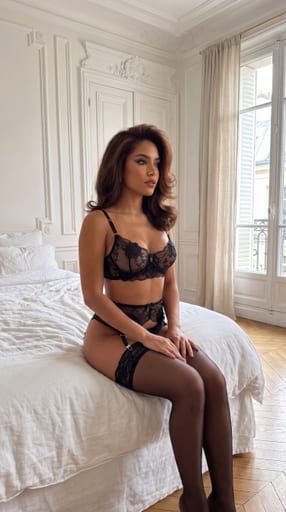
Bielizna w cichej sypialni
Spokojna, prywatna sypialnia w miękkim świetle jednego okna — rejestr quiet-luxury dla bielizny premium. Intymność bez glamouru: wyciszona poza, pozy leżące i naturalna relacja z meblem, len i blady tynk zamiast buduarowej scenografii.
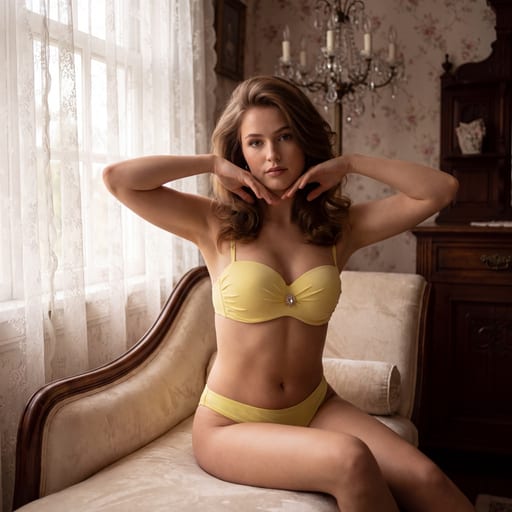
Buduar glamour
Zmysłowy glamour w klasycznym buduarze: ciepłe światło lamp, bogaty „glossy" grade obrazu i wysoka amplituda pozy budowana na relacji z meblem. Rejestr pewny siebie i zapraszający dla bielizny zmysłowej — z własnym, spójnym wnętrzem w komplecie.
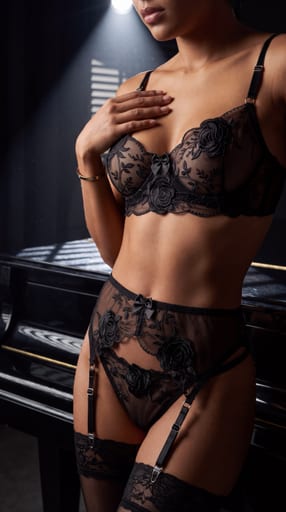
Nokturn z fortepianem
Elegancki apartament hotelowy po zmroku: jedna ciepła lampa jako jedyne światło, głęboka ciepła czerń w głębi pokoju i fortepian, o który modelka się opiera, a którego lakier oddaje sylwetkę. Wieczorny, dorosły rejestr dla bielizny premium i kompletów wieczorowych.
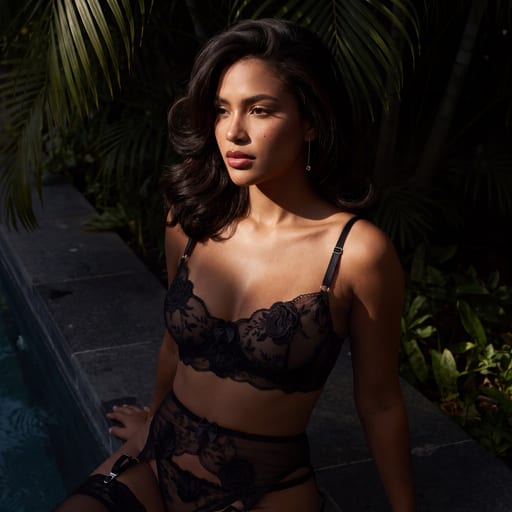
Chiaroscuro low-key
Rejestr low-key dla bielizny premium: jedno twarde kierunkowe światło, zero wypełnienia, większość kadru w głębokiej czerni. Światło wycina fragment sylwetki i wyciąga koronkę, taśmy i szwy w relief — produkt zawsze stoi w strefie światła.
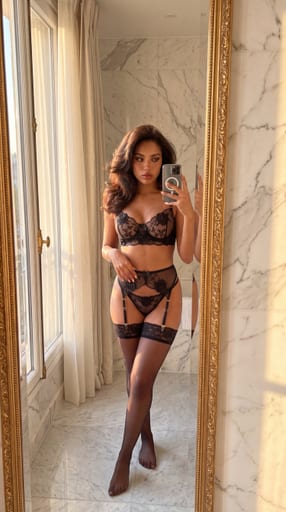
Natywny social w lustrze
Natywne treści social: pionowy kadr 4:5, lustro, telefon w dłoni i światło zastane prywatnego wnętrza. Zdjęcia wyglądają jak zrobione przez samą modelkę — ale są ostre, prawidłowo naświetlone i pełnowymiarowe, bez fejkowych artefaktów telefonu.
Gotowy, aby rozbudować swoją bibliotekę kreacji?
Dodaj ten styl do swojego konta i zacznij tworzyć lepsze kampanie w kilka minut.